
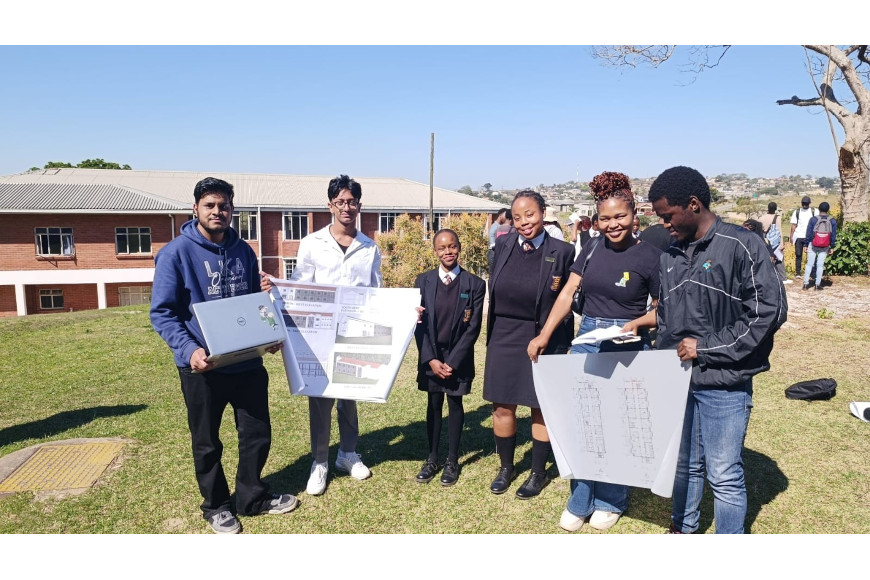
Inspired by a legacy of educating generations of African female leaders, students at the Durban University of Technology (DUT) are helping to shape the next chapter of Inanda Seminary’s story. Through an interdisciplinary collaboration between the Departments of Architecture, Civil Engineering, and Construction Management and Quantity Surveying, a new girls’ dormitory is being designed to meet the school’s growing infrastructure needs.
The initiative brings together second year students from the three disciplines in a transformative community-based project that reflects real world professional practice. Working as an integrated team, Architecture students lead the conceptual and spatial design development, Civil Engineering students focus on structural systems and technical feasibility, while Construction Management and Quantity Surveying students manage planning, costing and buildability.
Through coordinated meetings, site visits and shared critiques, students engage directly with a live client and real site conditions. This hands-on approach strengthens their communication, collaboration and critical thinking skills, while deepening their understanding of professional practice early in their academic journey.
Architecture lecturer, Mr Wendle Naidoo said he feels “extremely encouraged and inspired” by the initiative. “Students have shown enthusiasm and a strong sense of responsibility, knowing their work contributes to a real community need,” he said. He added that the opportunity to work within a real community context has significantly enhanced their appreciation of socially responsive design.
Architecture lecturer, Ms Temitope Olaniran highlighted the broader institutional significance of the project. “I am delighted to be part of the Project Based Learning and Design Thinking initiative supported by the Centre for Excellence in Learning and Teaching at DUT. The experience has strengthened students’ understanding of context responsive design within a real community environment and aligns with DUT’s ENVISION2030 priorities of improving lives and livelihoods, fostering creativity and innovation, and building meaningful partnerships that contribute to sustainable community development,” she said.
The project builds on an earlier Project Based Learning and Design Thinking programme, moving students beyond classroom theory into meaningful community engagement. Participants are involved in all stages of the development process, from site analysis and concept development to technical documentation and cost planning, gaining practical experience that bridges academic knowledge with industry expectations.
Key milestones achieved thus far include the completion of Phase One conceptual and schematic designs, detailed architectural drawings, three dimensional digital and physical models, preliminary structural input, and a draft Bill of Quantities. Stakeholder presentations have provided Inanda Seminary with tangible proposals that may support future development planning and funding opportunities.
More than a design exercise, the Inanda Seminary Project demonstrates how interdisciplinary collaboration can shape socially responsive built environments while preparing ethically grounded, work ready graduates. A new community-based project is set to follow in 2026.
Pictured: Architecture lecturer, Mr Wendle Naidoo with a DUT student and learners from Inanda Seminary School.
Phumeza Msongelwa


