The Durban University of Technology (DUT) is strengthening opportunities for students and community engagement practitioners to translate their community-based initiatives into scholarly knowledge, research and evidence-informed practices that contribute to meaningful societal change.
This commitment was demonstrated through the inaugural Practitioner-to-Scholar Community Engagement Symposium, hosted by DUT’s Community Engagement Office on 20 October 2026 at the ML Sultan Campus, under the theme “From Community Practice to Scholarly Knowledge: Advancing Student-Led Engaged Scholarship.”
The hybrid symposium brought together academics, researchers, postgraduate students, community engagement practitioners and student leaders to share experiences, reflect critically on their community initiatives and explore opportunities to develop their work into research proposals, conference presentations and scholarly publications.
The symposium also provided an opportunity to recognise the knowledge emerging from community engagement practice and strengthen connections between students, academics and communities in advancing socially responsive research.
Welcoming participants attending both in person and virtually, Dr Govender from Research Capacity Development in Research and Postgraduate Support (RPS) highlighted the importance of integrating teaching, learning, research and community engagement to address societal challenges.
“Today’s symposium represents far more than a platform for presenting projects. It is a celebration of engaged scholarship, community-based research and the meaningful connections that emerge when academic knowledge and community experience come together to address real-world challenges,” said Dr Govender.
Delivering the keynote address, Dr Dudu Shabane, Lecturer at DUT’s International Centre for Non-Violence (ICON), emphasised the importance of moving beyond service delivery towards meaningful and reciprocal partnerships in which communities are recognised as active contributors to knowledge production.
She encouraged participants to approach community engagement as a continuous process of learning, critical reflection and collaboration, supported by systematic research and evidence-informed practice. She further highlighted the importance of ensuring that knowledge generated through community-based initiatives informs future interventions, strengthens partnerships and is communicated in accessible ways that benefit participating communities.
“Community engagement becomes engaged scholarship when practical experiences are transformed into shared knowledge, critical reflection, evidence-informed action and sustainable change,” she said.
The symposium featured three thematic sessions: Education and Environmental Sustainability; Community Empowerment and Programme Sustainability; and Community Wellbeing and Social Development, with the latter conducted virtually.
Through these sessions, presenters shared their community-engaged initiatives, reflected on their practical experiences and explored opportunities to strengthen their projects through research and scholarly inquiry.
The presentations were followed by interactive discussions, providing participants with constructive feedback, opportunities for knowledge exchange and potential areas for academic collaboration and mentorship.
Reflecting on the symposium, Phumzile Xulu, Community Engagement Practitioner at DUT, commended participants for their commitment to developing their projects and research proposals, noting the progress they had made in moving from community practice towards scholarly engagement.
She emphasised the importance of connecting emerging scholars with academics and relevant university support structures to facilitate mentorship, supervision and co-investigator support as their projects develop.
Xulu also encouraged participants to consider opportunities to present their work at academic conferences and develop scholarly publications, highlighting the value of sharing practice-based knowledge with broader academic and practitioner communities.
“Our vision is to support students in moving beyond community engagement practice to becoming active contributors to scholarly knowledge. We want to create opportunities for them to present their work at academic conferences, engage with other scholars, receive constructive feedback and ultimately contribute to academic publications. Through this process, we hope to nurture a new generation of engaged scholars whose research is informed by their experiences and commitment to addressing societal challenges,” said Xulu.
She further announced plans for a broader community engagement colloquium to provide additional opportunities for students and practitioners to showcase their work, engage with academic and community stakeholders, and receive feedback to strengthen their research and practice.
Delivering the closing remarks, Dr Yachal du Plessis, Lecturer in Applied Management at DUT’s Midlands Campus in the Faculty of Management Sciences, congratulated participants on their scholarly development and the progress demonstrated through their presentations.
Reflecting on their journey, she acknowledged the challenges of engaging with unfamiliar research concepts and commended participants for their perseverance in developing and presenting their work at the symposium.
She encouraged them to remain committed to their initiatives, strengthen their partnerships and continue using research as a tool to improve community engagement practice and expand opportunities for societal impact.
“Practice to evidence and evidence to impact. It’s not just about the scholarship, it’s also about the practice that you’re doing. In every single presentation that we saw, there’s this love, there’s this urgency, there’s this desire to make a change within the communities,” she said.
Dr du Plessis also acknowledged the contribution of the Community Engagement Office’s Media and Support Team in promoting the visibility of participants and their initiatives, as well as the organising team and colleagues who supported the programme.
The inaugural symposium marked an important step in advancing DUT’s commitment to student-led engaged scholarship by creating opportunities for students and practitioners to critically examine their community engagement experiences and translate these into research and scholarly outputs.
By strengthening the relationship between community engagement, teaching, learning and research, the Practitioner-to-Scholar initiative contributes to DUT’s ENVISION2030 aspirations of developing socially responsive graduates, fostering collaborative knowledge production and advancing sustainable societal impact.
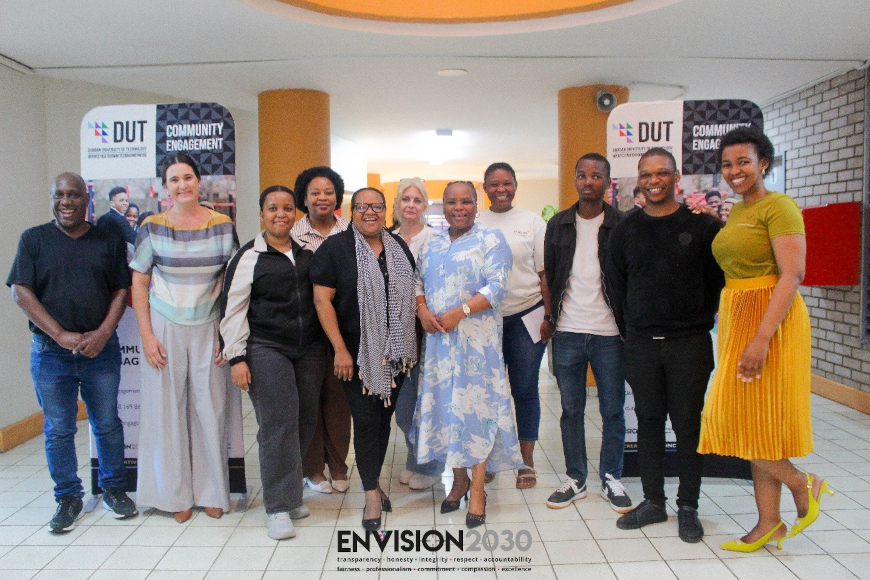
Pictured: Facilitators, academics and presenters at the Practitioner-to-Scholar Community Engagement Symposium.
Photographer: Sindiswa Mpongose
Phumeza Msongelwa


