
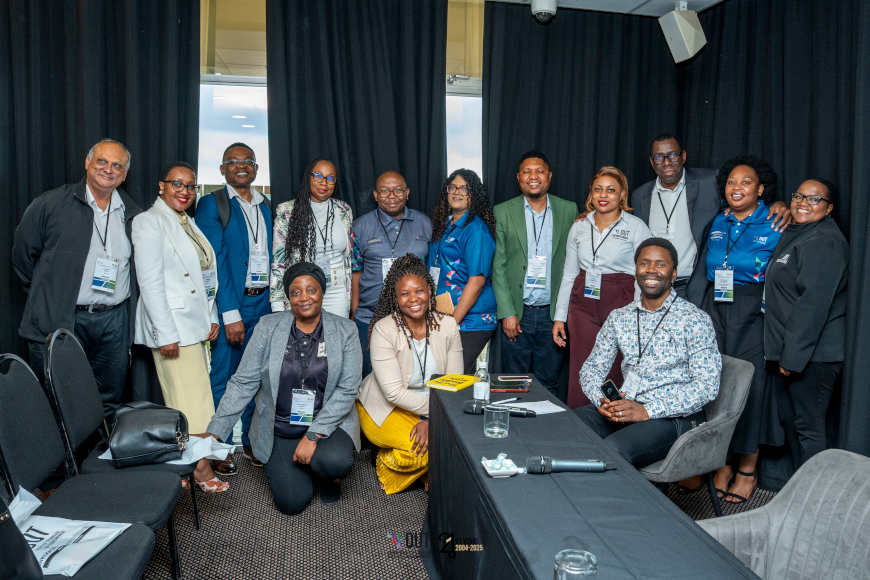
Day three of the Science Forum South Africa (SFSA) 2025 commenced with the exhilarating Durban University of Technology (DUT) panel session which took place at the Council for Scientific and Industrial Research International Convention Centre (CSIR ICC) in Tshwane, Gauteng on Wednesday, 26 November 2025.
The interactive session titled: Breaking Silos: Cultivating Entrepreneurial Thinking Through Design, Collaboration and Real- World Learning Science Forum South Africa 2025, addressed these gaps by presenting an integrated pedagogical framework that dismantles silos, fosters entrepreneurial thinking, and embeds real-world learning into curricula.
The Programme Director for the session was Dr Tessa Reddy, a lecturer and Work-Integrated Learning (WIL) coordinator in the Department of Marketing and Retail Management at the Faculty of Management Sciences at DUT. Dr Reddy is deeply committed to transforming teaching and learning through innovation, design thinking and project-based learning-focused pedagogy at DUT.
She elaborated on DUT’s commitment to research and innovation, which is a critical part of the broader scientific conversation. She further highlighted that the panel session aims to provide a practical and reflective framework that combines Design Thinking (DT), Problem-Based Learning (PBL), and stakeholder collaboration to encourage educators, students, and communities to co-create meaningful solutions.
Delving further into the panel session, Daniel Vilakazi from Technology Transfer and Innovation at DUT gave the context of why such a panel session was vital, sharing that in the face of complex and interconnected urban challenges, such as climate change, inequality, unemployment, economic exclusion, higher education institutions often remain constrained by siloed disciplines, traditional teaching methods, and limited engagement with real-world contexts.
“This fragmented approach hinders students’ ability to develop the critical, collaborative, and entrepreneurial skills needed to drive meaningful change in society and navigate an increasingly uncertain labour market,” he explained.
Vilakazi further highlighted, saying that the aim of such a panel session was to empower educators, students, and stakeholders with an integrated, real-world learning framework that fosters entrepreneurial thinking, interdisciplinary collaboration, and measurable social impact.
“The objectives is to introduce a practical framework, demonstrate real-world relevance, develop skills for impact-driven education, and to promote collaborative assessment models,” he commented.
Explaining why Design Thinking, and Problem-Based Learning are game changers, Vilakazi emphasised that in many educational settings, teaching and learning are still constrained by rigid disciplinary boundaries and traditional assessment methods.
“This siloed approach limits our ability to address the complex, interconnected issues that cities face today. In response, the classroom can be reshaped into a dynamic environment that facilitates both instruction and real-world innovation,” he said.
Giving a deeper context into what real-world learning into curricula is about was Professor Molusiwa Stephan Ramabodu, Acting Executive Dean, Faculty of Engineering and the Built Environment.
He spoke about DUT celebrating 21 years of excellence, the history of DUT, also showcasing DUT’s ENVISION2030 statement of intent by 2030 which states that DUT people will be creative, innovative, entrepreneurial and adaptive to changes of the world.
In terms of research, innovation and engagement, Prof Ramabodu shared that there are 61 NRF-rated researchers at DUT, two research chairs, 1184 master’s students, 860 doctorate students and 123 postdoctoral fellows.
He shared that DUT had 8293 graduates in 2024 and 36% of these graduates were from the Science, Engineering and Technology (SET) field of studies, and the aim is to keep increasing this percentage.
Prof Ramabodu elaborated on the importance of entrepreneurial thinking which is vital for creativity, adaptability, and problem-solving in today’s global economy.
“Universities incubate entrepreneurial mindsets by embedding these skills into academic programmes. Entrepreneurial thinking empowers students to address societal challenges and to promote economic growth sustainably. This mindset fosters resilience and prepares graduates to lead transformative initiatives amidst uncertainty,” he added.
He further highlighted on the primary objectives on entrepreneurship curriculum integration. Prof Ramabodu spoke on the role of interdisciplinary collaborations at DUT, saying that eliminating departmental barriers fosters innovation and promotes open knowledge exchange. He then delved into the core principles of design thinking, the challenges against entrepreneurship integration, and lessons from leading universities.
He indicated that DUT has actively sought to learn from leading institutions globally, including JAMK, Warwick, Maryland, Aston, Stanford and Harvard, to name but a few. “These collaborations have provided valuable insights into interdisciplinary approaches, fostering innovation, building robust ecosystems, and cutting-edge practices in entrepreneurship education. These engagements have highlighted the importance of organisational culture in fostering successful entrepreneurial activities, emphasising the need for DUT to prioritise this aspect,” he concluded.
Following the presentations, a robust panel discussion ensued with Ms Anne Gabathuse, Executive Manager for Business Development and Commercialisation at CSIR Smart Society highlighting on the proficiency in technology transfer and intellectual property management which she shared, plays an integral role in shaping business development and commercialisation strategies. Whilst Dr Thulile Mofokeng, Academic: Entrepreneurship Studies and Management at DUT focused on fostering innovation and engaging in knowledge exchange.
Dr Siyabulela (Siya) Ntutela, Business Development Specialist at University of South Africa (UNISA), emphasised on the commercialisation of technologies and research outputs.
The session drew upon human-centred design principles, experiential and challenge-driven learning methodologies, and inclusive cross-sector collaboration to foster novel forms of engagement. The session critically examined how the convergence of these elements constitutes a transformative pedagogical framework.
Ms Phumzile Xulu, Engagement Practitioner at the DUT Community Engagement, and DUT Science Forum South Africa 2025 Planning Committee leader, said: “Our programme flowed seamlessly-from the opening remarks and keynote speech to the rich, insightful panel discussion. The contributions from Prof Ramabodu, Dr Mkhize, Ms Gabathuse, Dr Mofokeng, and Dr Ntutela brought depth, relevance, and real-world expertise to the conversation. Each objective of the session was meaningfully addressed, and the engagement from the audience reflected the strength and clarity of the panel’s insights,” she expressed.
Professor Fulufhelo Nemavhola, Deputy Vice-Chancellor: Research Innovation and Engagement at DUT shared his thoughts on DUT’s participation in the Science Forum South Africa 2025. He emphasised that a defining feature of DUT’s transformation is its revolutionary philosophy of education.
“Our aim is to cultivate graduates who are creators, inventors, problem-solvers and leaders, individuals capable not only of participating in the economy but of shaping and expanding it,” he explained.
Prof Nemavhola indicated that to achieve this, DUT has embraced an educational approach rooted in creativity, innovation and entrepreneurial thinking.
“Divergent and Design Thinking are nurtured through the Universal Design Learning (UDL) framework, providing a robust foundation for teaching-learning methodologies such as Project-Based Learning (PBL), Problem-Based Learning, and Design Thinking. This evolution in curriculum design directly reflects ENVISION2030, and ongoing work ensures that our programmes fully embody this forward-looking philosophy. Once fully adopted, this approach will further cement DUT’s position as a university committed to producing graduates prepared for the complexities, opportunities and challenges of a rapidly changing world,” he added.
Prof Nemavhola highlighted DUT’s participation in the Science Forum South Africa (SFSA) 2025 which he says, exemplifies this commitment. “The Science Forum South Africa (SFSA) 2025 provides a strategic platform for DUT to showcase our innovations, research strengths and community-engaged initiatives. It affirms our role in the national and international science and innovation landscape and highlights the dynamic link between creative inquiry, engaged scholarship, entrepreneurial thinking and social impact, the core elements that drive DUT’s mission and strengthen our global presence.”
Pictured: Attendees at the panel session which took place at the Council for Scientific and Industrial Research International Convention Centre.
Waheeda Peters


