
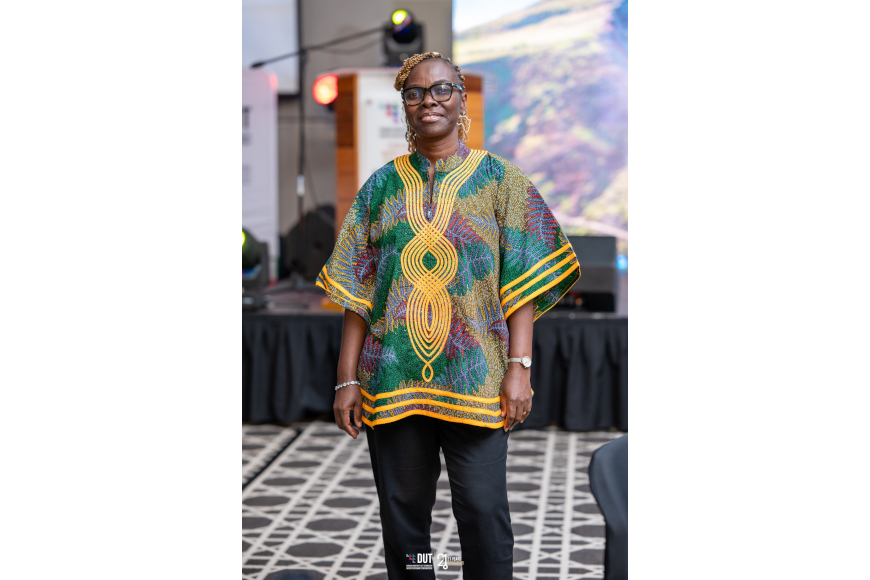
Dr Theodora Dame Adjin-Tettey, a senior lecturer in the Department of Media, Language and Communication at Durban University of Technology (DUT), has been honoured with the silver award in the Researcher Excellence Awards category as an established researcher at the 2025 ENVISION2030 Institutional Awards. The awards ceremony was recently held at The Capital Zimbali Resort in Ballito. Being recognised for her impactful scholarly work was both an honour and a privilege for Dr Adjin-Tettey, whose research explores how digital technologies have transformed democratic participation and governance.
Expressing her thoughts upon receiving the prestigious award, Dr Adjin-Tettey said it was a tremendous joy for her to receive the esteemed established researcher award.
The award is given to those who, among other requirements, have demonstrated excellence in scholarly research, as evidenced by high-impact publications, patents, or other forms of recognised outputs, with a compulsory requirement of at least five high-impact publications in peer-reviewed Q1/Q2 journals or equivalent scholarly outputs in the year under review.
“Seven of my published journal articles for the period in question met this requirement. I deeply appreciate the acknowledgement. The award has also made me reflect more deeply about my life in general and my professional path in particular. I am incredibly appreciative of God’s grace and the wonderful people in my life who have allowed me to be adventurous, grow, and thrive. These include my lovely family, who have had to make various sacrifices and adjustments for me,” she gushed.
Dr Adjin-Tettey is a senior lecturer of Journalism, Media, and Communication Studies. Her research interests span journalism and media studies (including media development and viability), emerging (digital) technologies usage and appropriation in diverse social and communicative contexts, audience research, climate information consumption and communication studies. She has published journal articles and book chapters in these and other related domains in highly ranked journals and by reputable publishing outlets.
She also has numerous commissioned special reports meant to address industry needs. Dr Adjin-Tettey was part of a team of scholars who researched and wrote the South Africa COVID-19 Country Report that looked into the South African government’s communications during the COVID-19 pandemic. She has co-edited open-access book, entitled Communication and Social Change in Africa: Selected Case Studies, published by the Institute of Network Cultures at the Amsterdam University of Applied Sciences and a book entitled: All’s well (Feehi): Living a Life Guided by Grace and Goodness, which chronicles the life and tenure of a former Vice Chancellor of a public university in Ghana.
Currently, Dr Adjin-Tettey is collaborating on several projects, one of which is interrogating how digital technologies have transformed and enhanced democratic participation and government service delivery in the Global South.
Elaborating on the specific focus of her current research and what inspired her to pursue this area of study, Dr Adjin-Tettey emphasised that the inspiration behind the project is grounded in the argument that the numerous affordances of digital technologies have generally transformed democracy.
“What we are currently witnessing is the alteration of the possibilities for citizens to speak truth to power through the digital democratic revolution. To put it in perspective, digital democracy is the use of information and communication technology (ICT) to enhance political and governance processes. While this can potentially increase political freedom, engagement, and equality, it can also be argued that the African continent is yet to fully realise digital democracy’s affordances. Our project is conceptual in nature and identifies the gaps and the emergent ethical, technological, infrastructural, and structural issues that challenge digital democratic development, and how Africa and other Global South countries can position themselves to take advantage of the affordances of digital technologies to entrench their democracies,” she said.
She highlighted that her research aligns with the objectives as outlined in the DUT ENVISION2030 strategy.
“I believe that all my research projects align nicely with DUT’s EVISION2023. For example the project on digital democracy fits within DUT’s EVISION2023 because by critically assessing and looking for shreds of evidence about the challenges related to digital democracy within the Global South context, and looking for robust solutions to the challenges, we aim to transformatively impact society through thoughtful and innovative solutions, thereby contributing to the vision of being an engaged, productive citizen through the application of knowledge,” she expressed.
Dr Adjin-Tettey spoke on some of the most innovative aspects of her research and how they contribute to advancing knowledge or solving real-world problems.
“My research is largely responsive to current and emerging issues within media and communication studies. I tackle contemporary issues and carefully interrogate them, as well as identify the challenges and the opportunities. I have done studies on media sustainability, AI use in journalism across different contexts, the responsiveness of journalism curricula to industry needs amidst current transformations happening within the media sphere, misinformation, climate change communication, safety and trauma in journalism, among others. All of these are contemporary issues that have brought about important revelations as well as yielded significant recommendations for improving the media and communication space,” she shared.
She further highlighted on her model curriculum that is responsive to the safety and trauma risks that journalists face. Dr Adjin-Tettey said that it is a collaborative project that has recently been published as part of an edited volume published by Palgrave Macmillan. “This is an important contribution to journalism training, which was informed by an earlier study that looked at trauma experiences of journalists. That study revealed the different kinds of trauma and other safety threats that journalists face and the coping mechanisms that journalists adopted to deal with them, some of which were maladaptive,” she said.
She further revealed that the model curriculum proposed is meant to equip journalists with knowledge and training on how to identify potential safety risks, including violence and traumatic situations, and how to meaningfully and successfully navigate these circumstances. It covers issues related to news reporting and trauma, online threats and digital safety, navigating trauma, institutional provisions for trauma prevention and the role of leadership, among others. It can be used for refresher courses and can also be incorporated into existing curricula of training/educational institutions.
Dr Adjin-Tettey sees her research contributing to the broader academic community and influencing future research directions in the field.
“I believe the work I have done is useful for students, scholars, and practitioners. They are thorough and generally easy to read. They provide useful insights and have very realistic recommendations. I am hoping that these groups of actors and individuals will engage with, and my collaborators’ works and take the recommendations applicable to what they do, so we can realise the full benefit of what we spend our time doing relentlessly,” she added.
For Dr Adjin-Tettey, she explained that she has had fruitful collaborations with scholars and industry experts across Africa, the United States, Sweden, Germany, the Netherlands, Russia, Canada, etc. “Most of the collaborations have been very enriching because these scholars bring diverse perspectives to the various projects. The rigorous conversations, debates and analysis that mark our engagements are always useful in improving the rigor of our research projects,” she explained.
Looking ahead, Dr Adjin-Tettey intends to continue doing what she been doing for the past years. Recently, she has received the Advancing Women in Research and Innovation Programme research grant under the DUT Research Capacity Development Grant Allocation. “I am hoping the funds will be released expeditiously to aid in the proposed research related to how fact-checking organisations conceive of their role, what constraints they face, how the constraints impact their role enactment as well as how they innovatively negotiate the challenges,” she concluded.
Pictured: Dr Theodora Dame Adjin-Tettey.
Waheeda Peters


