
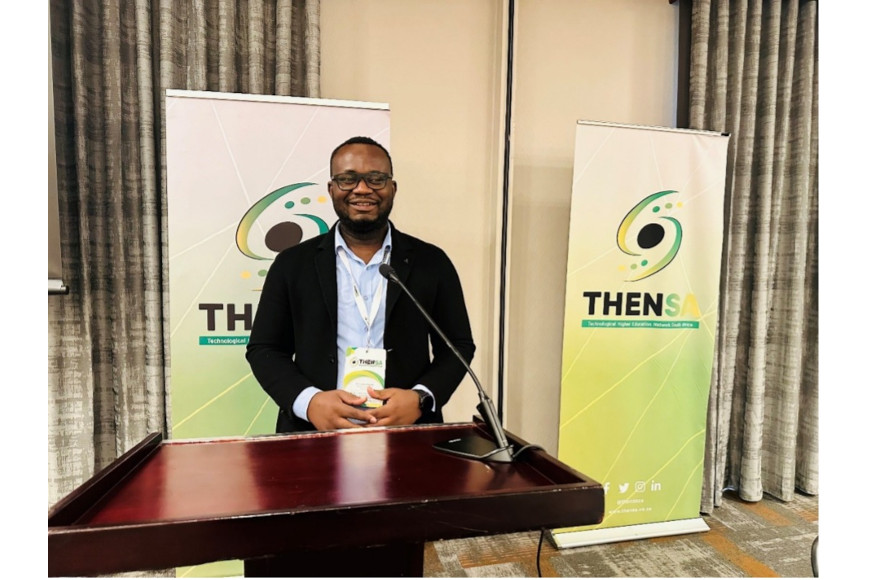
Dr Emmanuel Kweinor Tetteh, a Research Fellow and the Principal Investigator of the Green Engineering Research Group (GERG), under the Faculty of Engineering and the Built Environment at the Durban University of Technology (DUT) represented the university at the inaugural Technological Higher Education Network South Africa (THENSA) Green Energy Colloquium in Gauteng. His participation reaffirmed the university’s commitment to the betterment of society through sustainable innovation and impactful research.
The colloquium, bringing together over 40 academics from 10 member institutions marked a significant milestone in advancing South Africa’s Just Energy Transition (JET) and building a green economy. The event focused on creating jobs, fostering innovation, and promoting collaboration in renewable energy, decarbonization, energy storage, systems integration, and emerging opportunities in green hydrogen and the circular economy.
At the event, Dr Tetteh delivered a thought-provoking presentation titled, “Empowering a Green Future: DUT’s Leadership in Water-Energy Nexus for Sustainable Energy Transition.” In the presentation, he unveiled a strategic roadmap to accelerate South Africa’s Just Energy Transition, positioning green hydrogen, renewable energy integration, and water‑to‑energy systems as key areas of green-economy research. Dr Tetteh further underscored how GERG’s pilot work on groundwater‑enabled green hydrogen production, together with DUT’s interdisciplinary research ecosystem, demonstrates practical pathways to decarbonise industry, strengthen water security, and build a skills pipeline for the green economy, which positions DUT as a leading catalyst for sustainable innovation and inclusive development across South Africa.
Dr Tetteh further underlined DUT’s pioneering role in advancing green hydrogen, renewable energy integration, and water-to-energy systems aligned with national priorities and global climate goals. He described how DUT’s dynamic research ecosystem brings specialised centres and focus groups together to drive innovation and translate science into solutions for industry and communities. These include the Renewable and Sustainable Energy Research Group (RSERG) with the Energy Technology Station (IEETR), the Institute for Water and Wastewater Technology (IWWT), the Enzyme Technology Research Group, the Space Science and Smart Grid Research Centre (SS&SG), and the Green Engineering Research Group (GERG), alongside the AQUACYCLE community engagement initiative. He shared that this integrated approach enables DUT to handle critical challenges across energy, water, and socio-economic development.
Highlighting flagship works, Dr Tetteh showcased GERG’s pilot scale project with the South African National Energy Development Institute (SANEDI) to develop cost-effective green hydrogen technologies using groundwater.
“The project demonstrates a practical pathway to reduce coal dependency and cut emissions, while building a robust knowledge base around groundwater treatment, electrolysis, and renewable energy coupling for local conditions. This effort aligns directly with South Africa’s Just Energy Transition, positioning DUT as a technical anchor at KwaZulu-Natal in the country’s shift to cleaner energy,” explained Dr Tetteh.
Dr Tetteh also noted how DUT’s innovation extends beyond research labs to real-world impact. Under RSERG, the SiyaHamba Solar Boat, represented South Africa at the 2024 Monaco Energy Boat Challenge. He shared that it is currently being upgraded into an AI driven autonomous vessel, showcasing the fusion of artificial intelligence and renewable power.
“Complementing high profile projects, the RSERG energyDRIVE outreach truck has visited more than 200 schools and engaged over 100,000 learners nationwide, building awareness of clean energy technologies and inspiring the next generation. Meanwhile, skills development remains a cornerstone of DUT’s strategy, with RSERG-accredited programmes such as PV GreenCard Training and the forthcoming Hydrogen Fuel Cell Practitioner course equipping technicians and engineers to meet emerging opportunities in the green economy,” remarked Dr Tetteh.
In addition, Dr Tetteh highlighted the AQUACYCLE project as a model for inclusive sustainability, pairing hydroponics and aquaponics with entrepreneurship training to tackle food insecurity and empower youth and women in rural communities like Umbumbulu (KwaZulu Natal). He stated that by coupling water-efficient food production with enterprise development, AQUACYCLE illustrates how technology, education, and social innovation can deliver tangible benefits for vulnerable communities.
Looking ahead, Dr Tetteh set out five strategic priorities such as innovations in the water-energy nexus to boost resource efficiency; commercialising research and deepening industry partnerships to accelerate the green economy; nurturing future scientists, entrepreneurs and innovators through training and mentorship; strengthening global collaboration via knowledge exchange and joint ventures; and enhancing societal impact by advancing food-water-energy security, job creation, and community empowerment. He stressed that these priorities align with South Africa’s transition objectives and international sustainability mandates, ensuring DUT’s work remains both impactful and globally relevant.
In conclusion, Dr Tetteh echoed the call for Africa’s clean energy revolution, affirming that DUT is committed to shaping the policies, technologies, and partnerships that will define Africa’s sustainable energy future.
Pictured: Dr Tetteh at the THENSA Green Energy Colloquium.
Simangele Zuma


