
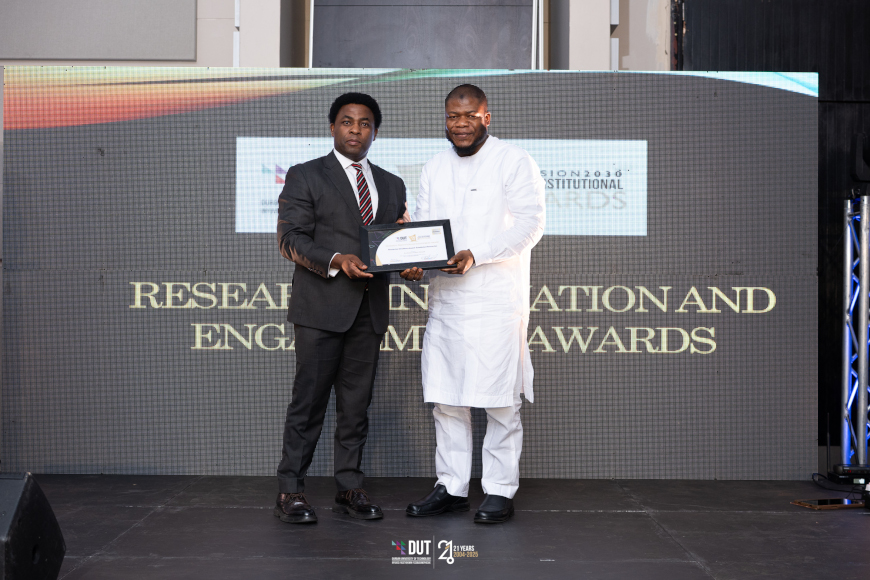
Professor Sabiu Saheed, a Professor in the Department of Biotechnology and Food Science, Faculty of Applied Sciences at the Durban University of Technology is passionate about commercialisation of South African medicinal plants-derived therapeutics. Together with his team, the Computational and Systems Biology Research Group, their research findings are targeted at microbial infections and diabetes mellitus, which are major health concerns in South Africa.
Prof Saheed recently received the highest level of recognition, the Research Excellence Award: Established Researcher (Platinum) Award at the ENVISION2030 Institutional Awards. He was recognised for his sustained research excellence and for making an outstanding contribution to knowledge, innovation, and societal impact within his field. He was celebrated not only for his academic excellence but also for advancing institutional research goals, mentoring emerging scholars, and contributing meaningfully to society through impactful research.
“It was highly humbling and it gladdened my heart with gratitude to be awarded the Research Excellence Award: Established Researcher (Platinum) of the Year Award. This was particularly so, when you consider the calibre of renowned and established researchers at DUT and the journey and preparatory works that eventually culminated into winning the award,” shared Prof Saheed.
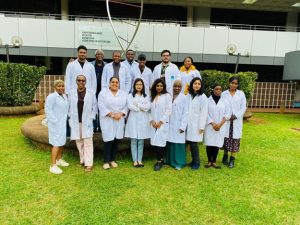
The Computational and Systems Biology Research Group.
Prof Saheed currently leads the Computational and Systems Biology Research Group, where postgraduate students and emerging researchers are being mentored on bioprospection of active pharmaceutical ingredients against degenerative diseases. According to Prof Saheed, the Group profiles plant secondary metabolites against communicable and non-communicable diseases using computational and experimental validation approaches, building library of compounds of therapeutic significance.
“Through these projects, the Group is significantly contributing to scholarly discourse, which is evident from our research outputs and publications in accredited, impactful and highly rated journals,” added Prof Saheed.
Elaborating on his current research focus, Prof Saheed said currently, the number of medicinal plants of southern Africa used in traditional medicine are more than 3689 taxa, representing 25% of the regional plants. Of these medicinal plants, Prof Saheed revealed that only about 700 taxa are actively traded, with the remaining taxa hugely underutilised, offering exceptional opportunity to discover novel natural products with pharmaceutical and nutraceutical applications.
“While a good proportion of the South African population use medicinal plants to meet their primary health care needs, only a few South African medicinal plants have been exploited to their full potential in terms of commercialisation. Likewise, there is a dearth of comprehensive data on the use of bioinformatics and computational modelling technologies for bioprospecting novel therapeutics from South African flora. These challenges coupled with the high prevalence of debilitating diseases such as the spiking trends in antimicrobial resistance (AMR) and diabetes in South Africa, have led to my current scientific inquiry into the use of computational and systems biology approaches to fast-track bioprospection for discovery and development of new drug candidates,” explained Prof Saheed.
Through using computational strategies, Prof Saheed has executed projects on diabetes and antimicrobial resistance (AMR). “These studies provided significant insights into the molecular mechanisms of interaction of plant metabolites towards the binding domains of key enzymes/proteins in disease pathogenesis. In addition to availing more novel compounds that will either be patented or added to the current over 100 therapeutic compounds in my library of metabolites, these two projects are significant and will contribute towards addressing the menace of diabetes and AMR, which constitute major threats to South Africa’s population, and adversely influence its economy through increase in healthcare costs to treat their associated primary and secondary complications.”
Prof Saheed has contributed significantly to scientific knowledge within the niche of phytopharmacology and computational systems biology with focus on drug discovery and development. He said this fits well into the theme “Biotechnology and Health Innovations”, which is in the forefront of the Sustainable Development Goals and South African National Imperatives of the National Development Plan.
He has enjoyed significant and fruitful collaborations from several national, regional and international collaborations with scholars in the USA, Sweden, India, Saudi Arabia, China, and Canada. Even at DUT, in addition to intradepartmental partnerships, he has ongoing high-level collaborations with the departments of Chemistry, Horticulture and Somatology. Besides affording high-quality joint publications and research outputs, some of these partnerships have facilitated exchange/mobility programmes involving students and emerging scholars in his team.
Looking ahead, Prof Saheed plans to continue to training and mentoring postgraduate students and emerging researchers as a way of knowledge transfer and human capacity development in computational and systems biology for new molecule therapeutic targets discovery against communicable and non-communicable diseases.
Besides contributing towards the South African national imperatives on bio-economy, transformation and Indigenous Knowledge Systems, as well as addressing “Good health and well-being” of the Sustainable Development Goals (SDG 3), Prof Saheed believes his mentorship will constitute knowledge transfer and human capacity development within the niche of glocal digital transformation that will inspire innovation and mentees to be competitively relevant in generating new knowledge and solutions in this digital era as enshrined in the DUT ENVISION2030.
Pictured: DUT Deputy Vice-Chancellor: Research, Innovation and Engagement, Professor Fulufhelo Nemavhola with the established researcher, Professor Sabiu Saheed.
Photographer: Khulasande Tshayile
Simangele Zuma


