
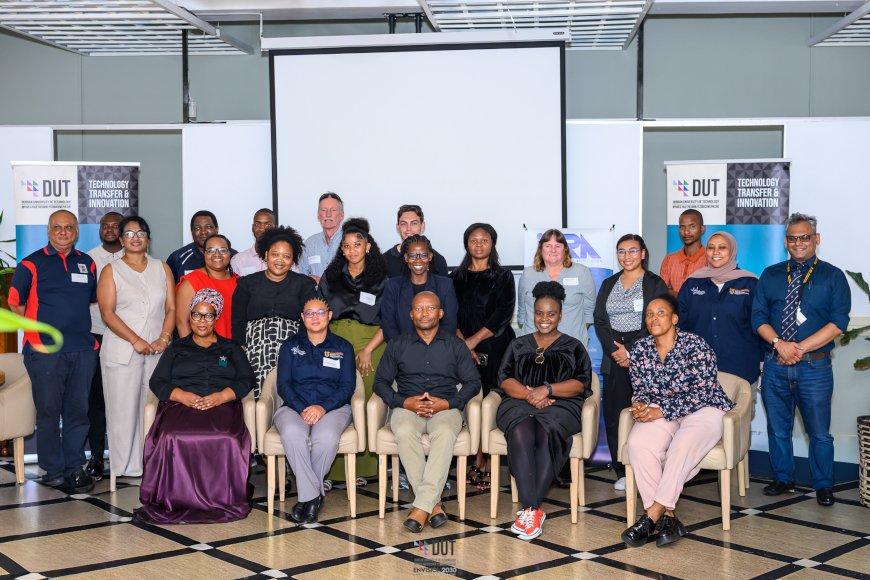
The Durban University of Technology’s Technology Transfer and Innovation and Research and Postgraduate Support units, in partnership with the National Research Foundation and the Department of Science, Technology, and Innovation, hosted the third KZN South Africa Indian Ocean Rim Association Academic Group Roadshow. The event was held at Steve Biko Campus, Rendezvous Restaurant, on Monday, 09 March 2026. Its aim was to raise the visibility of IORA across South African universities and highlight the benefits of engagement with the organisation.
The roadshow provided a major platform for innovation and research collaboration. It brought together students, researchers, and industry experts to explore advanced technologies and foster partnerships within IORA.
Dr Nomcebo Mthombeni, Interim Director of the Research and Postgraduate Support Unit, introduced IORA and encouraged researchers and experts to engage with the organisation, given South Africa’s proximity to the Indian Ocean. She emphasised the importance of identifying areas of growth that could strengthen the history, values, and culture of IORA. She highlighted the role of Artificial Intelligence in driving innovation and achieving significant impact.
Dr Nokuthula Mchunu, Manager of International Collaborative Research Grants at the National Research Foundation, provided an overview of the foundation’s priorities. She stated that the NRF’s mandate is to support, promote, and advance research, human capacity, and research infrastructure. She explained that partnerships aim to leverage additional resources to drive the system, extend mutual benefits, and are not limited to financial investment alone.
The Chair of SA IORAG, KGame Malope, discussed the role of the network in strengthening collaboration and research within the region. He explained that the network connects academics, researchers, and institutions to promote knowledge sharing and collaborative research on issues relevant to the region. He highlighted the importance of providing a platform where academics can contribute research that informs government policies and supports evidence-based decision-making.
Malope explained that IORAG fosters an open exchange of ideas among member states, disseminates knowledge related to the Indian Ocean Rim, and supports IORA’s institutional research work. This includes initiatives involving the Young Future Leaders of IORA, the Council of Women, the Academic and Technical Body, as well as financial and technical programmes that support IORA groups. The network also provides evaluation and advisory services on science activities within IORA and coordinates research produced by member states.
Nicole du Plessis from the SA IORAG Secretariat provided an overview of South Africa’s role in supporting academic engagement within the region. She highlighted IORA’s focus areas, including disaster risk management, water security, sanitation, desalination, climate change, marine science, and traditional medicinal products. She noted South Africa’s significant investment in maintaining strong participation in IORA, influenced by the country’s historical connection and Nelson Mandela’s role as a founding figure.
Du Plessis explained that South Africa strengthens collaboration between government, universities, and research institutions through platforms such as the SA IORAG academic network. This network coordinates academic participation, supports policy development through evidence-based research, and encourages regional cooperation. The platform consists of a steering committee, stakeholder groups, and thematic research groups aligned with IORA priority areas, including climate change. She also highlighted initiatives that expand academic engagement, such as workshops, national meetings, early-career professional networks, research collaborations, and funding opportunities through the IORA Special Fund. These initiatives support research projects, mobility opportunities, and knowledge sharing across member states. She concluded by encouraging academics, students, and stakeholders to participate in IORA activities, join the network, and contribute to research and policy development that supports sustainable development in the Indian Ocean region.
Guest speakers included Melissa Philander from the SA IORAG Secretariat, who discussed the Ocean20 overview and continuity, and Dr Veshal Surban from the University of KwaZulu-Natal, who presented on Anchoring Maritime Governance: Teaching the Law of the Sea and Maritime Law.
KGame Malope concluded the roadshow by thanking participants for their active engagement and continued support. He highlighted the importance of strengthening research networks and promoting multidisciplinary collaboration among students, academics, and professionals. He encouraged participants to remain involved in expanding research agendas and contributing ideas to the research community, and he expressed appreciation for everyone’s participation while encouraging continued engagement in future initiatives.
Pictured: Distinguished guests at the third KZN South Africa Indian Ocean Rim Association Academic Group Roadshow
Photographer: Khulasande Tshayile.
Sifundo Thwala and Phiwayinkosi Sibiya


