
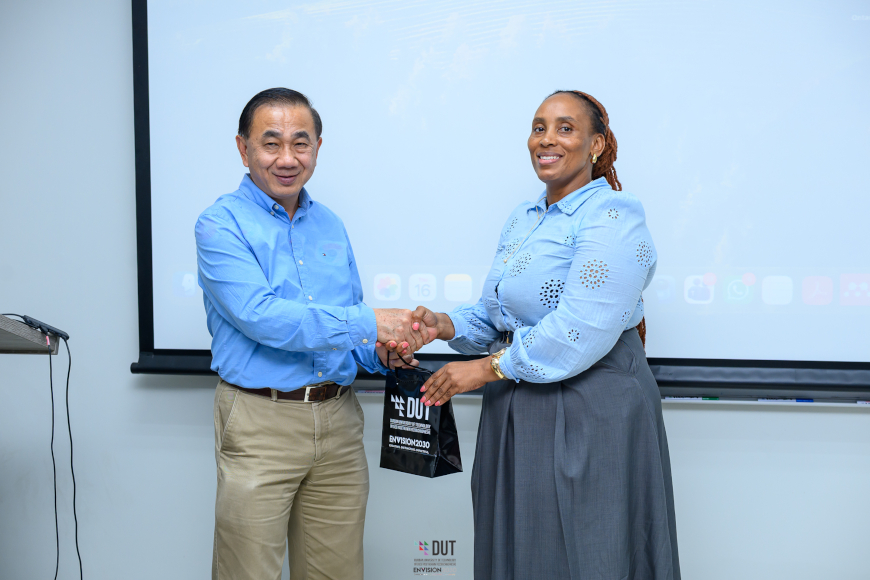
The Research and Postgraduate Directorate, together with the Department of Chemical Engineering, hosted a research seminar by Professor Michael KC Tam from the Department of Chemical Engineering and Waterloo Institute for Nanotechnology at the University of Waterloo on Building a Sustainable Future, One Nanomaterial at a Time. The event took place at the IWWT Seminar Room, Steve Biko Campus on Thursday, 16 April 2026.
Prof Tam’s research focuses on cellulose nanomaterials, colloids, self-assembly systems, polymer-surfactant interactions, and water treatment systems. He is an Honorary Researcher in the Chemical Engineering Department at the Durban University of Technology (DUT). His Google citation exceeds 34,220 citations, and his H-index is 96, cementing him as a researcher with significant global recognition for his influential body of work.
In his presentation, Prof Tam discussed the research ecosystem at the University of Waterloo, noting that the Waterloo corridor has the largest concentration of technology companies and startup activity in Canada. He shared that the University of Waterloo is a global leader in engineering education and research, ranked among the top 50 engineering schools in the world. He further highlighted collaborative graduate research programmes between the Department of Chemical Engineering and the Waterloo Institute for Nanotechnology in areas such as nanotechnology for advanced materials, soft matter engineering, electrochemical engineering, biotechnology, and sustainable reaction engineering.
He explained that nanotechnology is emerging as a transformative field driving innovation across science and engineering. Within this context, he emphasised the growing need to develop nanomaterials from renewable resources due to the environmental limitations of traditional carbon-based raw materials such as crude oil. This transition, he noted, is opening new opportunities for sustainable materials in advanced engineering applications. Cellulose nanocrystals (CNCs), in particular, offer a promising pathway for product development and formulation across multiple industrial sectors. He further emphasised that cellulose nanocrystals are stable, water-dispersible, non-toxic, renewable, and abundant.
 To unlock their potential, Prof Tam highlighted ongoing research, patent portfolios, and innovations at the Department of Chemical Engineering and the Waterloo Institute for Nanotechnology. Researchers are actively developing surface functionalisation strategies, including the grafting of amphiphilic polymers and the deposition of inorganic and metallic nanoparticles. He noted that the University of Waterloo has a distinctive creator-owned intellectual property policy, which generally allows researchers to retain ownership of the intellectual property they generate. Under this framework, researchers are able to commercialise their work independently or with institutional support while retaining ownership rights.
His presentation further explored how these functionalisation techniques impart enhanced properties to cellulose nanocrystals, enabling their application in innovative fields. He demonstrated how these sustainable nanomaterials can be tailored to address specific market needs, with applications in wastewater treatment, antimicrobial systems, conductive inks, agricultural technologies, and water harvesting.
He also showcased research led by Dr Debbie Wu on conductive cellulose nanocrystals. Prof Tam explained that Dr Wu’s work focuses on developing hybrid materials by incorporating intrinsically conductive polymers into cellulose nanocrystals. The resulting composites retain the mechanical strength and surface area of cellulose nanocrystals while also exhibiting the electrical properties of conductive polymers. He added that this approach improves synthesis using polyvinylpyrrolidone, enhancing the interaction between polypyrrole and conductive cellulose nanocrystals.
He further discussed emerging research directions, including selective removal of contaminants and the development of sustainable applications of cellulose nanocrystals in packaging, antimicrobial materials, consumer products, and filtration systems.
Prof Tam concluded this section of his talk by referencing the journal ACS Sustainable Resource Management, an interdisciplinary peer reviewed publication focused on the sustainable use of natural and waste resources. In his role as deputy editor, he encouraged DUT researchers to consider developing a similar publication to showcase the institution’s research outputs and achievements.
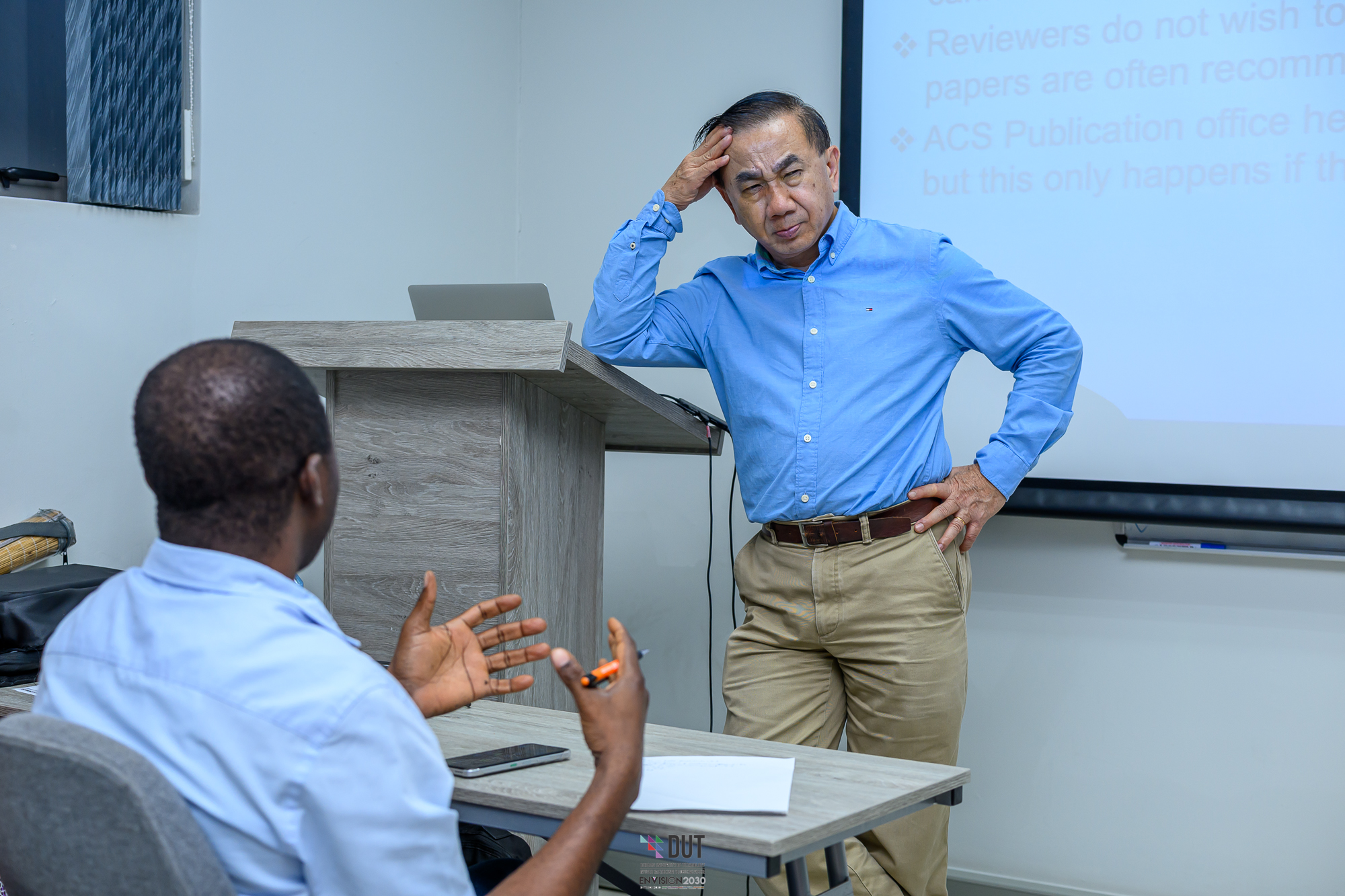
The programme continued with a question and answer session, where discussions focused on the potential of sustainable nanomaterials to address market challenges, new applications in advanced engineering, and approaches to research commercialisation while maintaining intellectual property ownership.
The second part of the seminar focused on writing effective journal articles. Prof Tam addressed key aspects of academic publishing, including selecting appropriate journals, publishing in high impact outlets, understanding the peer review process, common reasons for manuscript rejection, and strategies for preparing strong research papers.
He emphasised that publishing is a critical component of the research process, as it enables knowledge dissemination and contributes to the wider academic community. He also highlighted the competitive nature of academic publishing, noting that many journals accept only a small percentage of submitted manuscripts, making originality and scientific significance essential.
Prof Tam further guided attendees on structuring effective journal articles, stressing the importance of a strong title, clear organisation, and well presented data. He noted that titles and keywords are essential for research visibility, as they are often the first elements readers use to determine relevance. He also encouraged researchers to view peer review feedback as a constructive process that strengthens their work. In addition, he advised participants to aim for reputable journals while being prepared for rejection as a normal part of academic publishing.
He encouraged researchers to actively seek feedback and engage with experienced scholars to refine their writing and improve publication success. Overall, he emphasised that strong academic writing requires resilience, strategy, and a commitment to quality.
In her closing remarks, Dr Nomcebo Mthombeni, Interim Director of the Research and Postgraduate Support Directorate, expressed appreciation for the insightful presentation delivered by Prof Tam. She noted that the session made academic publishing more accessible, particularly for postgraduate students. She emphasised the importance of producing high impact research outputs and encouraged students to apply the knowledge gained to improve the quality of their work. She also reminded attendees that research tools support academic thinking and do not replace it, comparing them to a calculator that only produces meaningful results when correct inputs are provided.
She further encouraged students to view rejection as part of the academic growth process, highlighting that reviewer feedback plays an important role in strengthening research outputs. She urged participants to approach publishing with confidence and to use each experience as an opportunity for development.
Biography
Prof Michael Tam obtained his B.Eng. and PhD degrees in Chemical Engineering from Monash University, Australia, in 1982 and 199?, respectively. He completed a postdoctoral fellowship at McMaster University, Canada, before joining Nanyang Technological University, Singapore, where he taught for 15 years. In June 2007, he joined the University of Waterloo as a tenured full professor in the Department of Chemical Engineering. He is an active member of the Waterloo Institute for Nanotechnology.
He has published more than 400 journal articles in polymer science and engineering and has received several prestigious awards, including the Harold Jan Shoemaker Award and the Tan Chin Tuan Fellowship. He is recognised for his contributions to sustainable nanomaterials and functional colloids. He remains dedicated to advancing research and teaching in chemical and nanotechnology engineering.
Pictured: Professor Michael KC Tam (University of Waterloo) and Dr Nomcebo Mthombeni (Interim Director of the Research and Postgraduate Support Directorate), at the event.
Waheeda Peters/Sinamile Sithole


