
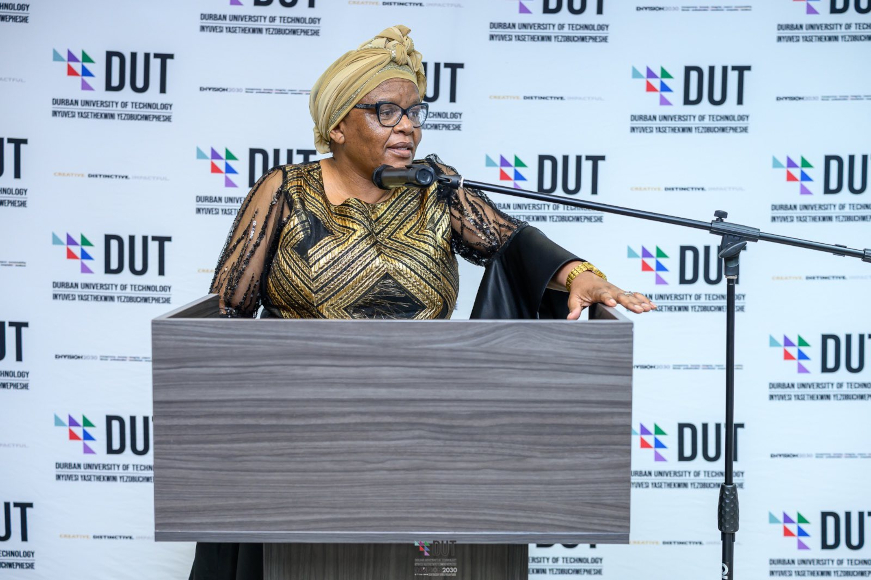
The Durban University of Technology (DUT) Library recently presented the launch of books edited by Professor Tlou Maggie Masenya, an Associate Professor in the Department of Information Systems at the Durban University of Technology. The book launch took place on 29 April 2026 at the BM Patel Library.
Prof Tlou Maggie Masenya is an accomplished researcher, editor, author and senior lecturer in the Department of Information Systems, Faculty of Accounting and Informatics at DUT with over eight years of working experience in the field of Information Science, Information Systems and Technology.
No stranger to academic publications, she has published numerous articles in peer-reviewed accredited journals (JSASA), (SAJIM), South African Journal of Libraries and Information Science (SAJLIS) Mousaion, Library Philosophy and Practice, International Journal of Knowledge Management (IJKM) and book chapters in IGI Global: International academic publisher.
At the launch was the programme director of the prestigious event, Romeo Matumba, the Marketing and Communication Librarian at DUT, who plays a central role in organising and facilitating library book launches and events. He thanked all attendees for being part of the book launches by colleagues from the Faculty of Accounting and Informatics and the Faculty of Management Sciences.
“As a library, we’re excited to be part of this journey as our academics come to share their current or recent publications,” he said.
The books launched were Innovative Technologies for Enhancing Knowledge Access in Academic Libraries, Digital Preservation and Documentation of Global Indigenous Knowledge Systems, Revaluation and Preservation of Indigenous Knowledge Systems in Modern Society, and Resurgence and Revalorization of Indigenous Knowledge Systems in Contemporary Society.
The event brought together scholars, students and guests for engaging discussions on Indigenous Knowledge Systems, technology and the decolonisation of knowledge.
The programme featured reflections and insights from Prof Mishack Gumbo, Dr Petros N. Dlamini, Dr Thulisile M. Bhuda and Dr Collence Chisita, alongside poetic performances that enriched the celebration of African scholarship.
Dr Chisita delivered a message of support in recognition of Prof Masenya’s milestone achievements in publishing books on Indigenous knowledge Systems and their value in supporting alternative ways of knowing and learning. He summed up some of the key issues and shared them with the audience, saying: “I have worked with Prof Masenya and other colleagues, and I like the fact that right from when everything started, one of the key issues raised was that we should put more emphasis not only on the credentialed society, but also on the uncredentialed society. In other words, knowledge is not only found within the four walls of the university, but it’s found throughout the university of life, which is society itself. We should also take into account that while we have an obsession with Artificial Intelligence(AI), we must also try to create some form of equilibrium by bringing in the notion of abundant intelligences, multiple intelligences so that you know indigenous ways of knowing how to find expression in how we design AI programmes so that this will also help to uplift society,” he said.
Sharing her heartfelt thanks was Prof Masenya, who said that as an academic, it is crucial to consistently write book chapters or journal articles as this will make scientific researchers and practitioners with similar interests aware of new knowledge in their field.
“You will be able to contribute to the body of knowledge in your field, it helps to advance knowledge, to share knowledge with the wider scholarly community, to address global socio-economic challenges, popularise your research to the world and to grow academically and professionally,” she said.
Sharing insights into one of her books, titled Digital preservation and documentation of global indigenous knowledge systems, she relayed that the objective of the book is to determine how indigenous knowledge can be documented and digitally preserved to support the sustainable development of indigenous communities and remain accessible for future generations.
“This book aims to provide the best practices, innovative strategies, theoretical and conceptual frameworks, and empirical research findings regarding digital preservation and documentation of indigenous knowledge systems, worldwide,” she explained.
She further thanked all the speakers, role players, family and friends for their unwavering support in her path in academia.
Prof Masenya’s book launch was followed by another launch of three books on 30 April 2026 at the same venue, by academics from the management sciences faculty focusing on governance, development and resilience in the Southern Africa region.
The first book, Development in the Post-Apartheid South Africa: Political and Governance Considerations, was co-authored/edited by Dr Nomzamo Hlengiwe Mabizela, Lecturer and WIL Coordinator in the Department of Public Management, Law, and Economics at the Durban University of Technology.
The second, Sustainable Urban Development in Southern Africa: Disaster Risk Reduction and Economic Resilience, was co-authored/edited by Dr Fortune Mangara, a Research Fellow in the Department of Public Management and Economics at DUT.
The third publication, BRICS+ and Governance in Southern Africa: Impact on Sustainable Development, Trade and Investment, was co-authored/edited by Dr Eustache Tanzala Kikasu, Research Coordinator in the Wholesale and Retail Leadership Chair at DUT.
The programme featured a keynote address by Associate Professor at DUT, Zamokuhle Mbandlwa and a reflective commentary from Co-author/Co-editor of all three books, Professor Nirmala Dorasamy, Senior Lecturer in the Department of Public Management and Economics at the Durban University of Technology. Authors shared insights from their works, highlighting themes of post-apartheid governance, sustainable urban futures, disaster risk reduction, and the evolving role of BRICS+ in shaping trade, investment, and development in Southern Africa. Another highlight of the event was the vibrant Q&A session facilitated by the programme director, during which students and academics engaged the authors with thoughtful and insightful questions.
Prof Mbandlwa spoke on political transformation. “Book number one speaks about the post- development, which focuses primarily on the political transformation after apartheid. I think we focus on the post date because nowadays we focus on the future, on what we want to see happen in the future. It is also based on the governance challenges and reforms,” he said.
Overall, both launches underscored DUT’s ongoing contribution to the preservation of indigenous knowledge and to critical scholarship on governance and sustainable development in the region.
Pictured: Professor Tlou Maggie Masenya at the BM Patel Library.
Thubelihle Dumakude/Waheeda Peters


