
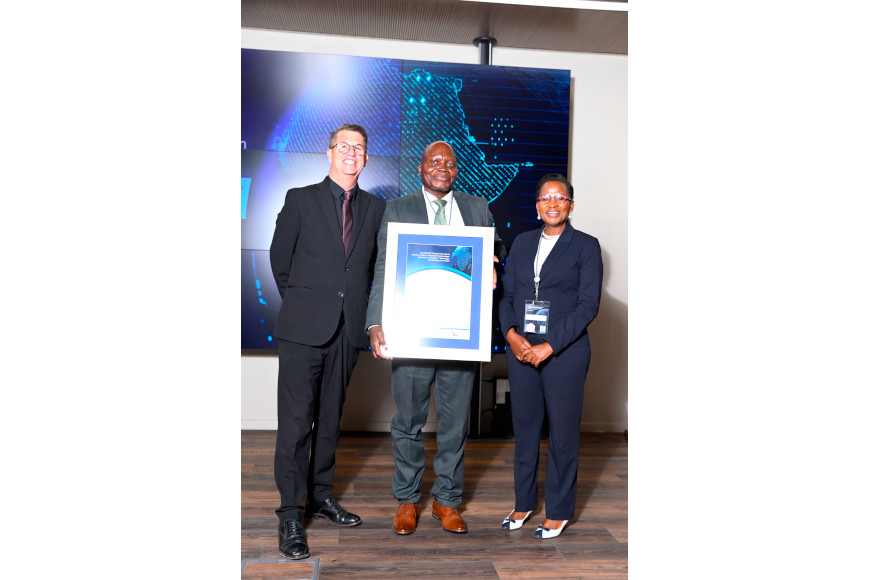
Positioning Durban University of Technology (DUT) as a national leader in advanced manufacturing research, innovation, and skills development was the recent appointment of Professor Rendani Maladzhi as the Chair in Smart and Sustainable Manufacturing Technologies by the National Research Foundation (NRF).
Prof Maladzhi, Associate Professor and Head of the Department of Mechanical Engineering in the Faculty of Engineering and the Built Environment at DUT, is among eight South African Research Chairs Initiative (SARChI) Chairs awarded to DUT by the NRF under the Department of Science, Technology and Innovation (DSTI) Decadal Plan Aligned Research Chairs for Historically Disadvantaged Universities, Universities of Technology, and Emerging Universities.
The Chair further strengthens DUT’s expanding research and innovation footprint, following the university’s recent establishment of 18 new research institutes aimed at accelerating high impact and solutions driven research across strategic sectors including advanced manufacturing, artificial intelligence, climate resilience, and smart technologies.
Professor Maladzhi’s research journey has been shaped by a long standing commitment to ensuring that engineering research addresses real industrial challenges and delivers tangible value to society, particularly for Small and Medium Enterprises (SMEs). His interest in SME focused manufacturing research began during his Master’s studies in Mechanical Engineering at the Cape Peninsula University of Technology (CPUT) in 2007, where he researched new product development in manufacturing SMEs. During this work, he observed that many SME owners and managers were technically skilled but heavily reliant on manual and traditional production methods.
Concerns about job losses, combined with deeply rooted operational practices, often resulted in resistance to technology adoption. This resistance limited innovation, efficiency, and competitiveness not because SMEs lacked potential, but because they lacked access to appropriate support and guidance. These early experiences shaped his doctoral research in 2009, which focused on innovation management and leadership within SMEs. His findings showed that many enterprises struggled not due to a lack of technical ability, but because of entrenched leadership mindsets that resisted change. This insight shifted his research focus towards demonstrating that responsible technology adoption can improve productivity, sustainability, and skills development, while supporting jobs rather than displacing them, shared Prof Maladzhi.
Speaking on the establishment of the SARChI Chair in Smart and Sustainable Manufacturing Technologies at DUT, Prof Maladzhi said the Chair provides a strategic platform to advance applied research, strengthen SME competitiveness, build advanced manufacturing skills, and contribute meaningfully to South Africa’s industrialisation, productivity growth, and broader socioeconomic development.
Being appointed as a SARChI Chair at the Durban University of Technology is both a humbling honour and a significant milestone in my academic journey. It affirms a research vision shaped over many years, focused on making research meaningful and responsive to the real challenges facing South Africa’s manufacturing sector and SMEs. This recognition reflects not only my own efforts but also the collective contributions of colleagues, students, mentors, and industry partners, shared Prof Maladzhi.
The Chair in Smart and Sustainable Manufacturing Technologies focuses on applied, industry embedded research that responds directly to the challenges faced by manufacturing SMEs, while simultaneously advancing human capacity development at undergraduate, postgraduate, and postdoctoral levels. The Chair’s research priorities are structured around interlinked thematic areas that integrate research excellence, skills development, innovation, and industry collaboration to deliver measurable industrial and societal impact, said Prof Maladzhi.
The Chair focuses on enabling inclusive industrialisation through smart manufacturing, digitalisation, automation, and sustainable production technologies, with a strong emphasis on supporting manufacturing SMEs. Aligned with the Decadal Plan’s focus on innovation, entrepreneurship, and commercialisation, the Chair actively supports technology transfer, industry adoption, and sustainable manufacturing solutions. Through strong industry and international collaborations, the Chair positions DUT as a key contributor to South Africa’s national innovation system and industrial development agenda, added Prof Maladzhi.
At a local level, Prof Maladzhi explained that the Chair works closely with manufacturing SMEs and larger firms across KwaZulu-Natal to improve day to day operations through smart manufacturing, automation, predictive maintenance, and sustainable production solutions. By working directly inside companies, the Chair helps improve productivity, equipment reliability, energy efficiency, and cost competitiveness, areas where many SMEs lack access to specialised expertise.
Sharing how the Chair will support postgraduate students and emerging researchers, Prof Maladzhi said:
The Chair was deliberately designed as a capacity building platform for postgraduate students and emerging researchers, ensuring that research excellence is coupled with mentorship, skills development, and real world relevance. The Chair will provide structured academic supervision and mentorship for 22 Master’s students, eight PhD students, and five postdoctoral fellows, across priority areas such as smart manufacturing, digitalisation, automation, sustainability, and systems engineering. Students and postdoctoral fellows will be integrated into clearly defined research programmes with achievable milestones, regular progress reviews, and strong scholarly guidance.
Over the next five years, the Chair in Smart and Sustainable Manufacturing Technologies aims to deliver measurable and practical impact that directly strengthens South Africa’s manufacturing sector, predominantly Small and Medium Enterprises (SMEs), while contributing to broader societal and economic development.
Pictured: Professor Rendani Maladzhi, Chair in Smart and Sustainable Manufacturing Technologies.
Simangele Zuma


