
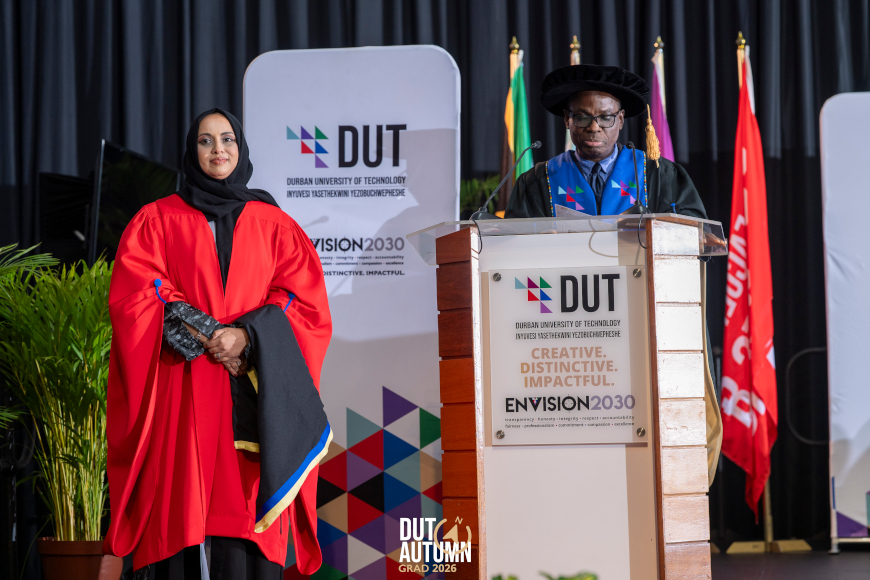
“Graduating with a PhD represents the culmination of an academic journey marked by perseverance, reflection, and growth. It is both a personal achievement and a professional responsibility,” said a jubilant Dr Fathima Razack.
The 47-year-old Quality Promotions Officer in the Faculty of Accounting and Informatics graduated with her Doctor of Philosophy in Business and Information Management at the Durban University of Technology ‘s (DUT’s) Autumn Graduation Ceremony at the Olive Convention Centre.
When she shared the news of passing her PhD with her family, their response was one of immense joy and relief. Dr Razack shared that she is grateful to DUT, particularly the Faculty of Accounting and Informatics, and her supervisors, Professor Nalen Naicker and Prof Reshma Sucheran, for providing her with an enabling environment that valued scholarship, quality, and continuous development. “This milestone affirms my commitment to contributing meaningfully to higher education. As I move forward, I remain dedicated to advancing research, supporting institutional excellence, and mentoring others on their academic journeys,” she accentuated.
Her academic journey at DUT began in 1996 when she had registered for her first qualification at ML Sultan Technikon , completing her National Diploma in Travel and Tourism. Thereafter, she registered for her BTech in Tourism Management at the Durban Institute of Technology but completed this qualification at the University of Johannesburg due to her relocating to Gauteng.
“My career at DUT commenced in 2021 as a Quality Promotion Officer in the Faculty of Engineering and the Built Environment on a contractual basis. In November 2022, she was fortunate to obtain a permanent position as a Quality Promotion Officer in the Faculty of Accounting and Informatics. In 2023, Razack decided to pursue her doctoral studies due to motivation from her Executive Dean Prof Olugbara and registered for the Doctor of Philosophy in Business and Information Management which she has completed.
Dr Razack said her thesis is titled: Towards a Transformative Higher Education Curriculum Model in Smart Tourism within the Fourth Industrial Revolution for Accommodation Establishments in KwaZulu-Natal.
The findings from her dissertation indicate that although Smart Tourism and Fourth Industrial Revolution technologies, such as artificial intelligence, the Internet of Things, and digital marketing tools, are increasingly adopted in the accommodation sector, tourism graduates exhibit notable skill gaps, particularly in computer literacy, industry-specific software, and digital competencies. “Curriculum analysis further emphasises a discrepancy between current higher education institution offerings and industry requirements, highlighting a pressing need for curriculum reform. The primary contribution of this study is the development of a Transformative Curriculum Model for incorporating the Fourth Industrial Revolution into Smart Tourism education, which advocates for the integration of digital competencies throughout core, major, and elective modules, enhanced by experiential learning, industry collaborations, and internationalisation,” she said.
Furthermore, Dr Razack highlighted that a prototype mobile application was developed to assess employees’ technological preparedness in accommodation establishments, providing practical benefits to the industry. “Overall, the study offers a strategic framework for higher education institutions to cultivate digitally adaptive graduates prepared for a Fourth Industrial Revolution-driven tourism economy,” she highlighted.
For Dr Razack, she expressed that she strongly resonates with DUT’s values and principles. Her academic and professional journey at DUT has been guided by a commitment to excellence through continuous learning and scholarly rigour, particularly in pursuing her doctoral studies.
Balancing full‑time employment with doctoral studies was demanding and required significant personal sacrifice, added Razack. Despite the pressures, the journey strengthened her resilience, discipline, and perseverance, and reinforced the value of commitment in achieving long‑term academic and professional goals.
She relayed that the doctorate provided a platform to interrogate how business, technology, and education intersect in response to 4IR demands, while contributing contextually relevant knowledge to the tourism and hospitality sector. “This journey was motivated by a passion for lifelong learning, a belief in the transformative power of education, and a commitment to advancing institutional relevance, graduate employability, and sectoral innovation,” she expressed.
Going forward, Dr Razack’s career aim is to continue contributing meaningfully to higher education by integrating scholarship, professional practice, and leadership. “I aspire to advance evidence‑based curriculum development, quality assurance, and digital transformation initiatives that enhance institutional relevance and graduate employability,” she indicated. Building on her doctoral research, she seeks to influence policy, curriculum innovation, and academic practice in response to Fourth Industrial Revolution demands. “Ultimately, my goal is to serve as a scholar‑practitioner who mentors future academics, supports institutional excellence, and contributes knowledge that bridges theory, technology, and real‑world application,” she added.
Her advice to a first year who wishes to embark in the same career is to begin with purpose, patience, and perseverance. “Take your undergraduate years seriously by developing a strong academic foundation, critical-thinking skills, and a genuine curiosity about learning. Engage actively in your studies, seek opportunities beyond the classroom, and develop digital, research, and communication skills early, as these are essential in a rapidly transforming world,” she concluded.
Pictured: Dr Fathima Razack
Waheeda Peters


