
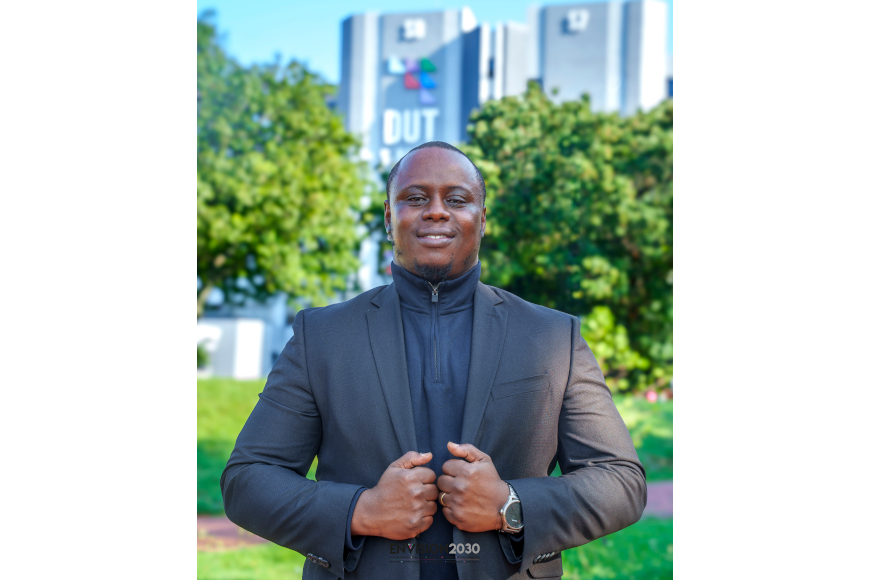
The Durban University of Technology (DUT) will host the Professorial Inaugural Lecture of Professor Oludolapo Akanni Olanrewaju on Thursday, 30 July 2026. Titled “Energy, Efficiency and Intelligence”, the lecture will explore how integrated modelling and artificial intelligence can help shape a more sustainable, energy efficient and equitable future.
Professor Olanrewaju is the Head of Department: Industrial Engineering and Interim Director of the Institute of Systems Science in the Faculty of Engineering and the Built Environment. An accomplished researcher with a National Research Foundation C2 rating, he has co-authored 112 peer reviewed journal publications, 107 peer reviewed conference papers and 18 book chapters. His research focuses on industrial energy systems, sustainability, artificial intelligence and climate resilience.
The lecture, which begins at 5 pm, will examine how advanced modelling techniques and artificial intelligence can improve energy efficiency, strengthen climate resilience and support sustainable development, particularly in developing economies.
Speaking about his forthcoming inaugural lecture, Professor Olanrewaju said it reflects both the evolution of his research and the growing need to integrate modelling and artificial intelligence in addressing global energy challenges.
“The lecture traces my scholarly journey in industrial energy systems modelling, culminating in the development of an integrated analytical and intelligent framework for advancing sustainable energy transitions.
“I will begin by outlining the motivation behind the creation of the IDA ANN DEA modelling architecture, designed to overcome the limitations of single method approaches by combining decomposition analysis, predictive artificial neural networks and efficiency evaluation through data envelopment analysis.”
Using long term case studies from Canada (1990 to 2000) and South Africa (1971 to 2008), Professor Olanrewaju said the lecture demonstrates how activity, structural and intensity effects shape industrial energy consumption, and how efficiency gaps, particularly in developing economies, translate into significant energy saving opportunities.
“The lecture further extends this integrated framework to industrial carbon dioxide emissions (1991 to 2035), incorporating energy mix and emission factor dynamics to reveal the dominant drivers of greenhouse gas growth and quantify feasible mitigation potential. While these retrospectives and forecast insights provide a robust analytical foundation, I argue that the accelerating pace of energy demand, climate disruptions and socioeconomic disparities necessitates a transition towards adaptive, real time decision support tools,” he explained.
To address this need, Professor Olanrewaju will introduce a deep Multitask Learning Reinforcement Learning framework aimed at optimising hybrid renewable energy deployment in underserved communities across sub–Saharan Africa.
“By integrating heterogeneous data sources, ranging from satellite imagery to socio technical indicators, the framework supports intelligent energy classifications, demand forecasting and autonomous recommendations for optimal microgrid configurations,” he said.
He added that the lecture will outline the expected social, environmental and economic impacts of AI driven systems before concluding by positioning this research within a broader agenda for continental collaboration, climate resilience and sustainable development.
Throughout his academic career, Professor Olanrewaju has received numerous accolades, including Best Paper awards at international conferences, the Data Analytics Award at the Zambia IEOM Conference, the Durban University of Technology Researcher of the Year Award in the Gold Category (2020) and Platinum Category (2021), as well as the Faculty Platinum Awards for PhD Research Supervision and PhD Excellence in Research Outputs in 2025.
His contribution to scholarship extends beyond research publications. He is currently editing a book with Elsevier and serves as Guest Editor for several international journals, including AgriEngineering, Sustainability and Atmosphere, on special issues focusing on sustainable energy, climate change and environmental management. He also serves on the editorial board of the SAGE Journal on Renewable Energies and reviews for numerous ISI accredited local and international journals.
Committed to developing future researchers, Professor Olanrewaju has successfully supervised nine doctoral and 21 master’s students and currently supervises 15 doctoral and nine master’s students.
The inaugural lecture forms part of DUT’s commitment to recognising academic excellence and celebrating research that advances knowledge, drives innovation and contributes to sustainable development in South Africa and beyond.
Pictured: Professor Oludolapo Akanni Olanrewaju.
Waheeda Peters


