
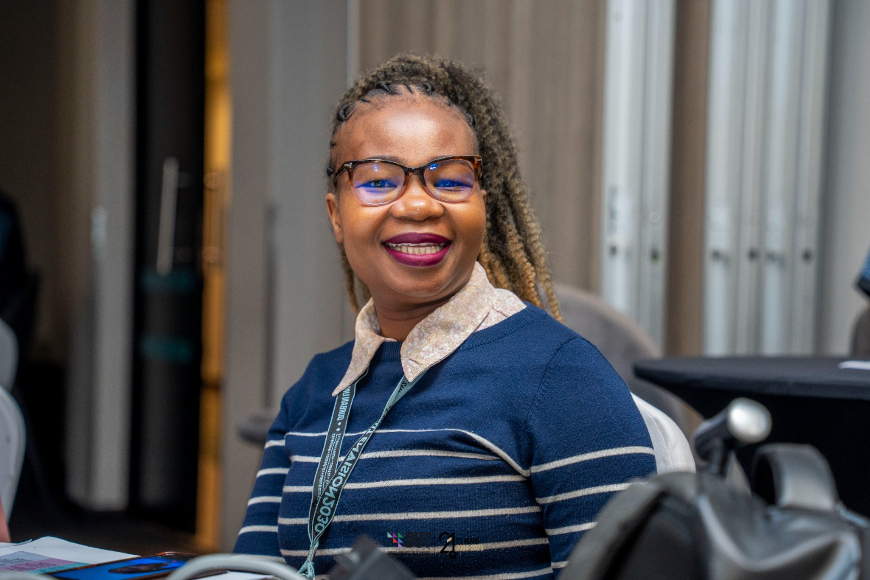
As the Durban University of Technology (DUT) celebrates Women’s Month, the University is recognising women whose leadership, research and determination continue to shape communities and transform lives. Among them is Dr Nomakhosi Mpofana, a researcher whose work is helping to bridge the gap between traditional medicinal knowledge and modern science, while advancing inclusive skin health for people of all skin types.
Affectionately known as Khosi, Dr Mpofana is a Senior Lecturer and researcher in the Department of Somatology within the Faculty of Health Sciences. Originally from the rural Nomlacu area in the Eastern Pondoland region of the Eastern Cape, she is a wife, mother of three and a committed member of the Seventh-day Adventist Church.
Her passion for skin science began long before she entered a university laboratory.
Growing up, she watched people in her community use clay and indigenous medicinal plants to treat wounds, improve skin conditions and care for their complexions. Those early experiences sparked a curiosity about the relationship between traditional healing practices and science, a curiosity that would later define her academic career.
Today, her research focuses on allied health sciences, photobiology and indigenous knowledge systems, with a particular interest in skin rejuvenation and melasma in darker skin types.
“My research focuses on developing culturally inclusive skin care by integrating indigenous medicinal knowledge with scientific research,” she explained.
That passion became even stronger while she worked as a therapist at a dermatology medical centre. There, she witnessed first-hand how many people with skin of colour could not receive appropriate treatment because most available therapies had been developed for lighter skin types.
“Seeing patients who could not be treated effectively because suitable therapies did not exist was deeply concerning. It became clear that more research was needed to develop solutions that reflected the diversity of our communities.”
Determined to make a difference, Dr Mpofana pursued advanced research aimed at improving the treatment of hyperpigmentation and other skin conditions affecting people with darker skin tones. Today, her work is published in leading international Q1 journals and has attracted support from the National Research Foundation (NRF), the University Capacity Development Programme (UCDP) and DUT seed funding.
Beyond research, Dr Mpofana plays an active leadership role within the University. She serves on several institutional committees, including the Institutional Research Ethics Committee, the Information and Communication Technology Committee, the Standardised Assessment Test for Access and Placement Committee and the Big Rocks Emerging Studies Committee. She also contributes to professional organisations such as the Phytomedicine Scientific Society and the eThekwini Traditional Health Practitioners.
Her commitment to lifelong learning continues through postgraduate studies in Public Health at the University of Pretoria, where she is exploring the links between clinical dermatology, public health and community engagement.
Reflecting on Women’s Month, Dr Mpofana believes it is both a celebration and a call to action.
“Women’s Month honours the courage and sacrifices of those who came before us. As women, we must continue to empower ourselves, lead with confidence and create opportunities for others. Let us become pioneers of change, ensuring that future generations know our history and are proud of the paths we have created. Once we rise, we must also lift others.”
Her academic journey has been recognised through several prestigious honours. In 2024, she received the DUT Research, Innovation and Engagement Institutional Gold Multidisciplinary and Interdisciplinary Award, followed by the Institutional Gold Research Excellence Award for Emerging Researchers in 2025.
She regards these awards not simply as personal achievements, but as recognition of the growing contribution that Somatology is making to research, innovation and society.
A defining feature of her career has been collaboration across disciplines. She has led projects such as the DUT Inclusive Wellness Project and the Translingual Competence in Health Professions Education initiative, while contributing to research exploring artificial intelligence in higher education, perceptions of male anger and the integration of Traditional African Medicine into modern drug discovery.
Balancing research, teaching, leadership and family life has not always been easy.
“One of my greatest challenges was balancing multidisciplinary research with being a wife, mother and full-time academic. There were moments when the demands felt overwhelming. I realised that asking for help was not a weakness but a strength. The support of my husband and children, together with my faith in God, gave me the resilience to persevere.”
For Dr Mpofana, the greatest reward comes from knowing that her work has the potential to improve lives.
She is motivated by the opportunity to preserve indigenous knowledge, strengthen healthcare for underserved communities, mentor future researchers and contribute to a more equitable healthcare system.
“I want students to understand that the challenges they observe in their communities can become powerful research questions. Our cultural heritage is not a limitation; it is a source of knowledge that can enrich science when approached with academic rigour.”
Looking ahead, Dr Mpofana hopes to leave a legacy of academic excellence, mentorship and innovation. She wants to position DUT’s Somatology discipline as a leader in skin-of-colour dermatology research while inspiring the next generation of researchers to pursue work that changes lives.
For many people, career and faith exist separately. For Dr Mpofana, they are inseparable.
Her commitment to research is guided by compassion, integrity and service, values that continue to shape every aspect of her academic journey.
“Until all people, regardless of their skin colour, can receive effective treatment with minimal unwanted side effects, I will continue pursuing research that advances culturally inclusive skin care by bridging the gap between our rich traditional medicinal knowledge and modern science. These two pillars should complement one another in improving people’s lives.”
As DUT celebrates Women’s Month, Dr Nomakhosi Mpofana’s journey demonstrates how curiosity, faith and perseverance can transform childhood observations into research that has the power to improve lives, influence healthcare and inspire future generations of women in science.
Pictured: Dr Nomakhosi Mpofana
Waheeda Peters


