
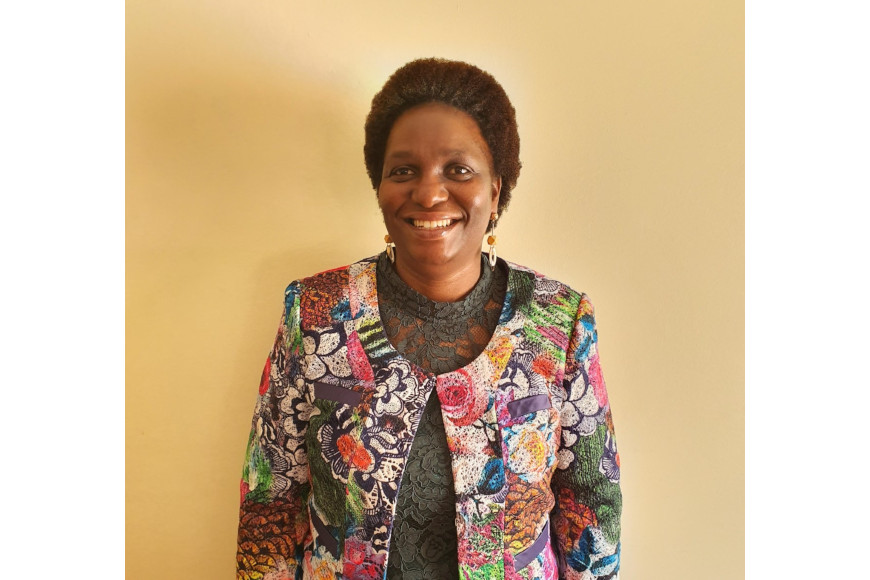
For Professor Gugu Mchunu, leadership has never been about the title attached to her name. It is about people, purpose and what happens to others because of the opportunities a leader creates.
As Executive Dean of the Faculty of Health Sciences at the Durban University of Technology (DUT), Prof Mchunu draws on a career that has taken her from nursing and clinical practice to academia, research, mentorship and university leadership.
Her journey began in KwaMaphumulo, Emthandeni (KwaQwabe), where she grew up in a community that shaped her understanding of people and their relationship with the world around them.
“I was always curious and asking questions about people and their connectedness with their environment,” she recalls.
That curiosity was accompanied by a natural desire to help others. Surrounded by mainly women headed families while growing up, she found herself fascinated by their lives and wellbeing. At one point, she wanted to become a social worker. Instead, she entered nursing, a profession that provided another avenue to work with people and make a difference.
“I was the one who always wanted to lend a hand, and grew up in a close-knit community with families who didn’t have much but bound by love, support and passion. I was fascinated by how we cared for each other as a community and made other people’s wellbeing my business. I actually wanted to be a social worker.”
Her career has since developed across clinical, private-sector and academic environments. She became a lecturer, nurse leader and nurse researcher before taking on the responsibility of leading a faculty.
Although she has not worked primarily in bedside nursing, her interest has always centred on wellbeing and how people can live healthier lives within their natural environments.
That people-centred approach remains visible in her leadership at DUT.
“Even in my current position staff and student wellbeing is my priority. I just love working with people!”
Her academic journey has brought significant milestones. Earning her PhD remains one of the achievements she is most proud of, remembering how the qualification opened doors and created new possibilities.
“Earning my PhD was a huge milestone for me. Although this was many years ago, thinking of it still warms my heart, as it opened many opportunities for me.”
But academic achievement, for Prof Mchunu, is not only about personal milestones. Seeing the people she has mentored succeed has become just as rewarding.
“Seeing my first PhD student graduate was a big deal for me.”
This is closely linked to the legacy she wants to leave at DUT. She wants to see a stronger research culture in which academic staff and students support one another, and more people reach the highest levels of academic achievement.
“Everyone must strive towards getting that red gown. Each one mentor one, instead of pulling each other down.”
Her commitment to developing others is rooted partly in her own experience of being mentored.
Two women, in particular, have shaped the leader she has become.
The first is her mother, who was a young widow, sugar cane farmer and self-made entrepreneur. Prof Mchunu describes her as a natural leader whose resilience and ability to work with people left a lasting impression.
“She was a born leader, and a self-made entrepreneur.”
From her mother, she learnt to love people unconditionally, forgive others and understand that women can succeed and lead on their own terms.
The second was Professor Leana Uys, a nurse leader who became her mentor.
Prof Uys taught her that leadership must be grounded in integrity, even when nobody is watching.
“She taught me that if you are a leader you must lead with integrity at all times even if no one is watching.”
That lesson continues to influence Prof Mchunu’s approach to leadership. She believes leaders should empower others, give their best and remain willing to learn, even from people with whom they may not always agree.
Some of her most profound lessons about leadership, however, have come from motherhood.
Prof Mchunu is a mother of three, an achievement she describes with both pride and amazement.
“Personally, becoming a mother was the best thing that ever happened to me. I always marvel at how I have managed to raise three human beings!”
Raising a child with special needs brought another dimension to her understanding of resilience and compassion. When her son was diagnosed with Autism, she had to adjust her routine while continuing with her studies and professional responsibilities.
“It was a big challenge when he was first diagnosed, but I also saw it as a blessing to me and my family.”
The experience taught her to listen before judging and to recognise that people often carry circumstances that are not immediately visible to others.
“I learnt not to judge others without listening to their life stories. It taught me patience and compassion.”
Those lessons have proved valuable in leadership, where kindness and empathy must sometimes be balanced with difficult decisions and responsibilities.
Her experiences also led her to engage with other parents and eventually put their stories and experiences into writing. A book inspired by those engagements is soon to be published.
The perspective she gained through adversity is reflected in words by Maya Angelou that she holds close: “You may not control all the events that happen to you, but you can decide not to be reduced by them.”
Her own journey has also strengthened her determination to see people from disadvantaged and rural communities succeed.
“I am outcomes driven. When I see people from rural communities succeeding, I get motivated, and work even harder since I know the hardships they get through in order to succeed.”
Her own rural upbringing gives that commitment a personal meaning. She understands that talent and ambition are not always enough when people have limited access to opportunities.
As a faculty leader, she therefore sees her role as part of a much bigger institutional responsibility.
Her decisions must help move the Faculty of Health Sciences in the right direction while contributing to the University’s ENVISION2030. She also believes that leaders have a responsibility to represent DUT positively and strengthen the trust and support of its stakeholders.
Women’s Month provides another opportunity for Prof Mchunu to reflect on the experiences of women, but she believes it should be about more than celebrating professional achievements.
“It means celebrating my feminine side and meeting other women to discuss women’s issues.”
For her, it is also about creating space to hear the stories of women outside academia and recognising the diversity of women’s experiences.
“It is about listening to stories of other women outside academia in a relaxed environment.”
Away from her role at DUT, her faith remains an important part of her life. She is a member of the Anglican Church Mothers Union and sings in her church choir.
“My faith keeps me grounded and helps me to deal with any challenges at work.”
Her experiences as a mother to a child with special needs have also given her a particular sensitivity towards differently abled people.
For young women who aspire to leadership, Prof Mchunu has a message that combines ambition with solidarity.
“They must be hungry for success but be kind to each other. As women, we are the strongest when we cheer each other.”
She encourages young women to be fearless, pursue their dreams even when they appear impossible and, above all, understand their worth.
“Only they can write their story and nobody else.”
From KwaQwabe to the leadership of a university faculty, Prof Mchunu’s story demonstrates that leadership can grow from the simplest of beginnings: curiosity, a willingness to help others and the determination to keep moving forward.
Her ambition is not simply to be remembered for the position she held, but for the people she inspired, the research culture she helped strengthen and the opportunities she created for others.
And perhaps that is the leadership legacy she wants to leave most: to rise, to bring others with you and to make sure that the next person has a better chance to succeed.
Pictured: Prof Gugu Mchunu, Executive Dean of the Faculty of Health Sciences at DUT.
Photo: Supplied.
Tiyani Mboweni


