
Durban University of Technology (DUT) has strengthened its international research collaboration and focus on entrepreneurship and innovation with the launch of a new international publication exploring how artificial intelligence can make market research more accessible and practical for Small and Medium-sized Enterprises (SMEs).
The book, Market Research for SMEs: Understanding Customers and Markets with AI-Enhanced Methods, co-authored by DUT Honorary Research Professors Thomas Dobbelstein and Wibke Heidig, was launched by the DUT Business School on 19 August 2026 at the BM Patel Library Conference Centre at the ML Sultan Campus.
Both authors are Honorary Research Professors at DUT, reflecting an established academic relationship with the university that creates opportunities for knowledge exchange, research collaboration and engagement with DUT students and the broader academic community. Professor Dobbelstein is from DHBW Ravensburg in Germany, while Professor Heidig is from Albstadt-Sigmaringen University in Germany.
Professor Dobbelstein’s connection with DUT has also included engagement with entrepreneurs and postgraduate students, providing a practical link between the international research underpinning the publication and the university’s focus on entrepreneurship, innovation and applied learning. His involvement in the book and its launch demonstrates how DUT’s international academic relationships can contribute directly to the university’s teaching, research and engagement priorities.
The launch brought this international collaboration into the DUT environment, providing academics, students and members of the university community with an opportunity to engage directly with the authors and explore the relevance of AI-assisted market research to business and entrepreneurship.
The programme featured a 30-minute panel discussion moderated by Professor Pfano Mashau. Professor Heidig joined the discussion virtually, while Professor Dobbelstein participated in person.
The panel placed particular emphasis on the practical applications of generative artificial intelligence in market research. Professor Heidig highlighted tools such as ChatGPT and Gemini and explained how they can assist SMEs with various stages of the research process, including information gathering, questionnaire development, qualitative analysis and reporting.
For SMEs, which may not always have access to dedicated market research teams or extensive resources, such technologies can provide opportunities to gather and interpret information more efficiently. However, the discussion also emphasised the importance of using AI responsibly and critically rather than treating it as a substitute for sound research practices.
Professor Heidig also reflected on the evolution of the publication, which developed from an earlier guide focused on the German-speaking market into an international English-language edition. The expanded publication incorporates examples and perspectives intended to make the material relevant across different markets and cultural contexts.
Professor Dobbelstein explained that the international edition was influenced by his close connection with DUT and his engagement with entrepreneurs and postgraduate students.
He said entrepreneurs need a clear understanding of their markets, particularly who their customers are, what they want and how their needs are changing. At the same time, students require practical and academically sound methodologies that allow them to apply their knowledge to real-world business challenges.
The publication was consequently developed as a concise and accessible guide that can support both entrepreneurs and students in navigating market research.
Professor Dobbelstein also highlighted the growing importance of generative AI and the need for students and entrepreneurs to understand how these technologies can be incorporated responsibly into research and business decision-making.
The discussion was further enriched by reflections from Mr Solomon Nyamurima and Ms Nontokozo Ngcobo, who shared their perspectives on the publication and its relevance to the DUT community.
In attendance was the President of the Baden-Württemberg Cooperative State University, Professor Dr Watty Robert, who reaffirmed his full support for the longstanding partnership between the two institutions. He is currently in South Africa participating in DUT International Week, which coincided with the book launch. During the event, he expressed his satisfaction with the collaboration between DUT and his institution and conveyed his excitement at witnessing the tangible outcomes of the Memorandum of Understanding (MoU) in action during his visit.
Participants were then given an opportunity to engage with the speakers during a question-and-answer session, allowing the discussion to move from the theoretical application of AI to practical considerations around market research, entrepreneurship and learning.
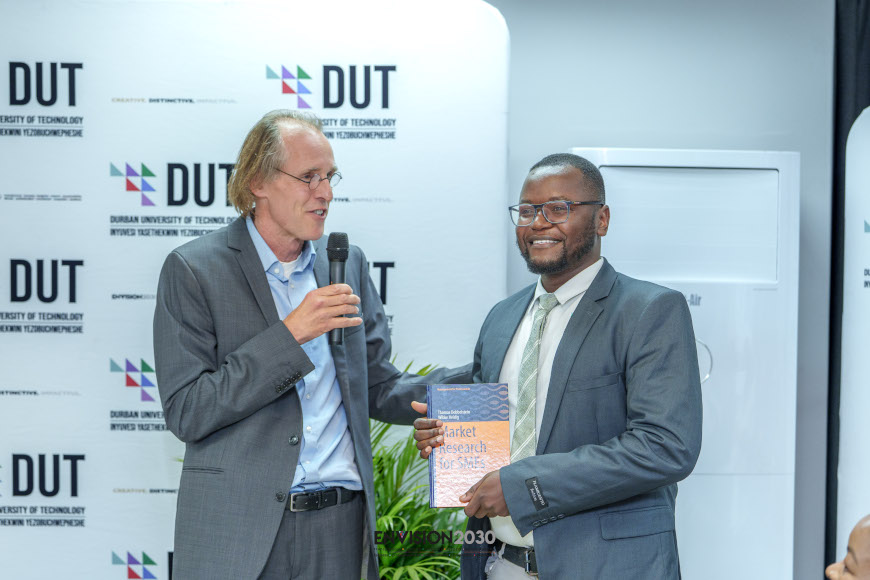
A significant moment of the evening was the official launch of the publication, followed by the ceremonial presentation of a copy to the DUT Library. Professor Dobbelstein formally handed the book to Library Director Dr Malefetjane Phaladi, marking its addition to the university’s library collection.
The publication is also accessible to DUT students through the university library as part of the Springer business package, providing students and researchers with an additional resource on entrepreneurship, market research, business and the application of artificial intelligence.
The launch demonstrated the value of DUT’s international academic partnerships in bringing global expertise and contemporary research into the university environment. Through the involvement of its Honorary Research Professors, DUT is creating opportunities for students and academics to engage with international scholarship while connecting research to practical challenges facing businesses and entrepreneurs.
It also highlighted the growing importance of artificial intelligence in business and the potential for AI-assisted research methods to help SMEs make more informed decisions about their customers, markets and growth opportunities.
For DUT, the publication represents more than the launch of a new academic resource. It is an example of how international research relationships can translate into tangible opportunities for teaching, entrepreneurship, knowledge exchange and research collaboration, while contributing to the university’s international profile.
Pictured: Co-author, DUT Honorary Research Professor Thomas Dobbelstein with DUT Business School Director, Professor Pfano Mashau at the book launch.
Photographer: S’bonelo Dlamini
Luyanda Mlaba


