
The Faculty of Accounting and Informatics at Durban University of Technology (DUT), in partnership with Technovation Girls – Mbasane KZN Chapter, is helping shape the next generation of women leaders by equipping high school girls with the technology and problem-solving skills needed to address challenges in their communities.
Through the Technovation Girls South Africa programme, learners from Sastri College, Lamontville High School and AJ Mwelase Secondary School were given an opportunity to learn coding, develop artificial intelligence models, create business pitches and transform community challenges into technology-driven solutions.
The programme’s mission is to empower young women to become leaders, innovators and problem-solvers using technology to address local and global issues.
Launched in February 2026, the initiative provided the learners with practical exposure to technology and innovation over a six-month period. Their journey included sessions at DUT during weekends, school holidays and after school, where they worked with mentors to develop their ideas and turn them into digital solutions.
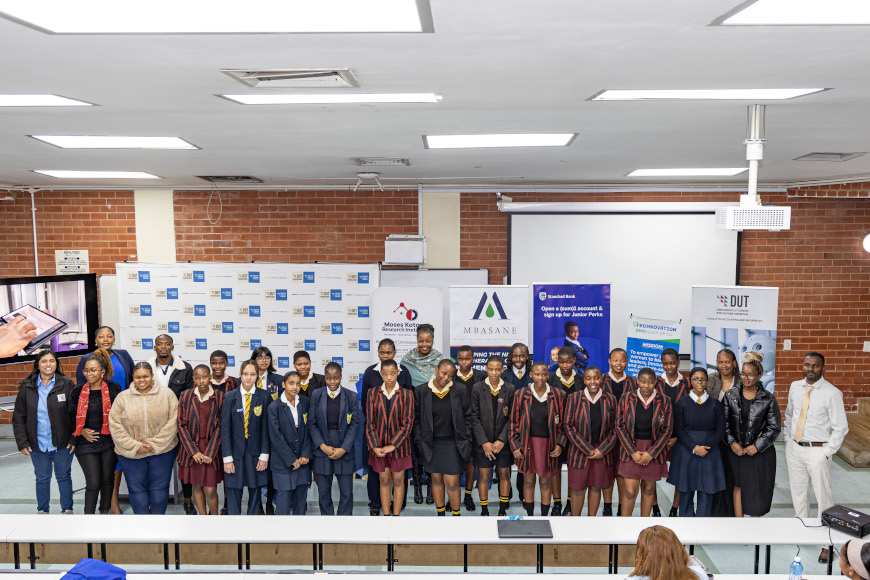
The journey culminated in the Technovation Girls Awards Ceremony, hosted by the Faculty of Accounting and Informatics at DUT’s Ritson Campus on Friday, 14 August 2026. The event was attended by the participating learners, teachers, parents, mentors, DUT representatives and partners, who gathered to celebrate the girls’ achievements and the solutions they developed.
Welcoming guests and outlining the purpose of the celebration, Faculty Technician and Community Engagement Coordinator Mrs Ugeshni Moodley welcomed the guests and congratulated the learners for their commitment throughout the programme.
She acknowledged the parents who supported their children throughout the demanding programme, including allowing them to attend sessions after school, on weekends and during school holidays.
For Tech Career Coach and social entrepreneur Fanie Ndlovu, the programme was designed to achieve more than simply preparing learners for a competition. It was an opportunity to expose young women from different backgrounds to technology, build their confidence and demonstrate that they can compete with their peers nationally and internationally.
The learners were challenged to identify problems within their communities, work collaboratively and develop technological solutions. Along the way, they gained practical experience in coding, app development, databases, artificial intelligence, design thinking, communication and teamwork.
One of the projects that emerged from this process was Radiantness, developed by Sastri College learners Sithandiwe Zungu and Tinotenda Tarwireyi.
They developed a digital app that addresses period poverty while promoting girls’ education, confidence and emotional wellbeing. It connects schools with verified non-governmental organisations to facilitate access to sanitary products, while providing learners with a private space to track their emotions, use journal prompts, access mental health information and find support resources.
Schools can use the platform to request and track sanitary-product deliveries, while administrators verify participating schools and organisations.
The project earned Zungu and Tarwireyi the winning position at the awards ceremony.
For Zungu, seeing their project emerge as the winner was an achievement she had not expected.
“I actually did not think we would get this far with our app. As much as it may not seem like a big problem, out there in Africa, there are a lot of girls who struggle with this, and I honestly do not think it is fair that other girls lack an opportunity to get an education just because of their circumstances,” she said.
She said the team was motivated by the belief that many girls have the intelligence and potential to make a difference but may lack the opportunities and resources needed to realise that potential.
The success of the programme demonstrates the value of creating opportunities for young women to engage with technology from an early age. Rather than waiting until university to develop these skills, the learners were given the opportunity to experiment, solve problems, collaborate and build digital solutions while still in high school.
Delivering the closing remarks, Mrs Pindiwe Filtane, from – Mbasane Women in Information Technology, reflected on the six-month journey from the programme’s launch in February to the awards ceremony. She thanked the learners, parents, schools, DUT, mentors, sponsors and other partners for their contribution to the programme and encouraged the girls to see the competition as the beginning of their innovation journey rather than the end.
Mrs Filtane emphasised that the solutions developed by the learners should not simply remain competition entries, but should be explored for possible implementation to benefit the communities they were designed to serve.
“The solutions don’t need to end there. We need to look at how we implement them,” she said.
The programme was made possible through collaboration between the Faculty of Accounting and Informatics, Mbasane and Technovation Girls, with further support from Standard Bank and Moses Kotane Research Institute. Schools, teachers, parents, and mentors also played an important role in enabling the learners to participate throughout the six-month journey.
Pictured: Mrs Phindiwe Filtane from Mbasane Technovation Girls, DUT representatives and other stakeholders from Standard Bank and Moses Kotane Research Institute with the participating learners during the Technovation Girls Awards Ceremony held at DUT’s Ritson Campus.
Photographer: Mandisi Mvunelo
Sinamile Sithole


