
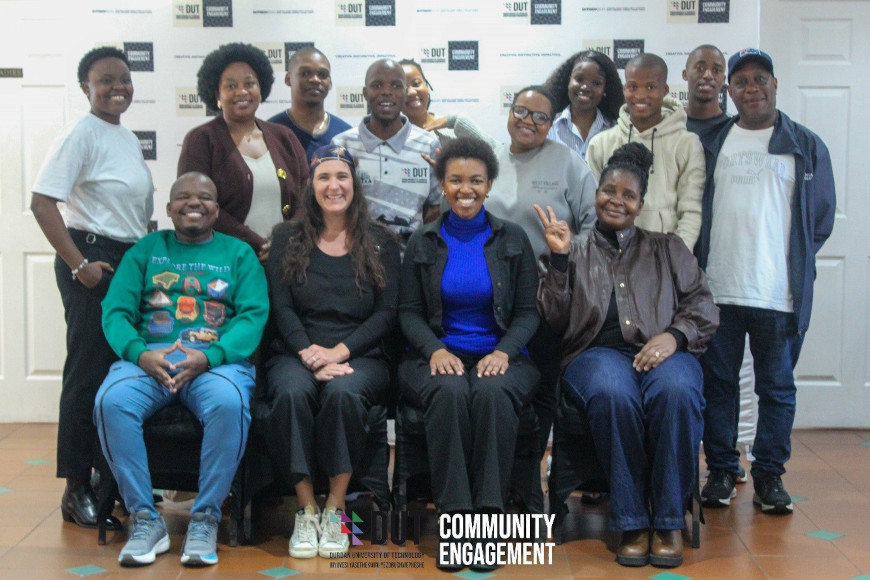
The Durban University of Technology (DUT) Community Engagement Office recently hosted a capacity-building workshop as part of the Practitioner-to-Scholar Programme, held from 7 to 8 August 2026.
Held under the theme, “From Community Practice to Scholarly Knowledge”, the workshop equipped participants with practical knowledge and skills to strengthen their community organisations, transform community-based experiences into scholarly knowledge and begin their journey from practitioner to scholar.
The programme covered key areas including organisational governance and sustainability, engaged scholarship, research development, ethical research practice, data collection and reflective practice.
Welcoming participants to the first capacity-building workshop, Ms Phumzile Xulu, Engagement Practitioner at DUT, acknowledged the significant community-based work already being undertaken by students and emphasised the importance of recognising, documenting and sharing the knowledge emerging from these experiences.
She noted that students are involved in initiatives responding to a range of societal challenges, including health and wellness, youth development, environmental sustainability, entrepreneurship, food security, gender-based violence, disability inclusion and social justice.
“We know that you have the information. We know that you are producing knowledge, but that knowledge sits with you,” said Xulu.
She challenged participants to recognise that their community-based work not only creates social impact, but also generates valuable knowledge that can contribute to scholarship and inform wider practice.
Xulu explained that the Practitioner-to-Scholar Programme aims to support students in moving beyond implementing community initiatives to becoming reflective practitioner-scholars who learn with and from communities, critically examine their experiences, generate evidence and translate their practice into knowledge that can be shared and applied more broadly.
She further emphasised that the programme is grounded in collaborative learning and knowledge co-creation, with students, academics and communities contributing to the learning process.
“As you are learning, we are learning. We are learning together, and that is called co-creation,” she said.
The two-day workshop featured practical and research-focused sessions designed to support participants in making the transition from practitioner to scholar.
Dr Thulile Mofokeng, Lecturer in the Department of Entrepreneurial Studies and Management, facilitated the “From Practitioner to Scholar” session, encouraging participants to reflect on their community experiences and consider how their practice can contribute to knowledge and social impact.
Dr Vaneshree Govender, from Research Capacity Development within Research and Postgraduate Support (RPS), facilitated the “Research Fundamentals and Engaged Scholarship” session, introducing participants to key research principles and the importance of connecting scholarly inquiry with community realities.
Dr Govender, together with Dr Yâchal du Plessis, Lecturer in the Department of Applied Management at DUT’s Pietermaritzburg (PMB) Campus, also facilitated sessions on “Research Design, Data Collection and Ethical Research Practice”. These sessions provided participants with a foundation for developing responsible, ethical and evidence-based research.
A key practical component of the workshop was the Proposal Writing Session, where participants delivered two-minute lightning presentations on their proposed research ideas. The presentations were followed by a plenary feedback session, during which facilitators highlighted common strengths and challenges and provided guidance to help participants refine their proposals for submission.
For Mohau Kabini, an Advanced Diploma in Accounting student, the workshop offered a new perspective on the relationship between community engagement and research.
“The Practitioner-to-Scholar workshop changed how I view the community work we do. I realised that community engagement is not only about implementing programmes and creating impact, but can also be a source of knowledge and research. It challenged me to reflect more intentionally on our work, document what we learn, and use evidence to guide the solutions we develop.”
Kabini said one of his key lessons was the importance of developing interventions based on evidence and the actual needs of communities, rather than assumptions.
“We need to engage communities, understand their actual needs and generate evidence that can inform our programmes. For me, this means becoming both a practitioner and a knowledge contributor, using research to strengthen our work and ultimately create more sustainable impact through well-governed organisations.”
The workshop concluded with a Practitioner-to-Scholar Pledge, through which participants affirmed their commitment to ethical community engagement, scholarship and leadership.
The pledge reinforced the programme’s central message: that community practitioners can transform their experiences into knowledge that strengthens interventions, informs practice and contributes to positive social change.
The Practitioner-to-Scholar Programme represents an important step in strengthening the connection between DUT’s academic mission and its commitment to social responsiveness. By supporting students to reflect on, document and research their community experiences, the programme is helping to develop a new generation of reflective practitioners and emerging scholars who can use knowledge to contribute to more sustainable community impact.
Pictured: Attendees at the Practitioner-to-Scholar Workshop.
Photo: Supplied.
Phumeza Msongelwa


