
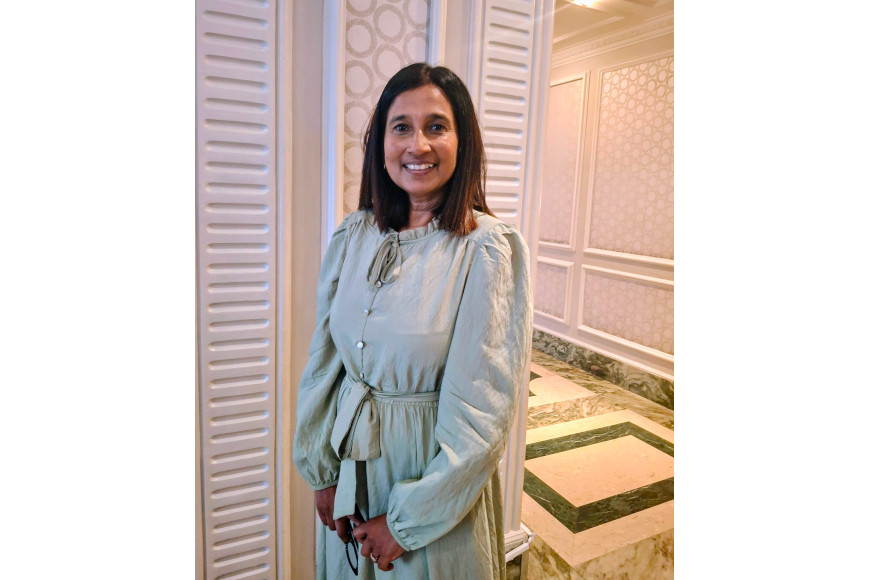
Dr Maleni Thakur, a lecturer at the International Centre of Nonviolence (ICON) at Durban University of Technology (DUT), is passionate about empowering people, building resilient communities and creating a more peaceful society.
Based at the ML Sultan Campus within the Faculty of Management Sciences, Dr Thakur’s work encompasses teaching, research, postgraduate supervision and community engagement. Her research interests include peacebuilding, violence prevention, environmental sustainability, climate change, water conservation, governance and community resilience.
“I want students to leave DUT feeling more confident than when they arrived. I want them to think critically, embrace lifelong learning and understand that their education can be used to improve the lives of others,” said Dr Thakur.
Her journey to academia has been shaped by a diverse professional and academic background. She holds a PhD in Public Management (Peace Studies), an MPhil in Quality Management, a Bachelor of Technology in Journalism and a National Diploma in Journalism.
Her career began in journalism, driven by a passion for listening to and telling people’s stories. However, as she encountered stories rooted in inequality, conflict, poverty and environmental challenges, she became increasingly interested in finding solutions to the issues she was reporting on.
“Journalism taught me to listen, quality management taught me to improve systems, and peace studies taught me that lasting change begins with dialogue, understanding and compassion,” she reflected.
Her transition into academia has allowed her to bring these different disciplines together, using research and education to address complex societal challenges.
One of her proudest professional achievements was completing her PhD, which she described as a milestone representing years of perseverance, sacrifice and resilience. Her appointment as a Lecturer at ICON has also been particularly meaningful, following her time at the Centre as a Post-Doctoral Fellow.
For Dr Thakur, however, success is not measured solely by academic qualifications or professional titles. Her greatest personal achievement is her family, particularly her children, whom she credited as her biggest supporters throughout her journey.
“Balancing family life, work, and years of studying was not always easy, but we faced every challenge together. Every milestone I have achieved has truly been a family achievement,” she said.
She also finds fulfilment in seeing others succeed, whether it is a student gaining confidence, a young researcher publishing their first paper or a community benefiting from research and engagement initiatives.
Her commitment to lifelong learning and global collaboration was further strengthened in June 2026 when she represented South Africa on a leadership and governance programme in China. The experience exposed her to different approaches to innovation, public leadership and sustainable development.
“I returned home inspired by the value of collaboration, lifelong learning and the importance of preparing students who can think globally while making a meaningful difference in their own communities,” she said.
Dr Thakur’s approach to academia is deeply connected to her philosophy of peacebuilding. For her, peace is not merely the absence of conflict, but the creation of spaces where people feel heard, respected and valued.
“Peacebuilding is at the heart of everything I do. I hope to encourage people to choose dialogue over division, understanding over judgment, and kindness over indifference,” said Dr Thakur.
Having joined ICON as a Post-Doctoral Fellow before progressing to her current role, she said the Centre has provided an environment in which collaboration, mentorship and personal growth are valued.
She expressed her gratitude to Prof Ndumiso Ngidi for his leadership, vision and encouragement, as well as to her colleagues and fellow researchers who have supported her professional growth.
“Working at ICON has strengthened my belief that peacebuilding begins with how we treat one another,” she said. “It is reflected not only in our research and community engagement but also in the way we work together every day, with respect, compassion, and a genuine commitment to seeing one another succeed,” she added.
As the country commemorates Women’s Month, Dr Thakur views the occasion as an opportunity to celebrate the courage and resilience of women while recognising the responsibility to uplift those who follow.
“Women’s Month is a celebration of courage, resilience, and possibility. When women celebrate each other’s success instead of competing, everyone grows,” she said.
Her message to young women aspiring to build careers in academia, research or other professional fields is simple: “Believe in yourself. Don’t allow your circumstances to define your future. Keep learning, work hard, stay humble and never be afraid to ask for help.”
She also encourages young women to resist comparing their journeys with those of others.
“Your story is uniquely yours, and your greatest strength lies in being authentic and lifting others as you rise,” Dr Thakur said.
Looking ahead, Dr Thakur hopes to leave a legacy of compassion, encouragement and peacebuilding at DUT and in the wider community.
Ultimately, she hopes her career will be remembered not simply for the qualifications she has earned or the positions she has held, but for the lives she has touched.
Pictured: Dr Maleni Thakur.
Photo: Supplied.
Simangele Zuma


