
Professor Santhosh Kuttan Pillai, a Professor in the Department of Biotechnology and Food Science in the Faculty of Applied Sciences, delivered his professorial inaugural lecture titled ‘The Invisible Engineers: Biocatalysts Shaping a Sustainable Future’ at the DUT Hotel School, Ritson Campus, on 28 August 2026.
The inaugural lecture stands as a celebration of a distinguished scholarly journey and the threshold of a consequential chapter in Professor Pillai’s career.
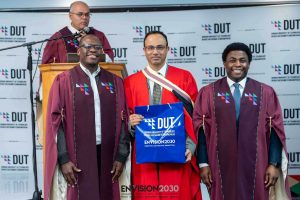
Congratulating Prof Santhosh Pillai were Professor Vusi Gumede, Deputy Vice-Chancellor: Teaching and Learning with Professor Fulufhelo Nemavhola, Deputy Vice-Chancellor: Research, Innovation and Engagement at DUT.
In his opening and welcome remarks, Professor Vusi Gumede, Deputy Vice-Chancellor: Teaching and Learning at DUT, said it was a privilege and honour to join the DUT community in congratulating Prof Pillai on attaining the prestigious status of full professor. He noted that professorships are awarded to academics who demonstrate excellence and scholarly achievement in teaching, research, innovation, and engagement.
“This is a well-deserved and remarkable achievement, and something to which all academics should aspire. It is a testament to dedication and outstanding scholarship. A high point in the life of any academic is being invited to deliver an inaugural lecture, providing an opportunity to present to the university community and the public insights into their research and publications, as well as their contributions to teaching and learning, which ultimately culminate in attaining full professorship. Today, you are being recognised for your dedication and hard work. We are proud of your achievement and wish you continued success and further knowledge generation,” said Prof Gumede, thanking Prof Pillai for the honour he has brought to DUT.
Introducing Prof Pillai, Acting Executive Dean of the Faculty of Applied Sciences, Prof Tukayi Kudanga shared that Prof Pillai began his academic journey at DUT in 2004 as a doctoral student and completed his Doctor of Technology (DTech) degree in Biotechnology in 2010. In the same year, Prof Kudanga said, Prof Pillai was appointed as a Senior Technician, marking the beginning of his transition into academia. He was appointed Lecturer in 2014 and steadily progressed through the academic ranks, becoming Senior Lecturer in 2016, Associate Professor in 2020 and Full Professor in 2025.
“Professor Pillai is an NRF C2-rated researcher and an integral member of the Enzyme Technology Research Group, specialising in the application of microbial systems for sustainable biotechnology. His work integrates microbial biotechnology, enzyme technology, biomass valorisation, bioactive products and sustainable bioprocessing, with a focus on converting underutilised biological resources and waste biomass into high-value products,” shared Prof Kudanga.
Highlighting Professor Pillai’s strong commitment to postgraduate training and mentorship, Prof Kudanga revealed that he has supervised 11 Master’s students and three doctoral candidates, and has hosted six postdoctoral fellows. He currently supervises 11 PhD and nine Master’s students, with three PhD and three Master’s theses currently under examination.
“Prof Pillai has published more than 80 peer-reviewed articles, primarily in Q1 and Q2 journals, as well as 19 book chapters. He has delivered nearly 50 presentations at national and international conferences. His work has attracted more than 3,800 citations and has an h-index of 29, reflecting the impact and influence of his research,” reiterated Prof Kudanga.
Professor Pillai delved into his presentation, speaking about how microorganisms have played a fundamental role in shaping the Earth’s biogeochemical cycles, maintaining ecological balance and driving biological processes that sustain life.
He indicated that despite their microscopic size, their metabolic capabilities offer opportunities to develop innovative solutions to some of the environmental, industrial and societal challenges facing the world.
“There is an entire world around us that we cannot see. It is ancient, extraordinarily diverse, and fundamental to our existence. Though invisible, they are the most important engineers of our planet,” he said.
Professor Pillai emphasised that, for centuries, humanity’s encounters with microorganisms were largely shaped by disease, epidemics and loss of life. He highlighted major historical examples, including the Plague and Cholera pandemics, which claimed millions of lives.
He also spoke on the COVID-19 pandemic caused by the SARS-CoV-2 virus, resulting in several million deaths, globally.
“Microorganisms have shaped human history, causing suffering, fear and enormous loss,” explained Professor Pillai.
He probed more on the microbes, saying only a small fraction of microorganisms are pathogenic, one in a billion (0.000001%).
“The vast majority are essential for life and offer extraordinary benefits. From threat to opportunity: microbes are nature’s most versatile bio-resources,” he shared.
He spoke of a world without microbial decomposers and what it would mean, indicating that, if they are present, they decompose, transform, recycle, fix, oxidise, reduce, and ferment.
Professor Pillai further highlighted how microorganisms function and how their remarkable capabilities can be harnessed to benefit humanity. .
He then explained his research and how his doctoral work laid the foundation for his journey in microbial biotechnology, enzyme technology, and sustainable bioprocessing. His research spans four interconnected themes: Industrial Biotechnology and Enzyme Technology; Sustainable Biorefineries and the Circular Bioeconomy; Food Microbiology and Functional Biomolecules; and Environmental Biotechnology and Bioremediation.
He showcased how his research is intertwined with the work of master’s and doctoral students like Ms Cherise Elisha, whose thesis focused on the antioxidant, antihypertensive, and antidiabetic activities of peptides from fish collagen and milk lactoferrin.
“Food proteins can serve as precursors of small bioactive molecules with potential antioxidant, antihypertensive and antidiabetic functions,” he said.
Another student, Mr Naveen Kumar’s, PhD thesis focuses on the identification, purification, and characterisation of novel antimicrobial peptides from microorganisms.
His research entails integrating microbiology, genomics, bioinformatics, and experimental validation to accelerate the discovery of new antimicrobial molecules.
“The invisible engineers are still doing their jobs without any applause, and we ignore them, but we exploit them. So when we walk around, we are not ourselves; they are travelling with us. Infact: if you look at our body, they outnumber our own cells. So they are incredible architects, invisible architects who have ruled ever since the birth of the cosmos,” said Prof Pillai.
Prof Pillai’s research work seeks to connect microbial innovation with practical applications in waste valorisation, renewable energy, sustainable food systems and the development of bio-based products.
In his closing remarks, Prof Fulufhelo Nemavhola, Deputy Vice-Chancellor: Research, Innovation and Engagement at DUT, congratulated Prof Pillai on his significant and richly deserved academic milestone. He said Prof Pillai’s journey affirms the enduring wisdom that there is no elevator to the summit of scholarship; it must be reached through patient steps, disciplined labour and fidelity to purpose.
“As an NRF C2-rated researcher, with more than 80 peer-reviewed publications, extensive international collaborations and a growing global scholarly influence, Prof Pillai has made a formidable contribution to DUT’s research stature. Yet the true measure of a professor is not found in bibliometric figures alone. His legacy is therefore also written in the lives of the postgraduate students he has supervised, the emerging scholars he has mentored and the intellectual networks he has cultivated,” shared Prof Nemavhola.
He applauded Prof Pillai for his academic journey of perseverance and intellectual growth, wishing him well as the seeds of knowledge he has planted continue to grow into discoveries that advance science, strengthen society and contribute to securing a more sustainable future.
Pictured: Professor Santhosh Kuttan Pillai delivering his professorial inaugural lecture.
Photographer: Sandile Lushozi
Waheeda Peters/Simangele Zuma


