
The Disability Rights Unit (DRU) at the Durban University of Technology (DUT) hosted its Disability Indaba at the DUT Hotel School, Ritson Campus, on 9 September 2026.
Held under the theme “Inclusive Excellence, Advancing Disability Rights, Accessibility and Student Success”, the programme provided a platform for meaningful dialogue on disability rights, accessibility and the experiences of students living with disabilities in higher education.
The programme was directed by Minenhle Zikhali and Joyful Gcabashe and welcomed by Dr Maditsane Nkonoane, DUT Registrar who emphasised that the Indaba was not only about persons with disabilities, but about everyone within the university community. He said the programme provided an opportunity to address issues affecting students with disabilities and stressed that the focus should not be on sympathy, but on recognising strength and promoting inclusion.
He further emphasised that students with disabilities should feel welcomed and valued and, regardless of their disability, should have the opportunity to belong, participate and take pride in their university experience. He encouraged students to speak openly about their experiences and raise concerns without hesitation, noting that the platform was created to ensure their voices are heard.
DUT Senior Psychologist, Mr Sihle Mbanjwa, outlined the purpose of the programme, which included promoting awareness and understanding of disability rights, highlighting the importance of accessibility in teaching, learning and communication, and identifying barriers that prevent students with disabilities from fully participating in university life.
“Students with disabilities must have equitable opportunities to learn, participate and engage,” he said.
Delivering a message of support on behalf of the SRC, SRC President Mr Sihle Nkosi said disability inclusion should not be treated as an additional awareness initiative, but should form part of how the university and student leaders communicate and how student success is understood.
He said the SRC’s responsibility extends beyond representing students to ensuring that less visible student voices are brought to the centre of university engagement.
“If we genuinely believe in fairness and respect, we must then confront the barriers that prevent equal participation,” he said.
The Indaba brought together guests from various organisations and institutions who contributed to discussions on disability inclusion and rights in higher education.
Among the speakers was Ms Sibabalwe Boyce, a former DUT and University of the Free State student who is currently pursuing a master’s degree at the University of Johannesburg. She spoke about inclusivity in higher education and the importance of understanding disability rights and responsibilities.
She highlighted that students with disabilities have the right to apply to and enrol at higher education institutions, provided they meet the relevant requirements. She also emphasised the importance of students voluntarily disclosing their disabilities so that appropriate support can be provided.
DUT alumnus Mr Cebo Hlubi also spoke about the importance of inclusive education and its role in creating opportunities. Drawing on his own experiences, he shared some of the challenges he encountered, which motivated him to advocate for improved access and educational opportunities for students living with disabilities.
Ms Senamile Nene, a Social Work Supervisor at the Association of and for Persons with Disabilities KwaZulu Natal, shared data on students with disabilities in higher education. She noted that approximately 13,700 students were reported as students with disabilities, representing only 1.3% of the student population.
She further highlighted that policies and frameworks addressing disability rights also recognise challenges relating to inequality and discrimination.
“We have policies that speak about participation and inclusion, including frameworks within the Department of Higher Education and Training,” she said.
A key feature of the programme was a panel discussion facilitated by Minenhle Zikhali under the subtheme “Nothing About Us Without Us”. The discussion gave DUT students living with disabilities an opportunity to share their experiences and challenges within the institution.
Students emphasised the need for greater involvement in discussions that affect them and encouraged their peers to make use of platforms such as the Disability Indaba to raise their voices. They also called for increased efforts to ensure that students with disabilities are aware of available opportunities and are meaningfully included in decision making and engagement processes.
The programme also featured an exhibition by Edit Micro, which showcased assistive devices and the latest technologies available to support persons with disabilities.
In his closing remarks, Mr Mfundo Madiba from the DRU thanked all attendees for participating in the programme. He encouraged students not to be afraid to raise their concerns and reaffirmed the DRU’s commitment to supporting students and helping them access the resources and assistance they require.
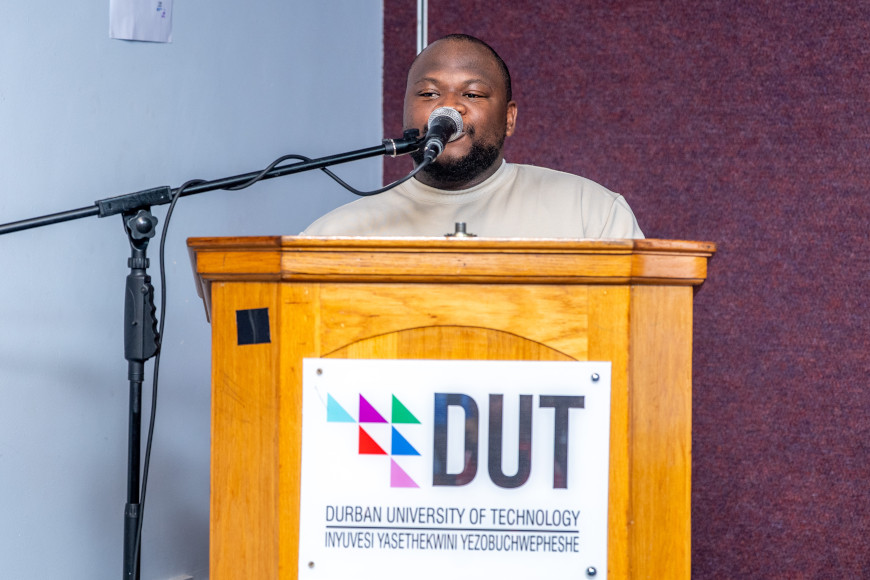
Pictured: Minenhle Zikhali of the Students with Disabilities Association (SWDA) facilitating the Disability Indaba.
Photographer: Sifundo Thwala
Luyanda Mlaba


