
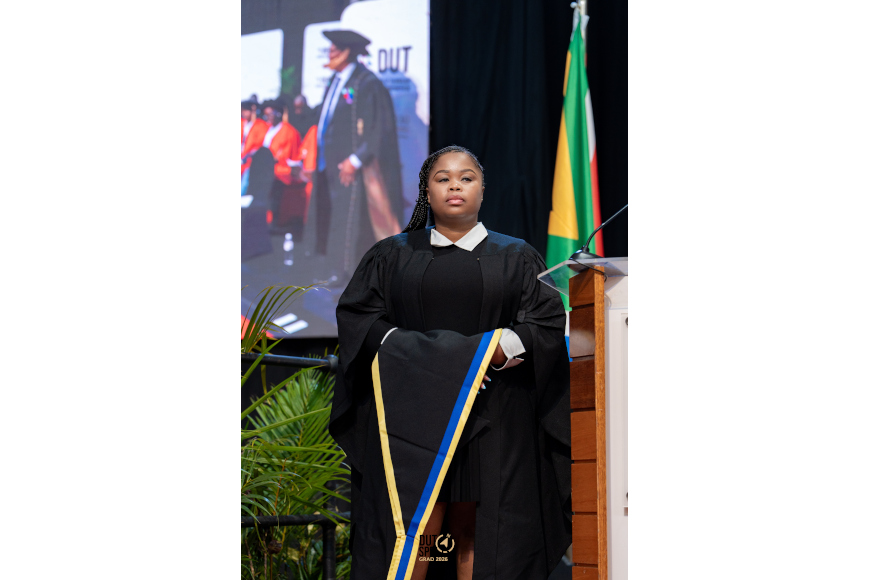
What began as a personal question during her own Work Integrated Learning (WIL) experience became the foundation of Nontuthuko Pahla’s Master’s research into whether university students are truly prepared for the world of work.
Phahla, a 32-year-old from Hlokozi Location in Highflats, KwaZulu Natal, graduated with a Master of Management Sciences in Administration and Information Management from Durban University of Technology (DUT) during the University’s Spring Graduation in September 2026.
Her dissertation, titled “Stakeholders’ Perspectives on the Work Readiness of Business and Information Management Students at a University in South Africa”, examines how different stakeholders understand and contribute to preparing students for employment. The idea for the research came from Pahla’s own experience as a student. During her WIL placement, she began questioning whether she was receiving enough meaningful exposure to the type of office work that could build her confidence, skills and experience for the workplace.
Rather than leaving the question unanswered, she turned it into a research topic. Her study brought together the perspectives of students, lecturers, WIL coordinators and workplace supervisors to examine whether those involved in WIL have a shared understanding of what students should gain from their placements and what responsibilities each stakeholder should carry.
“In simple terms, my research asked an important question: Are university students really being prepared for the realities of the workplace?” Pahla explains.
The research highlights the importance of meaningful workplace exposure, stronger collaboration between universities and industry, and clearly defined responsibilities among WIL stakeholders. Its findings emphasise that preparing students for employment cannot be the responsibility of universities alone. Students, academics, WIL coordinators and workplace supervisors all have a role to play in ensuring that WIL placements provide meaningful opportunities for students to apply their academic knowledge and develop workplace competencies.
For Pahla, the research has significance beyond completing her Master’s degree. She hopes it will contribute to improving WIL practices and encourage universities and host organisations to have clearer conversations about their respective responsibilities towards students.
“The study highlights the need for universities and industry partners to work together more effectively to ensure that students receive meaningful workplace exposure and opportunities to apply what they have learned,” she says.
Pahla’s academic journey at DUT has been one of continuous growth and determination. She completed a National Diploma before obtaining a Bachelor of Technology in Office Management and Technology and later progressing to her Master’s degree.
Her decision to pursue postgraduate studies was driven by a desire to develop herself academically and professionally, strengthen her position in the labour market and work towards her long-term ambition of entering academia.
In an interesting turn in her academic journey, Pahla’s family did not know that she was pursuing a Master’s degree until she completed it. When she eventually shared the news, their reaction reminded her that the people closest to her may not always see the full extent of what she is working towards until she reaches the finish line.
Her academic journey will not end with a Master’s degree. Pahla hopes to continue her studies until she earns her PhD, with the long-term ambition of working in academia and contributing through teaching, research and the development of students who are prepared to make a meaningful contribution to society. Currently working as an Administration Officer at the South African National Biodiversity Institute, Pahla is continuing to build her professional experience while pursuing her academic goals.
Pictured: Nontuthulo Phahla
Photography: Sifundo Thwala
Sinamile Sithole


