
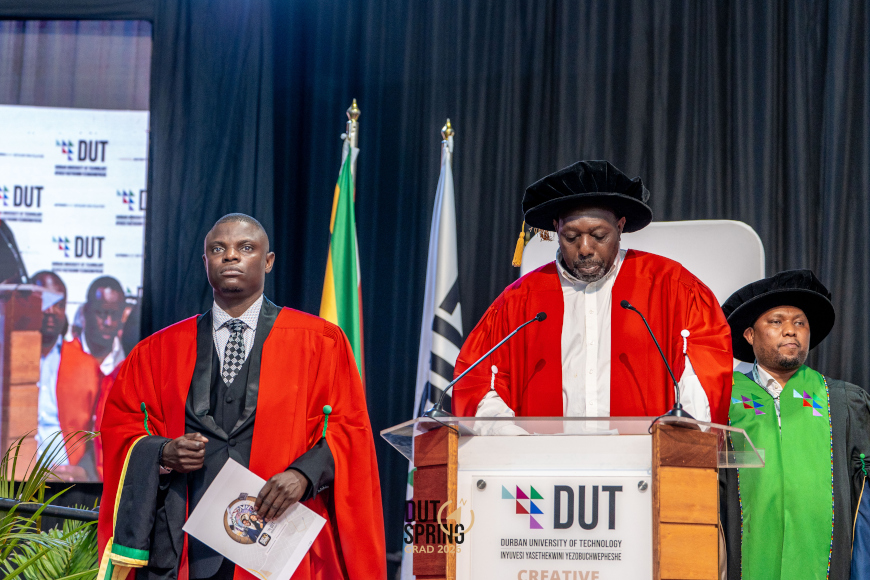
For Dr Oluwole Joseph Oladunni, earning a Degree of Doctor of Engineering from the Durban University of Technology (DUT) represents an opportunity for him to use research to help address some of South Africa’s most pressing environmental and developmental challenges. He obtained his PhD at the 2026 Spring Graduation ceremony which was held at Olive Convention Centre on Wednesday, 16 September 2026.
Dr Oladunni, originally from Ogun State, Nigeria was among the adaptive graduates from Faculty of Engineering and the Built Environment who were honoured for academic excellence.
His research, titled “Energy Econometrics System for the Mitigation of GHG/CO2-eq Emissions in the Transportation Industry of South Africa,” focuses on one of the country’s major environmental challenges: reducing greenhouse gas emissions from transportation while supporting continued economic development.
According to Dr Oladunni, South Africa’s growing economy, urbanisation and increasing dependence on road transportation have contributed to rising energy consumption and emissions. His research examined these trends across the country’s nine provinces, seeking to identify practical pathways that could help reduce transport-related emissions without undermining economic growth.
A key finding of his study is that South Africa requires solutions that recognise the different circumstances of its provinces, rather than relying solely on a single national approach. His research highlights the relationship between transportation, economic activity, urbanisation, fuel consumption and emissions, providing a basis for more targeted planning and decision-making.
The research projects significant opportunities for emissions reductions in several provinces by 2050. In KwaZulu-Natal, for example, the study projects a 43.3% reduction in emissions, together with a substantial decrease in fuel consumption, while economic growth continues.
For Dr Oladunni, the motivation behind the research was deeply rooted in the desire to make engineering relevant to real-world challenges.
“My doctoral research was driven by the conviction that engineering should not only solve existing technical problems but also anticipate emerging societal and environmental challenges,” he said.
He shared that his four year doctoral journey was challenging, bringing together different areas of knowledge, working with complex data and developing new analytical skills required persistence and continuous learning. Rather than viewing these obstacles as setbacks, Dr Oladunni said they strengthened his ability to approach difficult problems systematically.
He credited DUT and the Faculty of Engineering and the Built Environment with helping him grow not only as a researcher, but also as an emerging academic and professional.
“DUT strengthened my capacity to communicate technical research to different audiences, both national and international, and to appreciate the relationship between technical innovation, policy, industry and sustainable development,” he said.
One of the most rewarding aspects of his doctoral journey was seeing how his research could move from understanding the causes of transport-related emissions to considering how future emissions could be reduced.
For Dr Oladunni, this represents the broader purpose of research, turning knowledge into solutions that can benefit society.
Looking ahead, he plans to continue his work in sustainable transportation, energy systems, emissions modelling, artificial intelligence and data-driven engineering, while developing collaborations with universities, government and industry. He also hopes to contribute to the mentoring and development of the next generation of engineers and researchers.
Pictured: Dr Oluwole Joseph Oladunni.
Photographer: Sifundo Thwala
Simangele Zuma


