
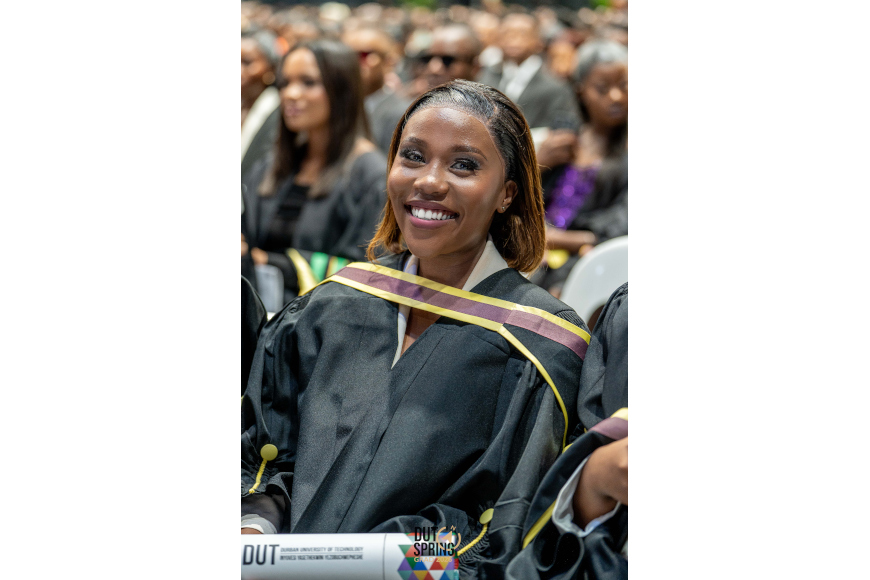
Andisiwe Jojo (32) from Mthatha in the Eastern Cape, graduated with Cum Laude for her Master of Applied Science in Chemistry at the Durban University of Technology (DUT) 2026 Spring Graduation ceremony.
“To receive Cum Laude for my Master’s is still so surreal to me, I am honestly in disbelief. This journey was not easy, but God’s grace carried me through. I put my heart into this work, and seeing it recognised in this way means so much to me,” said the euphoric Andisiwe.
Her journey with DUT started in 2020 when she enrolled for her Advanced Diploma in Chemistry. After my Postgraduate Diploma in Chemistry in 2021, she took a break from her studies and started working. In 2024, she then decided to take the ‘chemical step’ and pursue her Master of Applied Science in Chemistry where she excelled in academic excellence.
Andisiwe gave insight into her dissertation research which explores deep eutectic solvents (DESs) as greener alternatives to conventional organic solvents for sustainable chemical separation processes.
“My interest in deep eutectic solvents came from recognising that the chemical industry urgently needs greener alternatives to conventional organic solvents, many of which are toxic, volatile, and environmentally harmful. DESs stood out to me because they offer a compelling solution because they are biodegradable, low-cost, easy to prepare, and highly tunable, yet they can rival traditional solvents in performance,” she emphasised.
The most significant challenge Andisiwe had encountered during her research was a prolonged malfunction of the gas chromatograph (GC), which was essential for determining the infinite dilution activity coefficients.
“The instrument remained out of service for several months, which inevitably delayed that portion of my experimental work. However, rather than allowing this setback to halt my progress, I adopted a strategic approach. I continued working on the other parts of my research ensuring that my overall momentum was maintained.,” she explained. Throughout this period her supervisor, Prof Bakusele Kabane, worked tirelessly to ensure the instrument was repaired and restored to working order.
She explained that her supervisor’s dedication and support were instrumental in helping me navigate this difficult period.
“Ultimately, this experience taught me the value of adaptability, effective time management, and resilience in the face of unforeseen obstacles, qualities I believe are essential in any research career,” added Andisiwe.
She thoroughly believe that her work on the thermophysical and thermodynamic characterisation of DESs has only scratched the surface of what is possible, and she is eager to deepen her expertise in this field at a doctoral level.
Looking further ahead, Andisiwe sees herself contributing to research that bridges fundamental thermodynamics and sustainable industrial practice.
“My aspiration is to work within a research institution or academia where I can continue investigating green solvents and their applications in separation processes, while also mentoring the next generation of chemists through teaching and supervision,” she expressed.
Andisiwe indicated that she is particularly drawn to the academic path because it offers the freedom to pursue curiosity-driven research while addressing real-world challenges.
“That said, I remain open to opportunities in industry, particularly in sectors where green chemistry and process optimisation are gaining traction such as petrochemical, pharmaceuticals, or renewable energy. Ultimately, my aspiration is to become a researcher who does not merely generate knowledge, but applies it in ways that make chemical processes cleaner, more efficient, and more sustainable,” she highlighted.
Her sterling advice she shares with would-be students in this field is is the importance of a strong working relationship with one’s supervisor.
“Choose a research area that genuinely interests you, because postgraduate study demands sustained intellectual engagement over an extended period. I would also advise students to develop resilience and adaptability. Setbacks are inevitable in research, what matters is how you respond. Learn to pivot, manage your time strategically, and maintain perspective,” she concluded.
Pictured: Andisiwe Jojo
Photography: Sifundo Thwala
Waheeda Peters


