
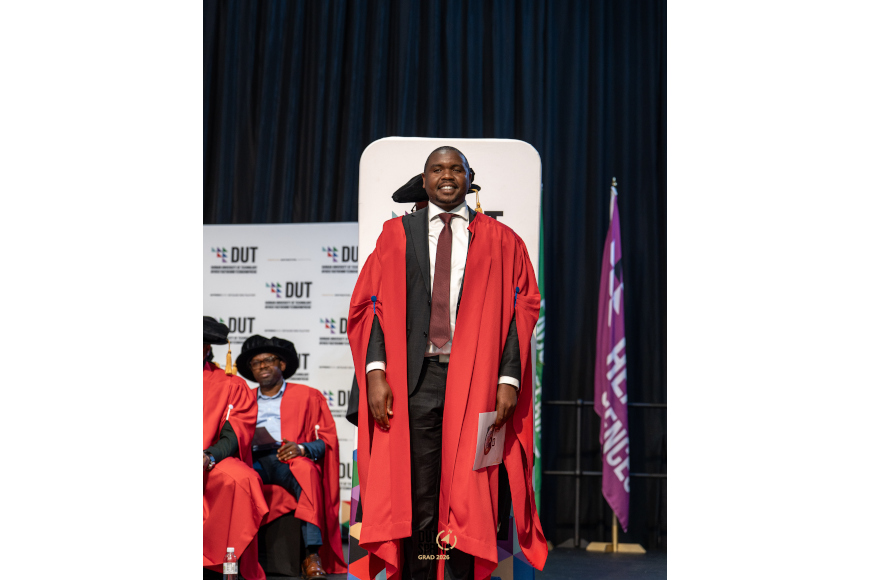
Information Technology academic, researcher and lecturer, Alex Maraga’s academic and professional journey has been driven by a passion for using technology to understand and solve real-world challenges
The techno-geek is particularly interested in research that connects technological innovation with practical solutions that can benefit society and contribute to sustainable development.
He crossed the stage at the Durban University of Technology’s (DUT’s ) 2026 Spring Graduation at the Olive Convention Centre in Durban, marking a significant milestone in an academic journey that he once questioned whether he could complete.
Becoming a PhD graduate is a significant personal achievement, but Maraga sees it as much more than receiving an academic qualification. It reminds him that knowledge comes with responsibility. Having reached this level, he feels a greater responsibility to use his knowledge, skills and research capabilities to contribute solutions to challenges facing society.
The PhD has also strengthened his confidence as a researcher and reinforced his belief that academic work should ultimately create value beyond the university.
“For me, the qualification is therefore not the end of the journey; it is a platform from which I can continue learning, researching, mentoring others and contributing to society,” he shared.
“I started my academic journey at Durban University of Technology (DUT) four years ago when I enrolled for a PhD in Information Technology. My journey at DUT has been both challenging and rewarding, and it has provided me with an environment in which I could grow academically, professionally and personally,” he shared.
Maraga is especially grateful for the support he had received from the university through access to research resources, facilities and a supportive academic environment.
“I was also fortunate to work with excellent supervisors, particularly Prof Ojo and Prof Mzee, whose guidance, mentorship and encouragement played a significant role in my success. They challenged him to think critically, remain focused and approach research with discipline and purpose.
Beyond the qualification itself, his time at DUT has given him valuable research experience, opportunities to engage with other academics and a deeper appreciation of the role that universities can play in addressing real-world challenges through research and innovation.
“Pursuing a PhD had been a personal academic goal since I began my undergraduate studies. I have always believed that education should go beyond acquiring qualifications; it should equip an individual with the ability to identify meaningful problems, investigate them systematically and contribute practical solutions,” he expressed.
After completing his master’s degree, this ambition became even stronger. He was fortunate to have mentors, particularly Prof Mzee and Dr Maake, who encouraged him to believe that he could take the next step. Their mentorship and the academic environment they created gave him the confidence and opportunity to pursue doctoral studies.
“I was motivated by the desire to become an independent researcher capable of contributing new knowledge and developing technology-based solutions to challenges affecting society,” he indicated.
Obtaining a PhD has been part of his long-term academic and professional vision since his undergraduate studies. “I have always viewed education as a continuous journey and wanted to reach a level where I could contribute not only by applying existing knowledge, but also by creating new knowledge,” he added.
For Maraga, his mentors played an important role in turning that aspiration into reality. Their encouragement, guidance and belief in his potential gave him the confidence to pursue doctoral studies. His family also provided an important source of motivation throughout the journey.
Most importantly, he was inspired by the possibility of using research to move from identifying problems to developing evidence-based solutions. That purpose kept Maraga focused throughout the PhD journey.
“I am the first person in my family to obtain a PhD. This achievement therefore means much more to me than an academic title. It represents years of sacrifice, perseverance, learning and the support of many people who believed in me. For my family, it is a source of great pride and happiness because they witnessed the commitment, challenges and sacrifices that came with the journey,” he excitedly said.
Personally, Maraga sees it as opening a new chapter rather than reaching the end. Being the first PhD graduate in his family carries a responsibility to inspire younger members of the family and demonstrate that ambitious academic and professional goals are achievable with commitment, discipline and perseverance.
His doctoral research is titled “Energy-Efficient and Carbon-Aware Virtual Machine Placement in Cloud Data Centres Using Deep Q-Networks and Agglomerative Clustering.”
“I was inspired by the rapid growth of cloud computing and the increasing amount of energy required to operate cloud data centres. As more people, businesses and institutions depend on digital services, the demand for computing infrastructure continues to grow. This growth has environmental implications because data centres consume significant amounts of electricity and can contribute to carbon emissions,” he explained.
He therefore wanted to explore how Artificial Intelligence could be used to make cloud computing more energy-efficient and environmentally sustainable, while still maintaining reliable services.
“The research brought together my interests in Artificial Intelligence, cloud computing, optimisation and sustainable technology to address an important environmental and technological challenge,” he highlighted.
In simple terms, his research looked at how computers in large cloud data centres can be managed more intelligently so that they use less energy and produce fewer carbon emissions without compromising the quality of services.
“I developed an intelligent approach that helps determine where computing workloads should be placed within a data centre. The approach learns from experience and groups similar workloads to make better placement decisions. In essence, the research demonstrates how Artificial Intelligence can help make the rapidly growing cloud computing industry more sustainable,” emphasised Maraga.
The key finding from his research was that Artificial Intelligence can be effectively used to make cloud computing more energy-efficient and environmentally sustainable while maintaining reliable services.
“The study therefore contributes to the growing field of sustainable computing and provides a foundation for future research on environmentally responsible digital infrastructure,” he relayed.
Maraga indicated that the research is important because of everyone’s dependence on cloud computing continues to increase, while the infrastructure supporting these services consumes significant amounts of energy.
“The challenge is how to meet the growing demand for digital services without unnecessarily increasing energy consumption and carbon emissions. Existing approaches often focus heavily on performance and resource allocation without adequately considering environmental impact. My research addresses this gap by using Artificial Intelligence to make more informed workload-placement decisions that balance service reliability, energy efficiency and carbon reduction. In the long term, such approaches can help data-centre operators and cloud service providers move towards more sustainable digital infrastructure,” he said.
Maraga believes the research has potential relevance to industry, future research and policy discussions around sustainable digital infrastructure.
“For industry, the approach can contribute to more energy-efficient management of cloud data centres, potentially reducing operational costs and environmental impact. For researchers, it provides a foundation for further work on Artificial Intelligence, sustainable computing and carbon-aware digital infrastructure. At a broader level, the findings can contribute to discussions about sustainable digital transformation and the need to consider environmental sustainability as digital infrastructure continues to expand. I also hope that future research can move beyond simulation and explore the application of these approaches in real-world cloud environments,” he added.
Going forward, Maraga has applied for a postdoctoral fellowship at DUT associated with research on Digital Innovation and Transformation for Governance, Accountability and Socio-Economic Development, and he has been shortlisted and interviewed for the position.
If successful, he would be delighted to continue his research journey at DUT and expand his work from sustainable and intelligent computing toward broader applications of Artificial Intelligence, digital innovation and digital transformation.
His long-term goal is to build a strong research career that combines technological innovation with practical solutions to challenges affecting institutions, communities and society, particularly within the African context.
His advice to future students is to not allow the size of the goal to discourage one from taking the first step.
“A PhD may look intimidating when viewed as one big achievement, but it becomes manageable when broken down into smaller goals. Be willing to learn, accept criticism, ask questions and learn from people who are more experienced than you,” he shared.
My PhD journey has taught me that achievement is rarely the result of one person’s effort. Behind every successful graduate is a network of people who provide encouragement, guidance, sacrifice and support.
My journey from Kenya to South Africa and through doctoral studies at DUT has been an experience of academic growth, cultural learning and personal transformation. I had to adapt to a new environment, build new relationships and navigate the demands of advanced research, but every challenge became an opportunity to learn and grow.
I am particularly grateful to my supervisors, mentors, colleagues, friends and family who contributed to my journey in different ways. I am also grateful to DUT for providing an environment that enabled me to pursue my research and develop as a scholar.
“For me, this PhD is not the conclusion of my academic journey. It is a new beginning and a responsibility to use knowledge to create solutions, inspire others and contribute positively to society,” he said.
Pictured: Alex Maraga
Waheeda Peters


