
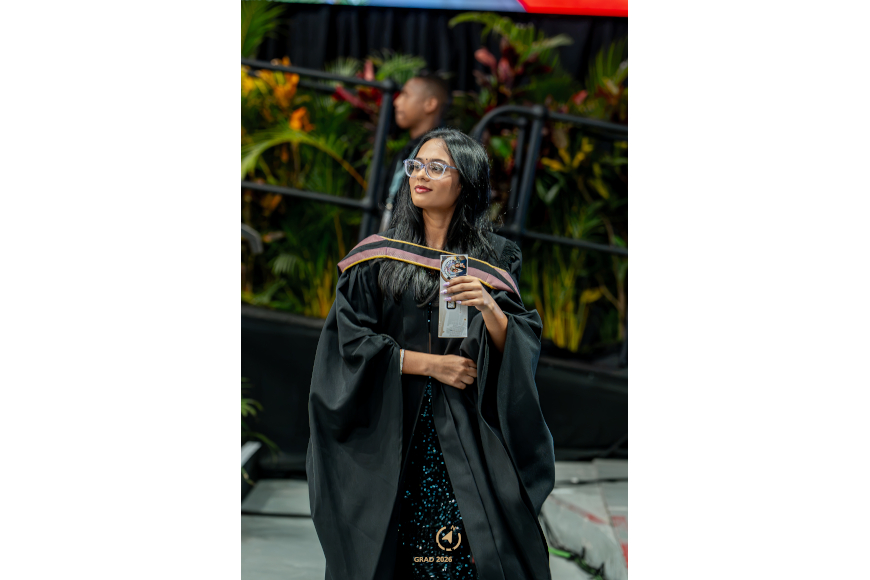
At 24, Durban University of Technology (DUT) Master of Engineering graduate Racquel Lallie is researching one of the technologies that could help shape South Africa’s cleaner energy future: hydrogen. Originally from Durban and residing in Phoenix, Racquel began her academic journey at DUT in 2020 with a Bachelor of Engineering Technology in Chemical Engineering. She later completed an Honours qualification, where her growing interest in research inspired her to pursue a Master of Engineering in Chemical Engineering.Beginning university during the COVID 19 pandemic presented its own set of challenges, but Racquel remained determined to complete her studies. Her Master’s journey, she said, taught her valuable lessons indiligence, resilience and independence. “I am thrilled to have finally completed this stage of my studies. The waiting period for my results was inexplicably taunting, and I was unsure that I would make the Spring Graduation. After hearing the news that I had passed, I was overjoyed and relieved,” she said.
Racquel’s research focused on one of the promising areas of the global transition towards cleaner energy: hydrogen production.
Her thesis, titled The Optimisation of a Lab Scale Photocatalytic Water Splitting System for Hydrogen Production, was supervised by Dr EK Tetteh and Professor S Rathilal.
The study explores photocatalysis, a solar driven process that uses semiconductor catalysts to split water and produce hydrogen, as a potential pathway towards cleaner energy production.Hydrogen is increasingly being explored as part of the global transition to cleaner energy, with potential applications across sectors such as industry, transport and power generation. For South Africa, research into hydrogen technologies could contribute to efforts to diversify the country’s energy mix and reduce reliance on fossil fuels
For Racquel, the growing importance of hydrogen in South Africa and the need to address the country’s energy challenges provided a strong motivation for her research.
“Hydrogen is a growing field in our country. I was inspired to do this work to understand and help advance our country into the hydrogen economy,” she explained.
As a problem solver, she was drawn to research that could potentially contribute to addressing the energy crisis and reducing dependence on fossil fuels.
“I want to find solutions and help accelerate the implementation of them. It also brings me a sense of fulfilment,” she said.
Her research investigated how different operating conditions could improve the effi ciency of a laboratory scale photocatalytic water splitting system, including catalyst selection and loading, reactor configuration, irradiation positioning and feedstock composition. Among the key findings, titanium dioxide (TiO2) emerged as the best performing semiconductor catalyst, with optimal performance at a loading of 10 g/L during the initial screening phase. The research also found that internal ultraviolet illumination was more effective than external illumination, while waste activated sludge enhanced theoretical hydrogen yields.
The road to these findings, however, was not without challenges.
Delays in obtaining research approvals and materials forced Racquel to adjust her original timeline. At the same time, changes to her research objectives meant that some experimental results had to be discarded and her thesis repeatedly revised as she conducted further research.
“I was aware that my objectives would change, but I had such drastic changes that I had to discard experimental results and constantly change and edit my thesis while conducting more research,” she explained.
Despite these setbacks, Racquel remained focused on completing her research.
“I kept my focus and reminded myself of the end goal,” she said.
Her Master’s journey also extended beyond South Africa. Through the Erasmus KA171 programme, Racquel spent five months in Spain, where she undertook research and coursework that broadened her knowledge, strengthened her research experience and exposed her to new academic perspectives. Although the international opportunity temporarily delayed her Master’s progress, she returned determined to complete her research within her planned timeline. The experience, she said, was invaluable.
“I am deeply grateful for the friends and colleagues I made there and the insight I gained,” she said.
Completing her research also required significant personal commitment. Racquel recalled spending long hours in the laboratory, sometimes from 7am until 8pm, to maximise the time available for her experiments.
The demands of the research eventually taught her another important lesson: the importance of maintaining a healthy balance between academic commitments and personal wellbeing.
After submitting her work, she experienced significant exhaustion and realised that rest was essential alongside academic dedication.
“This reminded me to take a break when needed and that rest is essential. I think more students need to remember this and try to find a balance between work and leisure time,” she reflected.
Despite the challenges of her Master’s journey, Racquel is already looking towards her next academic milestone.
She plans to pursue a PhD and continue contributing to research through academic publications and conference presentations. She also hopes to build a career in academia, with the goal of becoming a lecturer and eventually supervising postgraduate students.
“I have always enjoyed teaching and sharing my knowledge. I would love to be a lecturer and eventually a supervisor for postgraduate students,” she said.
Her advice to students pursuing their own academic dreams is simple but powerful: remain consistent. “Consistency is the key. If you want to achieve your goals, you must put in the effort. It definitely won’t be easy, but if you’re dedicated and strong willed, the sky’s the limit,” she added.
As she prepares to celebrate her Master’s achievement at DUT’s 2026 Spring Graduation, Racquel is already looking Beyond the qualification. With plans to pursue a PhD and enter academia, she Hopes to continue developing research that contributes to South Africa’s hydrogen ambitions while inspiring the next Generation of engineers and researchers.
Her journey reflects not only academic achievement, but Also the resilience, curiosity and determination required to Pursue solutions to some of South Africa’s most pressing Energy challenges.
Pictured: Racquel Lallie
Photography: Sifundo Thwala
Simangele Zuma


