
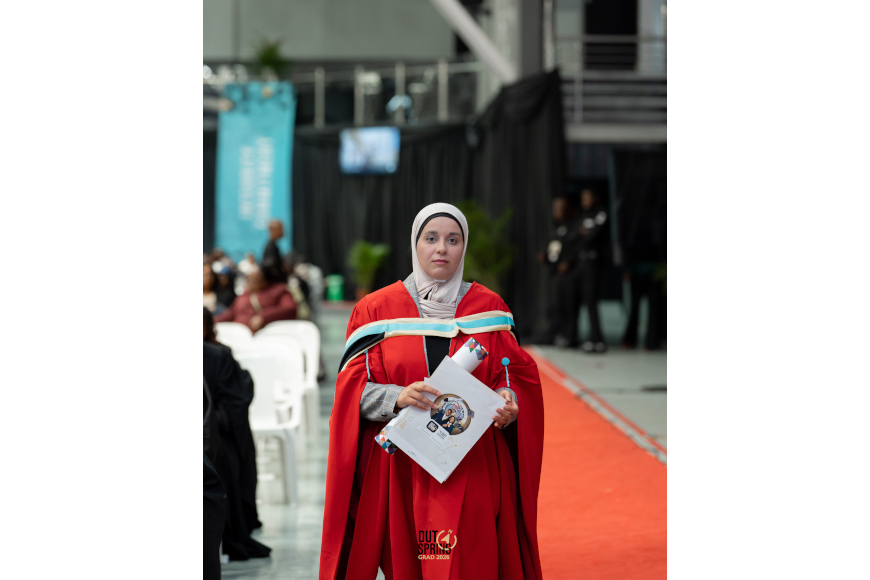
“I am so happy. I have been looking forward to my graduation since 2022. I want to thank my supervisor, he was a great help throughout my PhD studies. I hope everyone will feel the same way too,” said Yousra Ibrahim Othman Hasona.
The elated academic graduated with his Doctor of Philosophy in Management Sciences specialising in Public Administration in Peace Studies.
Her objection to take on the root of peace studies in an academic field was to examine the deep-seated triggers, and the conditions required to build sustainable, and positive peace.
Dr Hasona took up an unique topic for his dissertation which focuses on child soldiers and restorative justice in the Arab world. A case study of Iraq.
“Children used by Islamic State of Iraq and the Levant (ISIL) have experienced a lack of justice by the conventional criminal justice system which is hostile to their well-being. This research investigates the potential of restorative justice, especially Sulh—a local conflict resolution mechanism utilised in the Arab and Iraqi cultural context. Such conflicts are of both civil and criminal in nature,” she shared.
Dr Hasona explained that the Sulh indigenous alternative of dispute resolution serves as non-adjudicative model of accountability for former child soldiers in the context of Iraq and reveals the extent to which restorative justice and Sulh can be utilised as alternative models of accountability in contrast with retributive justice,” she said.
The findings from Dr Hasona’s thesis unravelled the multifaceted challenges confronting justice for former soldiers in the Iraqi community, especially in the post-ISIL environment, and revealed the impactful outcomes of restorative justice and Sulh to overcome the limitations of retributive approaches used in Iraqi antiterrorism and criminal laws against child soldiers.
“The conundrum of child soldiers’ accountability was addressed and that paved the way for their justice, rehabilitation and social reintegration, while emphasising the need for a comprehensive strategy for the former child soldiers’ wellbeing,” she said.
For Dr Hasona, such research she hopes will look at balancing accountability for war crimes with the recognition that child soldiers are themselves victims of manipulation, coercion, and trauma.
Pictured: Dr Yousra Ibrahim Othman Hasona
Photography: Sifundo Thwala
Sompisi Ntuli


