
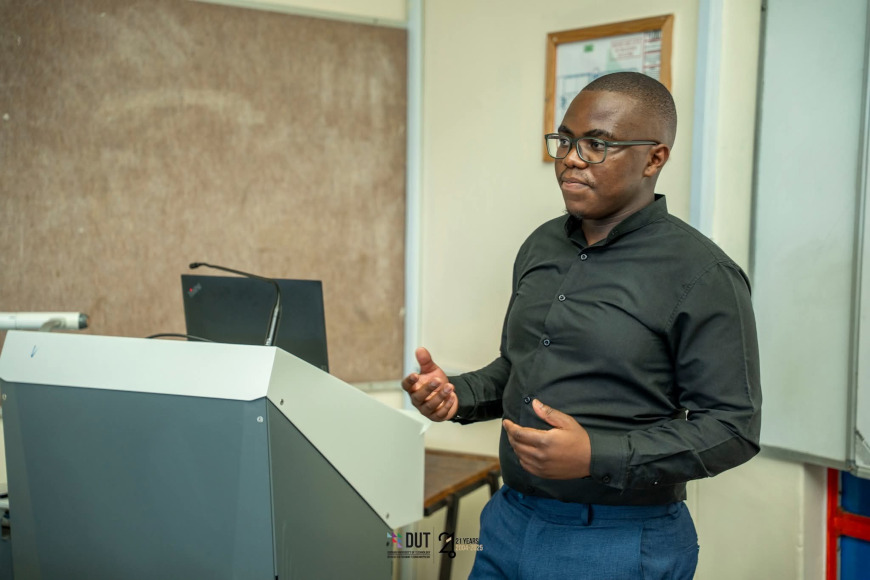
Agricultural waste is often something to be thrown away. For Durban University of Technology (DUT) innovator Thokozani Buthelezi, it became the starting point for a business.
Buthelezi is the founder of Myco Feeds, an enterprise that uses agricultural waste as a growing material for oyster mushrooms.
His work is one of the stories behind DUT’s recognition among the world’s Top 60 universities for Sustainable Development Goal 1: No Poverty in the 2026 Times Higher Education Impact Rankings.
The ranking recognises universities for their contribution to addressing poverty through areas such as education, research, innovation, community engagement and institutional practices. For DUT, it also provides an opportunity to highlight the people and initiatives working to create opportunities beyond the University.
Buthelezi’s journey with Myco Feeds began in 2023 while he was working with Enactus DUT. Through Design Thinking, he started exploring the connection between food insecurity and agricultural waste, and how waste could be put to productive use.
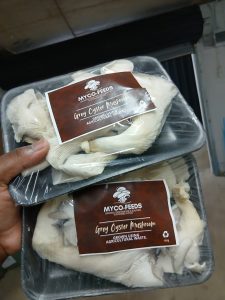
Oyster mushrooms produced by Myco Feeds using agricultural waste as a growing material.
This led to the idea for Myco Feeds, which uses agricultural waste to grow oyster mushrooms.
Building the business has not always been easy.
After securing funding and establishing a production facility, a natural catastrophe destroyed the business’s greenhouses in 2024. Buthelezi had to start again, rebuilding production from a rented parking base before eventually moving into a larger facility.
The experience changed the way he looked at entrepreneurship.
“An idea is not a business. Only when you act on it does it become one.”
For Buthelezi, acting on the idea meant testing it, learning along the way and finding ways to keep the business going when things did not go according to plan.
His journey also reflects DUT’s growing focus on entrepreneurship and innovation. Through the Technology Transfer and Innovation unit, innobiz DUT Centre for Entrepreneurship and Innovation and the Centre for Social Entrepreneurship Rapid Incubator, the University provides support for students, researchers and entrepreneurs developing ideas and taking them further.
In the case of Myco Feeds, agricultural waste becomes part of the production process rather than simply being discarded. The mushrooms then become a product that can be sold, creating an opportunity to build a business around an otherwise unused resource.
DUT is also playing a wider role in advancing entrepreneurship in the higher education sector.
Earlier this year, Universities South Africa appointed DUT to lead the development of a national entrepreneurship policy framework for the country’s 26 public universities. The initiative places entrepreneurship within the broader role of universities in preparing graduates for the economy.
DUT’s Deputy Vice-Chancellor: Research, Innovation and Engagement, Professor Fulufhelo Nemavhola, has described the University’s approach as “impactivity”.
Myco Feeds is one example of that approach in practice.
The connection to SDG 1 is found in the work itself. An entrepreneur identifying an opportunity, developing a product and building a business from an agricultural waste stream speaks to the wider role that innovation and entrepreneurship can play in creating livelihoods.
DUT’s Top 60 recognition gives international visibility to this work. But behind the ranking are people such as Buthelezi who are taking ideas developed through the University and putting them into practice.
For Buthelezi, the journey continues as he grows Myco Feeds and works to turn an idea into a sustainable enterprise.
Pictured: DUT innovator Thokozani Buthelezi, founder of Myco Feeds.
Tiyani Mboweni


