
ENVISION2030 strategy, the Durban University of Technology (DUT) aspires to produce adaptive graduates who will participate productively in the development of the region, the country, and the world. Through sport, the University continues to nurture discipline, leadership, teamwork, and holistic student development.
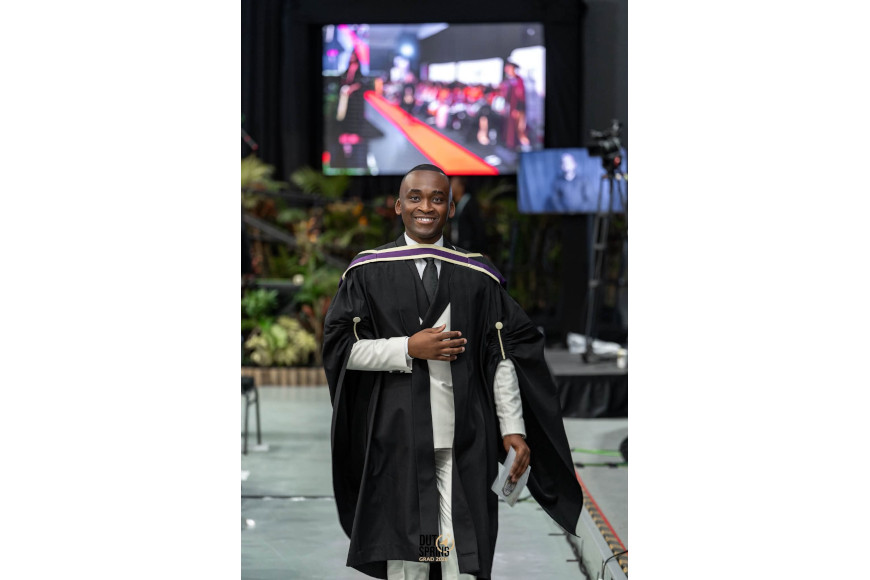
S’bonelo Dlamini, a member of the DUT Communications team, recently engaged with DUT sports medic star Nkosikhona Dube, who graduated with a Master of Health Sciences in Chiropractic at the 2026 DUT Spring Graduation Ceremony, to share his journey in sport, his passion for sports medicine, and how he lives the DUT Living Values through his involvement in varsity sport.
Names: Nkosikhona Lwazi Dube
Place of Birth: Ndwedwe, KwaZulu-Natal
Sport Code: Football
Q: When did you become part of the DUT sports medical team?
A: “I officially became deeply involved with DUT sports during my clinical training at the university while serving as a chiropractic intern at the DUT Chiropractic Clinic in 2025. Since then, I have served as the medic for both the DUT Rugby and DUT Soccer teams, providing pitch-side medical support, acute injury assessments, and comprehensive clinical care during major tournaments.”
Q: What sparked your interest in being a DUT sports medic?
A: “My interest was driven by a deep passion for sports medicine and athlete rehabilitation. Having participated in sports myself, I possess a firsthand understanding of how vital accessible healthcare and specialised injury prevention are for athletes striving to perform at their highest level without chronic pain or career-ending injuries. Furthermore, I focused my Master’s research thesis specifically on soccer injuries.”
Q: In terms of the role you play as a DUT sports medic, kindly elaborate on what it entails and how it benefits the members within your club?
A: “As the team medic, my role encompasses immediate pitch-side emergency management, acute sports injury assessment, clinical rehabilitation, and targeted manual therapies, including chiropractic adjustments, dry needling, and kinesiology taping. This directly benefits student-athletes by keeping them game-ready, accelerating recovery times, reducing re-injury rates, and educating them on optimal biomechanics and physical wellness.”
Q: Besides being a football and rugby medic, what sport codes are you interested in and why?
A: “Beyond rugby and football, I am deeply interested in long-distance running and endurance sports such as mountain biking. This is because of my strong passion for treating multi-stage endurance athletes due to the complex overuse injuries and extreme biomechanical demands placed on the human spine and lower limbs.”
Q: What is the biggest tournament you have participated in?
A: “I served as the medic for the DUT Rugby and Soccer teams during the national University Sports South Africa (USSA) tournaments and Varsity Football competitions in both 2025 and 2026.”
Q: Why is it vital for DUT to develop students in sport?
A: “Sport is a powerful vehicle for holistic development. It instils resilience, discipline, time management, and team dynamics that extend far beyond the playing field. Developing student-athletes ensures that DUT produces well-rounded, adaptive graduates who can excel both academically and socially.”
Q: Who is your role model and why?
A: “Having lived a rich and fulfilling life, it is difficult to select a single role model. Personally, my mother inspired me to pursue my dreams through the immense sacrifices she made for me. Professionally, I am deeply grateful to Nondyebo ‘Tumie’ Mgudu, who provided me with the opportunity to work with the DUT Rugby and Soccer teams and has since become a valued mentor in my life.”
Q: Which ENVISION2030 Living Values and principles do you associate with and why?
A: “I strongly align with Integrity, Respect, and Compassion. In healthcare and sports management, upholding integrity ensures evidence-based, ethical patient care. Respect and compassion allow me to deliver culturally inclusive, empathetic care to athletes from all backgrounds, ensuring they feel understood and valued both as competitors and as human beings.”
Q: Do you see a future as a sports medic?
A: “Yes, I do see a future as a sports medic, since I am very passionate about sport and chiropractic as my profession.”
Q: What impact has sport made on your life?
A: “I have had the opportunity to travel and experience new things, which have played an important role in developing my personal character, broadening my perspective, and supporting my growth both professionally and personally. I am increasingly interested in understanding how different sporting activities affect the human body and mind, which motivates me to explore and research the psychological and physical changes associated with different sports. Through continuous learning, travel and exposure to different sporting environments, I have grown as a sports medic while contributing meaningfully to the development and well-being of athletes.”
Q: Having recently graduated at the 2026 DUT Spring Graduation Ceremony, how does it feel to achieve this milestone while also reflecting on your journey through sport and your development within DUT?
A: “Graduating with my Master’s degree is a deeply fulfilling and emotional milestone. Reflecting on my journey from Ndwedwe through the DUT Chiropractic Clinic to serving on the sidelines for DUT’s sports teams fills me with gratitude. It proves that with dedication, mentorship, and a commitment to serving others, you can bridge any gap.”
Q: Can you suggest some ideas to attract spectators to varsity sport?
A: “1. Interactive Fan Zones & Health Booths: I think we can make match days more exciting by having fan zones and health booths where spectators can get quick posture checks, learn more about physical wellness, or take part in fun fitness challenges. It would give people another reason to come to the games and make them feel more involved. 2. Student-Athlete Storytelling:We can also use social media to tell more stories about our student-athletes. People want to know what happens behind the scenes, how athletes prepare for games and how they recover after competitions. Sharing these stories can help fans connect with the athletes and the teams on a more personal level.”


