
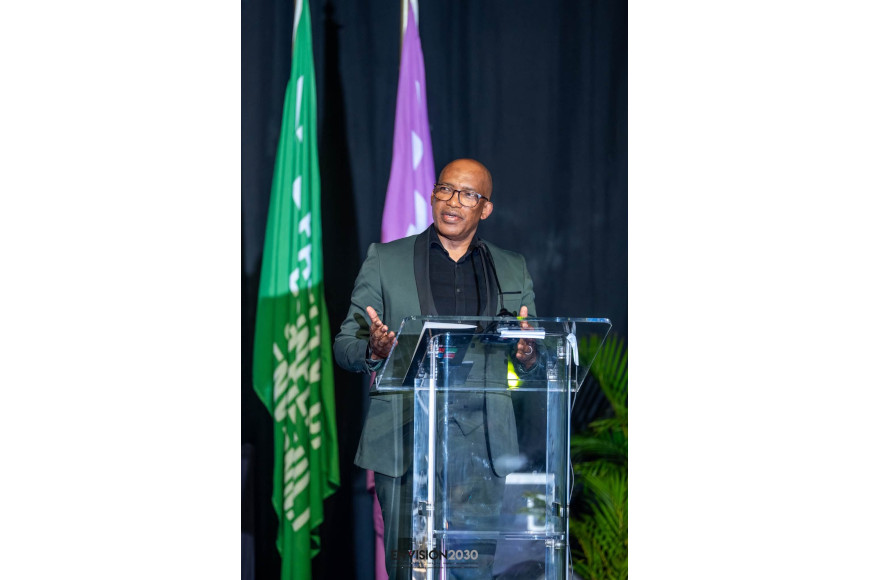
The Durban University of Technology (DUT) has strengthened its research and innovation agenda with the launch of 18 Research Institutes, the recognition of 11 South African Research Chairs Initiative (SARChI) Chairs and further gains in global sustainability rankings.
The developments were highlighted at an event held at the Durban International Convention Centre (ICC) on Wednesday, 30 September 2026, which brought together DUT researchers, academics, industry partners, government representatives, students and other stakeholders.
The event provided an opportunity for the University to reflect on its progress in research and innovation, while setting its sights on the next phase of its ENVISION2030 strategy.
Welcoming guests, Professor Vusi Gumede, Deputy Vice-Chancellor: Teaching and Learning at DUT, said the occasion was about more than celebrating achievements.
“This milestone is the result of commitment, hard work, foresight and a shared belief in ENVISION2030. Undoubtedly, we are entering the transformed phase (2027–2030) as we conclude the upended phase. Progress does not happen overnight. Shared responsibility and shared accountability, the critical aspects of the DUT personality, have helped ensure that our institutional character allows us to do things the DUT Way,” said Prof Gumede.
He acknowledged the contribution of DUT Vice-Chancellor and Principal, Professor Thandwa Mthembu, the University Council and the leadership team in advancing the institution’s work.
Prof Gumede also announced DUT’s improved position in the Times Higher Education World University Rankings 2027, released on Wednesday. The University moved from 13th to ninth nationally and climbed more than 200 places globally, placing it in the 1201–1400 band.

Professor Fulufhelo Nemavhola, Deputy Vice-Chancellor: Research, Innovation and Engagement at DUT.
For Professor Fulufhelo Nemavhola, Deputy Vice-Chancellor: Research, Innovation and Engagement, the growth in research at DUT presents an opportunity to do more.
Delivering his address, “The Architecture of Becoming Through Epistemic Imagination and the Craft of Tomorrow,” Prof Nemavhola called on academics and researchers to consider how the University’s expanding research capacity can be translated into solutions that make a difference in society.
DUT’s research output has grown significantly over the past decade. Research outputs increased from 209 units in 2016 to 975 in 2025, while research publications increased from 467 in 2016 to 1 139 in 2024. The number of NRF-rated researchers also increased from 26 to 72 between 2016 and 2025.
Prof Nemavhola credited DUT researchers and postgraduate students for contributing to this growth and encouraged them to continue pursuing research that responds to real challenges.
One example is the development of an amadumbe-based juice with potential applications in diabetes management, highlighting how research can move beyond academic outputs and towards practical innovation.
He said he looked forward to seeing the newly established Research Institutes develop strong research programmes and produce tangible results by 2030.
DUT’s growing international profile was also evident in its performance in the 2026 Times Higher Education Sustainability Impact Rankings.
Presenting the University’s results, Dr Pinkie Ntola, Interim Director of Technology Transfer and Innovation at DUT, noted that DUT had moved into the 401–600 global band, from the 1001–1500+ band in 2025.
The University also placed 60th globally for Sustainable Development Goal (SDG) 1: No Poverty.
The event further recognised the contribution of DUT’s researchers through the introduction of 11 newly recognised SARChI Chairs.
Dr Nomcebo Mthombeni, Interim Director of Research and Postgraduate Support at DUT, introduced the Chairs, who were subsequently honoured by Prof Mthembu and Prof Nemavhola.
The SARChI Chairs represent DUT among South Africa’s 26 universities and contribute to strengthening the University’s research profile in their respective fields.

Dr Msizi Myeza, Chief Executive Officer of the Council for the Built Environment (CBE).
Delivering the keynote address, Dr Msizi Myeza, Chief Executive Officer of the Council for the Built Environment (CBE) and a DUT alumnus, turned the focus to the broader development challenges facing South Africa.
Speaking under the theme “Roadmap Towards a Better Life,” Dr Myeza reflected on the National Development Plan (NDP) 2030 and the need to address poverty, inequality and unemployment.
“The NDP remains a vital national framework through which we can continue to confront the intractable and interconnected challenges of poverty, inequality and unemployment. At the same time, our cities, towns and peri-urban villages are urbanising rapidly, placing increasing pressure on infrastructure, housing, public services, transport systems, environmental resources and local economies,” he said.
Dr Myeza said institutions such as research centres and centres of excellence have an important role to play in providing the evidence needed to inform decisions and respond to complex developmental challenges.
“In an environment characterised by uncertainty, complexity and competing priorities, reliable evidence must guide our choices. We must engage with our future from an intelligence standpoint. We must draw on credible data, rigorous analysis, professional expertise and practical experience. Evidence-based decision-making is not simply a technical requirement; it is a responsibility,” he said.
A major moment of the programme was the launch of DUT’s 18 Research Institutes by Prof Mthembu.
The Institutes bring together researchers from different areas of the University to work on research that responds to regional, national and global challenges. They are expected to strengthen collaboration, build research capacity and support the development of solutions with practical and societal value.
The programme was directed by Mr Alan Khan, Senior Director of Corporate Affairs, and Dr Ntola.
The three toastmasters were Mr Siboniso Shabalala, Chief Financial Officer; Prof Ndumiso Ngidi, Advisor and Executive for Institutional Review in the Office of the Vice-Chancellor and Principal; and Dr Matheakuena Mohale, Interim Deputy Vice-Chancellor: People and Operations.
Closing the programme, DUT Registrar Dr Maditsane Nkonoane thanked the speakers, researchers, guests and the broader DUT community for their contribution to the event.
“This is indeed a milestone moment for DUT. We did not just launch Research Institutes; we launched a new chapter in our ENVISION2030 strategy. A chapter that declares that DUT is not just a university of technology, but a university that produces knowledge, that impacts society, and that creates solutions for our city, our province, and our continent,” said Dr Nkonoane.
The launch marks another step in DUT’s efforts to strengthen its research ecosystem and position research, innovation and knowledge production at the centre of its institutional development.
Pictured: DUT Vice-Chancellor and Principal, Professor Thandwa Mthembu launching the new 18 Research Institutes.
Photographer: S’bonelo Dlamini
Simangele Zuma


