
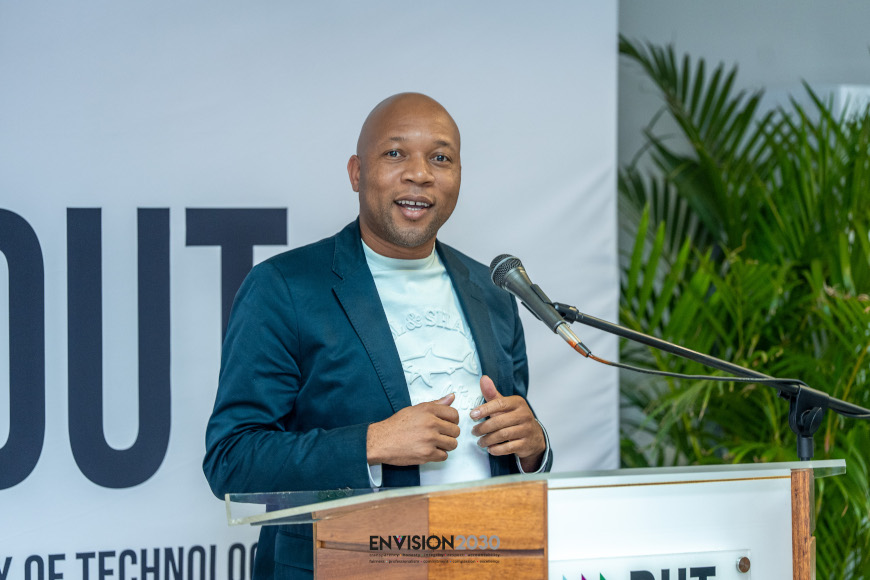
The Durban University of Technology (DUT) Library hosted the launch of two volumes of the book, Three Decades of South African Democracy, commemorating 30 years of South African democracy. The publication features contributions from distinguished authors, including DUT Acting DVC: People and Operations, Dr David Mohale.
Volume 1 explores Political Leadership and Local Government, while Volume 2 focuses on Public Sector Development and Economic Freedom.
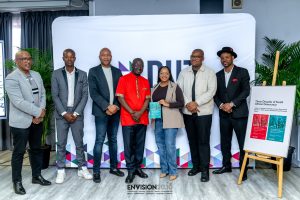
Distinguished guests at the Book Launch.
Other contributors present at the launch included Prof Busani Ngcaweni, Director of the Centre for Public Policy and African Studies at the University of Johannesburg; Dr Ayabulela Dlakavu, Senior Lecturer at the Wits School of Governance; Ms Sinelisiwe Thwala, Deputy Director of Research at the National School of Government; and Mr Godfrey Mashamba, Deputy Director-General: Evidence and Knowledge Systems at the Department of Planning, Monitoring and Evaluation (DPME).
Dr Malefetjane Phaladi, Director of Library Services, congratulated the editors, authors and contributors on the successful publication of the two volumes. He also commended Dr Mohale for his contribution to knowledge creation and scholarly advancement through his involvement in the publication over the past five years.
Reflecting on the role of the Library in fostering research and innovation, Dr Phaladi noted that the DUT Library has published more than 60 research outputs in internationally peer-reviewed publications. He said these achievements are a testament to the Library’s commitment to knowledge production and dissemination, while reinforcing the role of librarians as facilitators of access to information, research and learning.
Programme Director and co-editor, Prof Busani Ngcaweni, welcomed attendees and reflected on the importance of ethics. He also provided an introduction to the book and shared insights into the journey that led to its publication.
Against the backdrop of the current challenges facing governments and state institutions in South Africa and globally, Prof Ngcaweni explained that the book seeks to address these pressing issues through critical and scholarly engagement.
“Books like these are significant in the sense that they help us decode and become more scientific in engaging with phenomena in society,” said Prof Ngcaweni.
Dr Dlakavu, co-editor of the book, provided an overview of Volume 1, which focuses on public administration and governance since 1994. He examined the differences between administrative systems in Asia and South Africa, highlighting how varying political and institutional contexts shape governance approaches.
Drawing on international examples, including Bolivia, Dr Dlakavu argued that the country shares similarities with South Africa due to its history of racialised indigenous populations. He further noted that, despite significant democratic gains, the government has not yet fully addressed societal inequalities, which continue to contribute to high levels of poverty and unemployment.
Ms Sinelisiwe Thwala, co-editor of the book, provided an overview of Volume 2, offering a sequential analysis of South Africa’s democratic journey over the past three decades. She reflected on both the successes and challenges that have characterised governance since 1994, highlighting the progress made in building democratic institutions while acknowledging the persistent social and economic realities affecting many South Africans.
Ms Thwala emphasised that democracy requires more than periodic elections, as it also depends on ethical leadership, capable administration, effective governance and active citizen participation. She noted that while elections are a cornerstone of democracy, they alone are not sufficient to address the complex challenges facing society.
Mr Godfrey Mashamba, a contributor to Chapter 4 of Volume 2, presented on the theme of the 30-Year Review. He took the audience through South Africa’s democratic history, reflecting on key developments over the past three decades.
Drawing from the chapter, Mr Mashamba examined changes in the geopolitical landscape and their impact on the nation’s development trajectory. He highlighted how shifting national priorities, policies and global dynamics have shaped South Africa’s progress since 1994, while encouraging critical reflection on both the achievements and challenges of the democratic era.
Dr Mohale examined the geographic factors driving migration from rural areas to urban centres. He noted that many people relocate to cities in search of better employment opportunities, while acknowledging that these perceived opportunities are not always available.
He posed a thought-provoking question to the audience: “What happens to rural areas when people leave in search of opportunities elsewhere?” The question encouraged reflection on the social and economic impact of migration on rural communities.
The event concluded with an engaging question-and-answer session, during which common challenges were discussed. The session provided the audience with an opportunity to interact directly with the contributors, seek clarification on key issues and share their perspectives on the topics explored in both volumes.
Pictured: DUT Acting Deputy Vice-Chancellor: People and Operations, Dr David Mohale speaking at the Book Launch.
Photographer: S’bonelo Dlamini
Luyanda Mlaba/Nikiwe Sukazi


