
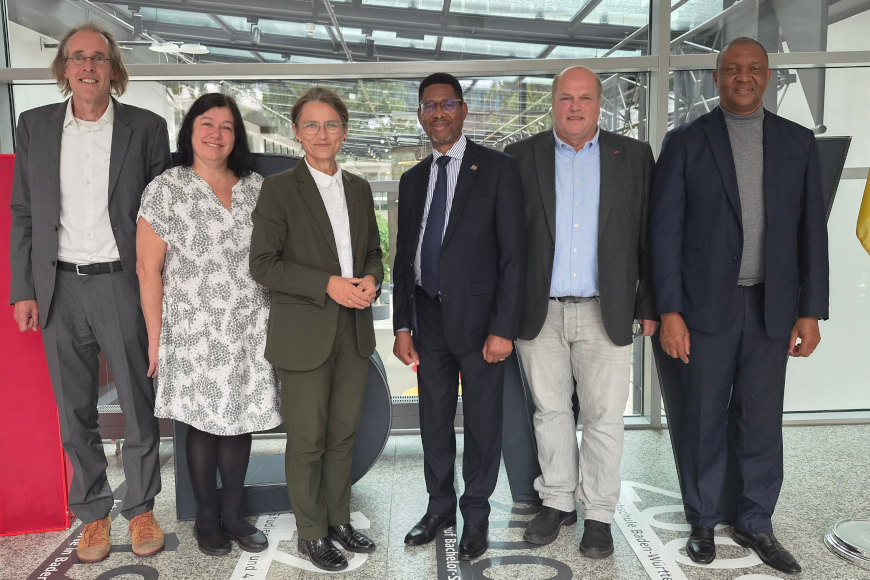
The Durban University of Technology (DUT) has welcomed the positive outcomes of a recent visit to Germany by Reverend Musa Zondi, KwaZulu-Natal’s MEC for Economic Development, Tourism and Environmental Affairs. During his visit to Baden-Württemberg Cooperative State University (DHBW) Ravensburg, Reverend Zondi expressed strong support for the longstanding academic and research partnership between DUT and DHBW.
The visit provided an opportunity to highlight the achievements of a relationship that has developed over 20 years, bringing together academics, researchers and students from South Africa and Germany through collaborative research, international exchanges, entrepreneurship and innovation.
During his engagement with DHBW representatives, Reverend Zondi showed particular interest in the joint research undertaken with DUT in sustainability, recycling and food waste, as well as collaborative initiatives involving DUT’s innobiz Centre for Entrepreneurship and Innovation and the DUT Business School.
The relationship between DUT and DHBW Ravensburg has grown considerably over the years, with Professor Thomas Dobbelstein playing an important role in developing and maintaining the partnership.
Professor Dobbelstein, who is a distinguished academic at DHBW Ravensburg, has maintained close ties with DUT for more than two decades, contributing to academic exchanges, collaborative research and initiatives that connect universities with industry and business. His contribution was formally recognised in 2012 when he received an honorary research professorship at DUT.
In 2020, he was appointed to the founding board of the DUT Business School, bringing his international academic and business experience to the development of the Business School. More recently, Professor Dobbelstein was appointed to the board of DUT’s innobiz Centre for Entrepreneurship and Innovation, further strengthening his involvement in the University’s entrepreneurship and innovation activities. These appointments reflect his longstanding commitment to DUT and the important role he continues to play in strengthening the relationship between DUT and DHBW Ravensburg.
One of the significant achievements of the partnership has been the international recognition of collaborative sustainability research. In July 2026, Professor Dobbelstein’s sustainability research received third place at the DHBW Sustainability Research Award.
The recognised work included research on recycling, recycled products and food waste, drawing on activities undertaken in Germany and South Africa. The research is particularly relevant to South Africa, where waste management, recycling and environmental sustainability remain important challenges for communities, municipalities and businesses. By examining consumer attitudes and behaviour, the research contributes to a better understanding of the factors that influence recycling practices and how more sustainable behaviour can be encouraged.
Among the DUT academics who have collaborated with Professor Dobbelstein is Professor Veena Rawjee, Professor Roger Mason, Dr Caren Corbisley and Dr Yachal Du Plessis, amongst others. The recognition received in Germany is another encouraging achievement for the partnership, demonstrating how academics from different countries can work together to address challenges that affect communities in both South Africa and Europe.
The DUT and DHBW partnership has also created valuable opportunities for students to gain international academic and cultural experience. In 2019, six students from Durban undertook studies at DHBW Ravensburg, supported through the Wholesale and Retail SETA Leadership Chair. The partnership is now preparing for another important engagement, with a planned visit of 26 Master’s students from DHBW to DUT. To date, more than 300 students and 35 academics have benefitted from the exchange programme during the course of the partnership.
Reverend Zondi expressed his support for the visit by the 26 Master’s students, during his engagement with DHBW executives. The visit will provide an opportunity for the German students to engage with DUT academics and students, learn more about KZN and South Africa’s business and social environment and gain exposure to the University’s research and innovation activities. It will also allow DUT to further strengthen its academic relationship with DHBW and explore new opportunities for postgraduate engagement and collaborative research.
Another important outcome of Reverend Zondi’s visit was the discussion around a possible joint event to present and discuss the findings of collaborative sustainability research conducted by DUT and DHBW. The proposed event could bring together academics, researchers, government representatives and industry partners to consider the findings and their possible application in addressing environmental and sustainability challenges.
The MEC’s interest is particularly encouraging because it creates an opportunity to connect the work undertaken by the two universities with the development priorities of KwaZulu-Natal. Greater engagement between universities, government and industry could also help translate research findings into practical solutions that benefit communities and businesses.
For DUT, this represents an opportunity to build on a partnership that has already demonstrated its value through research achievements, student exchanges and institutional cooperation.
Reflecting on the visit, Professor Dobbelstein expressed his appreciation for the interest shown by Reverend Zondi and the support received from colleagues and partners at DUT over the years. He was particularly encouraged by the MEC’s interest in DHBW’s dual study system and the joint research activities focusing on sustainability, recycling and food waste.
Professor Dobbelstein also welcomed the MEC’s support for the planned visit of the 26 Master’s students and the possibility of hosting a joint event to share the findings of collaborative sustainability research. He acknowledged the important contribution of DUT colleagues who have supported the partnership and helped develop the relationship over the years.
For Professor Dobbelstein, the visit was an opportunity to demonstrate what has been achieved through sustained cooperation and the potential for the partnership to grow further.
The DUT and DHBW Ravensburg partnership demonstrates the value of international academic relationships that extend beyond traditional student and staff exchanges. Over the years, the collaboration has developed to include research, postgraduate engagement, entrepreneurship, business education and innovation, which is aligned with the DUT ENVISION2030 strategy.
Reverend Zondi’s visit has added another important dimension to this relationship, with the prospect of closer engagement between the two universities and the KwaZulu-Natal provincial government. As DUT continues to advance its ENVISION2030 strategy, international partnerships such as the one with DHBW Ravensburg remain important to the University’s commitment to research excellence, innovation, student development and societal impact.
Pictured left to right: Prof. Dr. Thomas Dobbelstein, DHBW Ravensburg and Honorary Professor at DUT; Ms. Donnée Kruger, General Manager, International Relations & Destination Marketing, Trade & Investment KwaZulu-Natal; Prof. Dr. Martina Klärle, President DHBW; Rev. Musa Zondi, KZN MEC Economic Development, Tourism and Environmental Affairs; Mr. Thomas Schieber, Director, International Relations DHBW Ravensburg and Mr. Sihle Ngcamu, CEO, Trade & Investment KwaZulu-Natal.
Photo credit: Supplied by DHBW Ravensburg.
Alan Khan


