
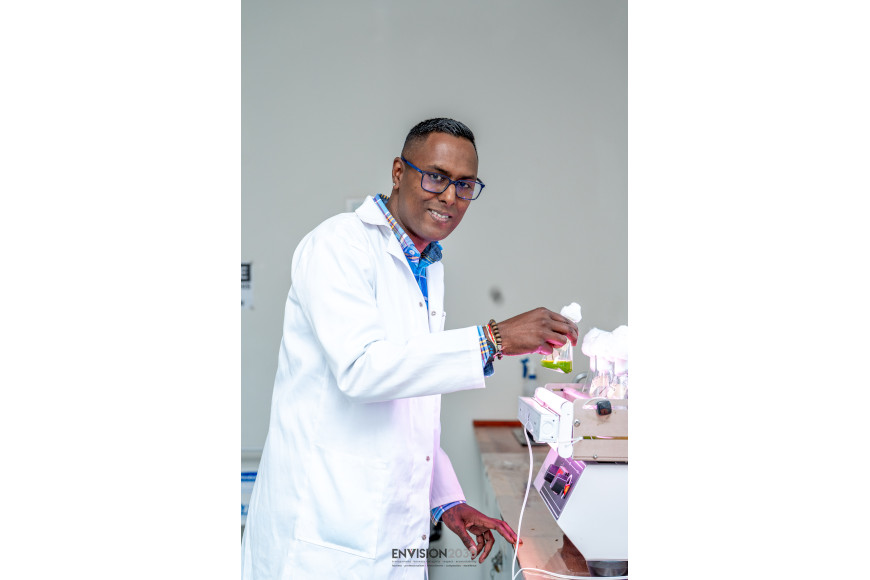
The Durban University of Technology (DUT) is celebrating the recent achievement of Dr Luveshan Ramanna, a Research Fellow and Biotechnologist at the Institute for Water and Wastewater Technology (IWWT), who has received a Y2 rating from the National Research Foundation (NRF).
His achievement comes as DUT continues to strengthen its research profile, having received the NRF Focused Research Advancement Award for three consecutive years, from 2024 to 2026.
The Y2 rating recognises Dr Ramanna’s research profile and potential to establish himself in his field. His work focuses on environmental biotechnology, exploring scientific approaches to wastewater treatment, resource recovery and environmental sustainability.
Dr Luveshan Ramanna, a Research Fellow and Biotechnologist at IWWT.
At IWWT, Dr Ramanna investigates the use of microalgae and macroalgae in wastewater treatment, carbon capture and the development of value-added bioproducts. He also researches microbial contamination in recreational waters and the associated public health risks.
Reflecting on his NRF rating, Dr Ramanna described it as an important milestone in his research journey. He highlighted his research publications, conference presentations and applied projects as contributors to his development as a researcher.
“My next goal is to strengthen my research portfolio through high-quality publications, collaborative projects and continued contributions to the field, with the longer-term aim of progressing to a higher NRF rating,” he said.
An important aspect of his research is investigating how wastewater can serve as a nutrient source for microalgae. This approach explores opportunities to combine wastewater management with biomass production, potentially supporting resource recovery and more efficient use of available resources.
He also examines ways to improve microalgal cultivation, including the use of fluorescent materials to modify light conditions and potentially enhance photosynthesis. These investigations could inform the development of cultivation systems for environmental and biotechnological applications.
His research further explores the potential uses of beach-cast seaweed and seagrasses in biofertilisers, pigment recovery and bioenergy. By assessing the properties and possible applications of these coastal materials, his work contributes to investigations into alternative resources and more sustainable production methods.
Water quality and public health form another important part of his research. Through microbial monitoring, source tracking and quantitative microbial risk assessment, Dr Ramanna investigates contamination patterns and evaluates potential risks to recreational water users. This work can contribute to a better understanding of water-quality challenges and inform efforts to protect public health.
“My motivation stems from the need to develop scientifically sound solutions to environmental problems that directly affect communities. These research areas offer opportunities to connect fundamental science with practical applications in pollution management, resource efficiency and sustainable development,” he explained.
Beyond the laboratory, Dr Ramanna participates in community engagement initiatives involving tap-water and beach-water testing. He also visits schools to educate learners about water conservation, water quality and wastewater treatment, helping build awareness of environmental issues and their implications for communities.
His contribution extends to teaching and developing future researchers. At DUT, he teaches undergraduate Water Microbiology, supervises Honours and Master’s students, and supports research capacity development through laboratory training and workshops.
His research has been published in international peer-reviewed journals, including Chemical Engineering Journal, Journal of Environmental Management, Journal of Cleaner Production and Renewable and Sustainable Energy Reviews.
Looking ahead, Dr Ramanna aims to advance research into scalable microalgal cultivation systems, sustainable seaweed utilisation and improved water-quality monitoring. He also plans to strengthen collaborations with municipalities, water utilities, industry and other research institutions to support the practical application of research findings.
Dr Ramanna’s achievement highlights the researchers contributing to DUT’s growing research profile. His work connects environmental biotechnology with challenges in wastewater management, resource recovery and water quality, while supporting the University’s research, teaching and community engagement activities.
As DUT builds on three consecutive years of NRF Focused Research Advancement Award recognition, researchers such as Dr Ramanna represent the expertise and research potential shaping the University’s continued development.
Pictured: Dr Luveshan Ramanna, a newly Y2-rated NRF researcher at DUT.
Photographer: Sifundo Thwala
Simangele Zuma


