
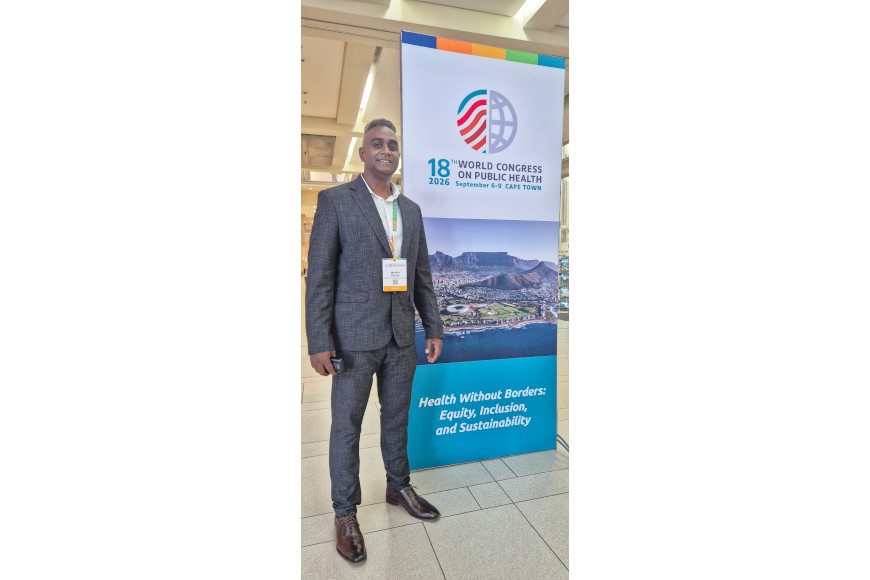
Durban University of Technology (DUT) lecturer and doctoral researcher Melvin Chetty has taken research into the mental health of South African paramedic students to the international stage, presenting his findings at the 18th World Congress on Public Health in Cape Town.
The Congress, held in Africa for the first time, brought together researchers, healthcare professionals, policymakers and public health advocates from around the world. For Chetty, presenting his doctoral research was an opportunity to highlight the psychological challenges faced by students preparing for careers in emergency medical care.
“Knowing that the Congress was being hosted in Southern Africa for the first time made the opportunity even more meaningful. Standing before delegates from around the world and sharing research conducted in South Africa was something I felt incredibly proud to be part of,” he said.
Chetty, a lecturer in DUT’s Department of Emergency Medical Care and Rescue, said the opportunity to bring the experiences of paramedic students into international public health discussions was particularly significant.
“Having the opportunity to bring their experiences to an international audience was, for me, the most rewarding aspect of the Congress,” he said.
His research focuses on mental distress among Bachelor of Emergency Medical Care (BEMC) students in South Africa, a group whose psychological wellbeing has received limited attention in the country’s research landscape.
Chetty submitted an abstract based on his doctoral research, which was accepted for an oral presentation at the Congress. The abstract was also published in the Congress supplement of Population Medicine, extending the reach of the research beyond the presentation itself.
The 18th World Congress on Public Health was organised by the World Federation of Public Health Associations in collaboration with the Public Health Association of South Africa. Held under the theme “Health Without Borders: Equity, Inclusion, and Sustainability”, the Congress explored a broad range of public health issues through plenary sessions, symposia, workshops, oral presentations and poster sessions.
For Chetty, the Congress provided an important platform to draw attention to the experiences of South African paramedic students and the circumstances in which they undertake their clinical training.
South Africa faces a substantial burden of injury and trauma, including road traffic accidents and interpersonal violence, alongside ongoing challenges associated with HIV and tuberculosis. During clinical placements, emergency medical care students encounter critically ill and injured patients, death and dying, and other potentially traumatic events while still developing the clinical skills and coping mechanisms required for professional practice.
Chetty said the research highlighted the extent to which these experiences form part of students’ training.
Many participants reported exposure to potentially traumatic events, including transportation accidents, life-threatening illness, physical assault and sudden violent death. He noted that, despite these experiences, there is limited South African evidence on the mental health of paramedic students, making locally grounded research important for understanding their needs and informing appropriate support.
The study found high levels of mental distress across several domains, pointing to significant psychological challenges among students during their training. It also identified associations between different aspects of mental distress.
“Higher levels of stress were associated with higher levels of burnout, while depressive symptoms were closely linked to post-traumatic stress symptoms. These findings suggest that different aspects of mental distress often occur together rather than in isolation,” he said.
The findings highlight the importance of considering student wellbeing as part of preparing the future emergency care workforce. While further research is needed to determine the most appropriate interventions, understanding the mental health challenges students experience can help inform support within training environments.
Chetty said the research aligned with the Congress theme of equity and inclusion because paramedic students are an essential but often overlooked part of the future health workforce.
“Their experiences matter, not only because of their own health and success as students, but because they will soon be responsible for caring for others,” he explained.
He emphasised that the research was a collective achievement, made possible through collaboration with his supervisors and co-authors, Professor Rosaley Prakaschandra, Professor Julian David Pillay and Professor Soraya Seedat. He also acknowledged the Department of Emergency Medical Care and Rescue at DUT and the paramedic students from across South Africa who participated in the study.
“Presenting the findings felt less like sharing my own work and more like representing the voices and experiences of the students who took part in the study,” he said.
Beyond his research, Chetty is committed to advancing emergency medical care in South Africa, particularly by improving access to quality healthcare for poor and vulnerable communities. He is also passionate about mentoring future emergency care practitioners and making complex concepts easier for students to understand.
For Chetty, supporting the wellbeing of students is an important part of preparing them for the demands of professional practice.
“Today’s distressed student may become tomorrow’s overwhelmed clinician, and the people we train to save lives should not have to struggle in silence while doing so,” he said.
Through his doctoral research and international presentation, Chetty is bringing attention to an important aspect of emergency medical education: the wellbeing of those preparing to care for others. His work contributes to the growing conversation about student mental health and the need to understand the challenges faced by South Africa’s future emergency care practitioners.
Pictured: DUT lecturer and doctoral researcher Melvin Chetty at the 18th World Congress on Public Health in Cape Town.
Photo: Supplied.
Waheeda Peters


