–The Durban University of Technology (DUT) marked a decade of research collaboration and technological innovation when it hosted the 10th IEEE International Conference on Information Communications Technology and Society (ICTAS 2026) from 14 to 16 October 2026.
Held at the Radisson Blu Hotel in Umhlanga, the conference brought together delegates from 34 countries across Africa, Asia, North America, Europe and Oceania. Researchers, academics, industry leaders, policymakers and students gathered to share knowledge, present new research and explore technology-driven solutions to societal challenges.
Representing the Acting Executive Dean of the Faculty of Engineering and the Built Environment, Professor Mohohlo Tsoeu welcomed delegates and highlighted the importance of research-driven innovation in shaping the future. He encouraged participants to use the conference to exchange knowledge, build partnerships and develop solutions that can make a meaningful difference in society.
Conference Chairperson Dr Akeem Alimi reflected on ICTAS’s growth over the past decade and its role in connecting researchers, innovators and industry leaders internationally.
“Over the years, ICTAS has evolved beyond being a conference. It has become a platform that drives innovation, cultivates collaboration and creates opportunities for researchers to develop solutions that respond to real-world challenges,” he said.
ICTAS 2026 received 398 paper submissions from universities, industries and research institutions worldwide. Following a peer-review process and quality assessment in accordance with IEEE standards, 80 papers were accepted, representing an acceptance rate of approximately 20%.
The accepted papers covered three tracks: Information and Communication Technology, which accounted for 39 papers; General Engineering, with 32 papers; and Digital Finance, with nine papers. Of the 80 accepted papers, 67 were presented during the conference.
The research explored areas including artificial intelligence, machine learning, cybersecurity, data science, smart systems, digital transformation and sustainable technological development.
The conference also featured keynote presentations by local and international experts from academia and industry. Their presentations examined emerging technologies, digital transformation, innovation ecosystems and the role of research in addressing complex global challenges, prompting discussions on how research can be translated into practical applications.
DUT academics and students contributed to the conference programme, with 16 papers authored or co-authored by University staff and students. DUT students presented 11 papers, highlighting their participation in research and the development of emerging scholars.
One of the notable moments was the presentation by DUT Honours student Violan Pillay, who became the first deaf student to present research at an ICTAS conference.
Pillay’s research explored sign language recognition using machine learning, focusing on how technology could improve accessibility and inclusion. He said presenting at the conference was both a significant personal milestone and an opportunity to advance his research goals.
“It was my first time, and I was extremely nervous to present at such a very important conference. I’m also the first deaf person to present at an ICTAS conference. I conducted this research with the understanding that I want to have sign language recognised in machine learning, and that is my ultimate goal.”
He said the experience also demonstrated the contribution that people with disabilities can make to research and technological innovation.
“This recognition means that I’m able to showcase that a deaf person can do anything. I can develop and I can conduct research by a deaf person for a deaf person,” he explained.
His presentation highlighted the potential of machine learning to support more inclusive technologies and brought an important accessibility perspective to the conference.
The conference attracted delegates from universities and organisations in South Africa and abroad. Participating institutions included DUT, the University of KwaZulu-Natal, the University of Johannesburg, the University of South Africa, the University of the Western Cape, North-West University, the University of Zululand, Tshwane University of Technology, Nelson Mandela University and the University of Fort Hare.
International institutions included the Namibia University of Science and Technology, Sheffield Hallam University, Southern Illinois University, the University of Houston, UC Santa Cruz, De Montfort University and Jouf University, among others.
Industry participation further strengthened engagement between academia and the private sector. Organisations included Pert Industrial, Mbasane Women in IT, Oracle, SAP, KwaZulu-Natal Tourism and Film, EBL Institute of Business and Technology, Bronto, Visual Works and MICTSETA.
Their involvement created opportunities to exchange perspectives on innovation, digital transformation and emerging technologies, while encouraging closer links between research and industry needs.
As part of its tenth-anniversary programme, ICTAS also introduced an initiative to support emerging scholars. South African researcher Sinawo Nomandela from Walter Sisulu University received complimentary conference registration for his accepted paper, reflecting the conference’s commitment to supporting the next generation of researchers.
The conference concluded with a gala dinner and awards ceremony recognising outstanding contributions to research and innovation.
DUT student Asmah Yaseen received the Best Emerging Student Paper Award. Sibasiswa Nkuna from Eduvos was named runner-up, while the Best Overall Paper Award went to Rovhona Mudau and co-authors for their contribution to knowledge creation and innovation.
The awards recognised the quality of research presented and highlighted the contribution of students and researchers to advancing knowledge across different fields.
Beyond the formal programme, ICTAS 2026 provided opportunities for networking, knowledge exchange and discussions on future research collaborations. Delegates engaged with colleagues from other institutions and industry representatives, exploring ways to strengthen partnerships and develop collaborative initiatives.
Celebrating its tenth edition, ICTAS reaffirmed the importance of international collaboration, interdisciplinary research and technological innovation in responding to global challenges. The conference also provided a platform for DUT academics and students to share their work with an international audience.
As ICTAS enters its second decade, it continues to offer researchers, students and industry partners a space to exchange ideas, build collaborations and explore technology-driven solutions that can contribute to social and economic development in South Africa and beyond.
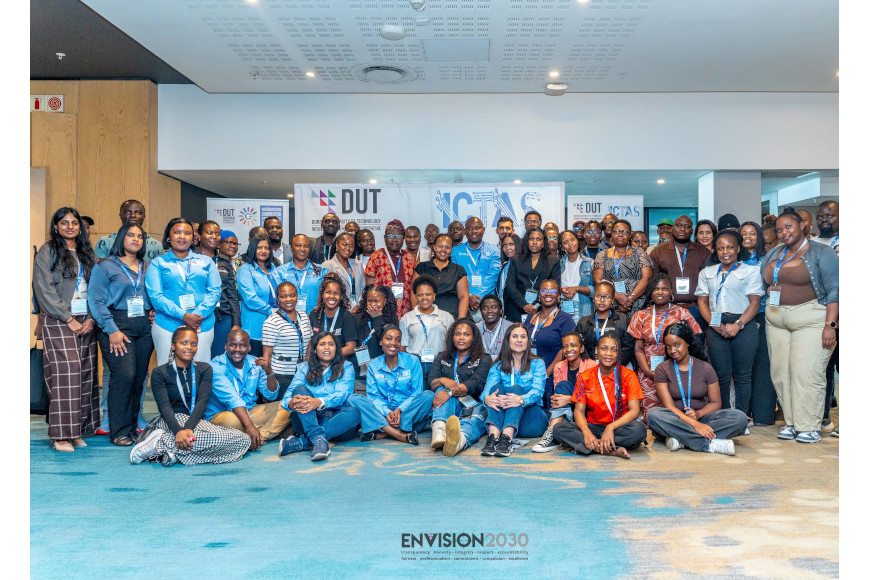
Caption: Delegates, researchers, industry experts and students from 34 countries across five continents attended the 10th IEEE ICTAS 2026 conference hosted by DUT, celebrating a decade of research excellence, innovation and international collaboration.
Photographer: Sifundo Thwala
Sinamile Sithole


