The Durban University of Technology (DUT) hosted a three-day International Fraud and Corruption Risk Conference from 16 – 18 November 2026, at Durban ICC. The theme of the conference was: “Weaving the governance fragility with authoritative gentleness: A hill too steep to climb?”
The first day of the conference, held on 16 November 2026, brought together a distinguished gathering of internal and external stakeholders, industry experts, and prominent guests. The proceedings were facilitated byMr Alan Khan, Senior Director of Corporate Affairs, who warmly welcomed attendees and introduced an esteemed lineup of speakers and facilitators. The programme featured contributions from Professor Thandwa Mthembu, DUT Vice-Chancellor and Principal; Retired Chief Justice Raymond Zondo; Ms Nokuthula Ngonyama, Group Information Officer at PRASA; Professor Sakhela Buhlungu, Former Vice-Chancellor of the University of Fort Hare; Dr Matheakuena Mohale, Acting Deputy Vice-Chancellor: People and Operations at DUT; Professor Puleneg LenkaBula, Vice-Chancellor and Principal of UNISA; Professor Husain Coovadia, Senior Lecturer and Deputy Head of Department in the College of Business and Economics; Professor Suren Pillay, Coordinator of Accounting Programmes at UKZN; Mr Msizi Gwala, Lead: Public Sector and Thought Leadership at SAICA; Mr Siboniso Shabalala, Chief Financial Officer at DUT; Professor Vusi Gumede, Deputy Vice-Chancellor: Teaching and Learning at DUT; and Dr Pali Lehohla, former Statistician-General of the Republic of South Africa.
Their collective expertise and diverse perspectives enriched discussions on governance, accountability, ethical leadership, institutional integrity, and the challenges and opportunities facing both the higher education sector and the broader public sphere.
In his opening remarks, Professor Thandwa Mthembu, DUT Vice Chancellor and Principal, spoke on the importance of institutions moving beyond mere commitments towards fostering a culture of integrity, transparency, and accountability. He stressed that these values should not only be reflected in institutional policies but also embedded in leadership practices, decision-making processes, and everyday operations across the institution.
Among the high-profile speakers was Retired Chief Justice Raymond Zondo, who delivered a thought-provoking address titled “Delivering on the Apex Court’s Higher Purpose – The Realities, Challenges, Milestones and Lessons Learned.” Drawing from his wealth of experience in the judiciary, including his service as Chief Justice of South Africa and Chairperson of the State Capture Commission, Justice Zondo shared valuable insights on the importance of ethical leadership, institutional accountability, and adherence to the rule of law. His address underscored the need for organisations across all sectors to uphold the highest standards of integrity and governance.
On the second day of the conference, discussions shifted from theory to practice, with a strong emphasis on the strategic value of enterprise risk management to organisational success. The day commenced with the first plenary session facilitated by Dr Sikhuthali Nyangintsimbi, the DUT Chief Risk Officer, who challenged delegates to consider how organisations can create meaningful value propositions for strategic impact. Framing the discussion around the realities faced by risk practitioners, Dr Nyangintsimbi encouraged participants to rethink the role of risk management as a catalyst for organisational growth, resilience and sustainable performance. He encouraged practitioners to position their value proposition through the lens of the stakeholders, who are essentially the judges of such value proposition.
The session was enriched by insights from Ms Yvonne Mothibi, Chief Executive Officer of the Institute of Risk Management South Africa (IRMSA), who provided a compelling overview of the evolving risk environment and the need for organisations to respond proactively to emerging challenges. Contributions from respondents, including Ms Valery Modeste-Jacob and Dr Joey Krishnan, introduced valuable perspectives from Mauritius and the municipal finance sector, broadening the discussion on governance and risk practices across different contexts.
Mr Ashley Grow, the Vice-President of Continuous Improvement & Implementation Enablement, led a discussion on the evolution of safety practices in the oil and gas industry. He drew links between occupational health and safety, infrastructure design and the creation of future-focused learning and working spaces. Mr Grow challenged delegates to think beyond conventional notions of risk.
Demonstrating the value of elevating the maturity level of risk culture within organisations, he sketched the interconnectedness of risks, e.g. that health and safety incidents may have a linkage with health and wellness statistics within the organisation. As such, the imperative for a shared responsibility and accountability posture became evident.
Delegates also benefited from a thought-provoking presentation by Ms Isolde Kanikani, the Vice-President of Association of Change Management Professionals, who explored the relationship between change leadership and organisational transformation. Through practical examples, she demonstrated that change is not a destination but a continuous process requiring organisations to develop and mature their capabilities over time. She encouraged institutions to view change as a strategic asset rather than a crisis to be managed.
Dr Thami Zikode, from the Office of the Office of the Auditor-General outlined the Auditor-General’s role in enabling accountability, strengthening governance and safeguarding public resources. Dr Zikode emphasised that a strong governance culture, founded on integrity, transparency, accountability and performance, is essential for improving the lives of citizens. In this regard, he illustrated the practical role of which the AGSA play, including some of the key milestones achieved,
Gagasi FM, East Coast Radio, and SAfm covered the conference working closely with DUT’s Corporate Affairs Division. Thus, affording the conference delegates an opportunity to portray their perspectives on the conference itself and, inextricably, the distinctiveness of the DUT brand image.
Dr Kavita Beemsen led a discussion on the underbelly of organisational ethics- complexities and key success factors, enriched by the contributions of Dr Lincoln Cave. The panellist featured Ms Aarathi Krishnan and Dr Liezl Groenewald. Their discussion reinforced the message that ethics is not merely an add-on to risk management, but rather its moral compass. Delegates were encouraged to recognise both the complexities and opportunities associated with embedding ethical decision-making into organisational culture and governance practices.
Dr Phethiwe Matutu unpacked the strategic imperatives for navigating mutually beneficial stakeholder-centricity in higher education, highlighting emerging challenges, key sensitivities and unexplored opportunities in pursuit of sustainable growth and impact. She also reflected on the influence of global geopolitics on the higher education sector, citing the tariffs imposed by the United States on South Africa as an example of external factors shaping institutional environments.
Ms Phumzile Xulu facilitated a panel discussion featuring Ms Dudu Mkhize, Ms Xoliswa Cele and Mr LF Mbongwe. The panellists shared their experiences of managing risks within schools, drawing on case studies from the Mahlabathini and Bergville CMCs. They discussed the challenges they have encountered and the strategies they employ to mitigate risk effectively. Distinctive about the case study which they were self-reflecting on is that it presented a maiden opportunity for the DUT to ‘sell’ ERM solutions to the schools and supplemented the efforts of KZN Department of Education’s efforts.
Ms Sasha Knott provided graduates with practical guidance on positioning themselves for success in the job market. She emphasised the importance of personal branding and entrepreneurship, noting that entrepreneurial thinking is embedded as a core pillar of DUT’s ENVISION2030 strategy.
During a session on carving the leadership pipeline, facilitated by Professor Sibusiso Chalufu, panellists Dr Clement Moreku and Dr Gugulethu Xaba underscored the importance of strong and purposeful leadership within universities. They highlighted that student development should be intentional, inclusive, evaluative and progressive to cultivate future leaders who can contribute meaningfully to society.
Ms Ntokozo Ngcobo co-led a discussion with entrepreneurs Mr Siyanda Mqokozo and Ms Hlengiwe Ngubane on elevating student entrepreneurship as a strategic initiative with tangible impact. The entrepreneurs reflected on their experiences of establishing and growing businesses, sharing key lessons on resilience, innovation and partnership. They stressed the importance of carefully selecting business partners as a critical factor for success.
As the conference drew to a close, Dr Andile Masuku, Mr Asigri Solomon, Ms Purity Mutua and Mr Sihle Nkosi shared their aspirations for the future as adaptive graduates. Their reflections offered personal insights into the opportunities and responsibilities awaiting the next generation of leaders and professionals.
In his closing remarks, Professor Phathabantu Ngidi reflected on the key highlights and outcomes of the conference and thanked attendees for their active participation throughout the three-day programme. He extended special appreciation to Dr Sikhuthali Nyangintsimbi, his team and the co-organisers for delivering a successful event that fostered meaningful dialogue, collaboration and learning.
The intrinsic value of the conference itself centred around the breadth of participation in terms of professional background, their portfolio of sectors/industries they represented, geographic footprint, and the multi-generational constituency. It served as the culmination of about 15 months of behind the-scenes-planning.
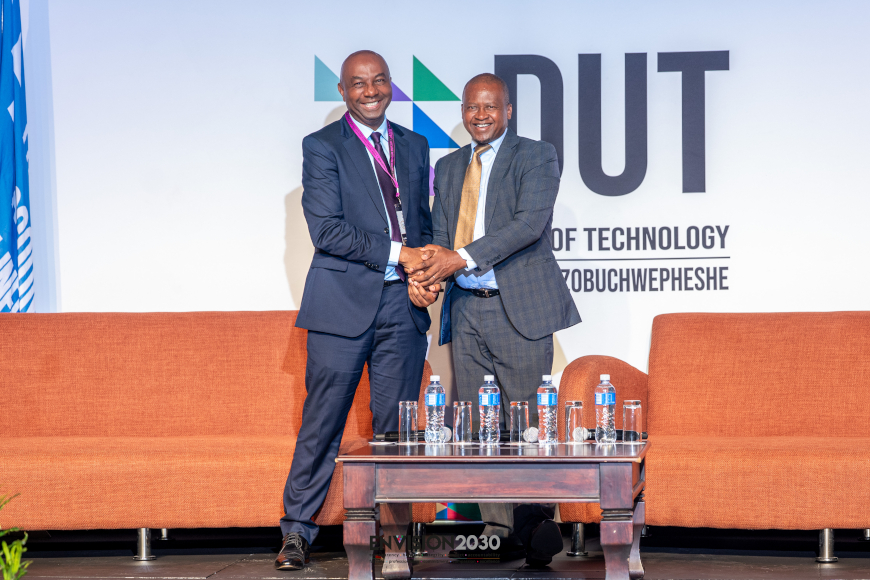
Pictured: Dr Sikhuthali Nyangintsimbi and Mr Siboniso Shabalala, at the Conference.
Nikiwe Sukazi


