
The Faculty of Accounting and Informatics at the Durban University of Technology (DUT) has made history by becoming the first institution in Africa to host the prestigious DataScientia International Symposium. Taking place from Wednesday, 22 July 2026 to Saturday, 25 July 2026, the symposium marks a significant milestone for both the university and the African research community.
The opening day welcomed more than 200 delegates representing over 50 institutions across five continents, setting the stage for four days of scientific discussions, policy dialogue, and cultural exchange. Held under the theme, Diversity-Aware, DataScientia Symposium 2026 is especially significant as it is the first time in more than a decade that the event has been hosted outside Europe, highlighting Africa’s growing role in advancing global research and innovation.
 Welcoming delegates, DUT Executive Dean of the Faculty of Accounting and Informatics, Professor Oludayo Olugbara, said it was an honour for the University to host the inaugural African edition of the DataScientia International Symposium, bringing together researchers, policymakers, industry leaders and international organisations from around the world, both in person and online.
“Hosting the symposium in Africa for the first time is a proud moment for DUT and a testament to the continent’s growing contribution to global research and innovation,” said Prof Olugbara.
Before the official programme commenced, delegates were welcomed in true KwaZulu-Natal style by DUT’s traditional student cultural group, oThulamsindo. The vibrant performance of traditional Zulu dance and music celebrated the province’s rich cultural heritage, offering local and international guests a warm African welcome while reflecting the symposium’s emphasis on diversity, cultural inclusion and cross-cultural exchange.
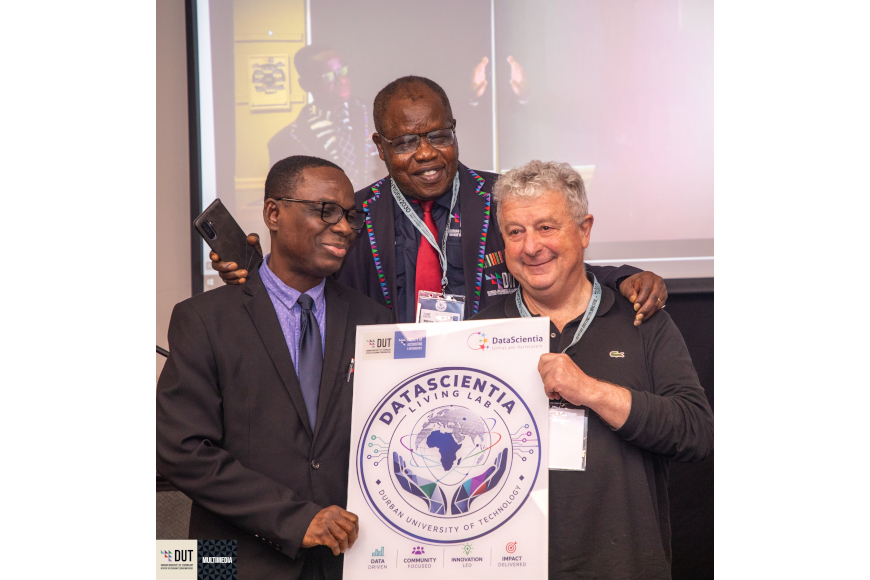
A major highlight of the symposium was the launch of Africa’s first DataScientia Living Lab, located within DUT’s Faculty of Accounting and Informatics. The Living Lab was officially unveiled by Prof. Olugbara alongside Professor Sunday Ojo and Professor Fausto Giunchiglia from the University of Trento, Italy, one of the founders of the DataScientia Initiative.
Prof Olugbara described the Living Lab as an open innovation platform where academia, government, industry and communities can collaborate to develop and test solutions that address societal challenges while advancing the DataScientia vision across South Africa and the continent.
He said the initiative aims to empower people to understand, manage and benefit from their own data rather than simply serving as data sources. One of its flagship projects focuses on digitising more than 7,000 human languages and developing AI-powered language technologies that support communication in indigenous languages.
“Our goal is to ensure that artificial intelligence reflects Africa’s diversity and creates opportunities that benefit our communities,” he said.
Prof Olugbara also noted that African institutions remain underrepresented in the DataScientia partnership network. He said hosting the symposium at DUT would help strengthen collaboration, encourage greater African participation and position the continent to play a leading role in shaping the future of responsible and inclusive artificial intelligence.
Professor Fausto Giunchiglia unpacked the symposium’s theme, explaining that diversity-aware AI refers to developing systems that recognise and represent the world’s rich diversity rather than reducing it to a single model. He added that sovereign AI focuses on ensuring societies have the ability to shape AI according to their own cultural values, priorities and needs.
He emphasised that true AI sovereignty begins with research grounded in local cultures before translating into innovation and industry. The symposium programme reflected this approach, with the first day dedicated to science, the second focusing on policy and the development of an African AI manifesto, the third on collaborative projects and innovation, and the final day reserved for networking and cultural activities.
Throughout the four-day programme, delegates will explore the latest developments in diversity-aware AI, policy and governance, African leadership in sovereign AI, education, research, innovation and community-building through the DataScientia Initiative.
Joining virtually from Brussels, Dr Vincenzo Lorusso, Policy Officer at the European Commission’s Directorate-General for Research and Innovation, highlighted the growing importance of Africa-Europe collaboration in AI. He said discussions in Durban would contribute to the implementation of the AU-EU Innovation Agenda, a ten-year framework adopted in 2023, with outcomes expected to feed into a ministerial meeting in Addis Ababa later this year.
Following the launch of the DataScientia Living Lab, delegates delivered a series of presentations aligned with the symposium theme, “Diversity-Aware Sovereign AI.” Researchers and experts from universities across Africa, Europe, North America and Asia shared insights on topics including AI for healthcare, scientific discovery, language diversity, community-centred AI, machine translation for African languages and the preservation of cultural heritage through artificial intelligence. The presentations highlighted the importance of developing AI systems that are inclusive, culturally responsive and capable of addressing real-world challenges across diverse communities.
Reflecting on the opening day, Owen Queen, a researcher from Stanford University in the United States, said he was impressed by the diversity of participants and perspectives represented at the symposium.
“The people who are in the room come from such a wide range of backgrounds, cultures and experiences. It has really broadened my understanding of AI beyond the technical aspects and highlighted the importance of developing technologies that work for people living in very different contexts,” he said.
The symposium continues until 25 July, with delegates expected to strengthen international partnerships and advance collaborative efforts towards building inclusive, diversity-aware and sovereign AI for Africa and the world.
Pictured: DUT Executive Dean of the Faculty of Accounting and Informatics, Professor Oludayo Olugbara, Professor Sunday Ojo, and Professor Fausto Giunchiglia of Italy officially launched the DUT DataScientia Living Lab during the DataScientia International Symposium 2026.
Photographer: Wanga Majali
Sinamile Sithole


