
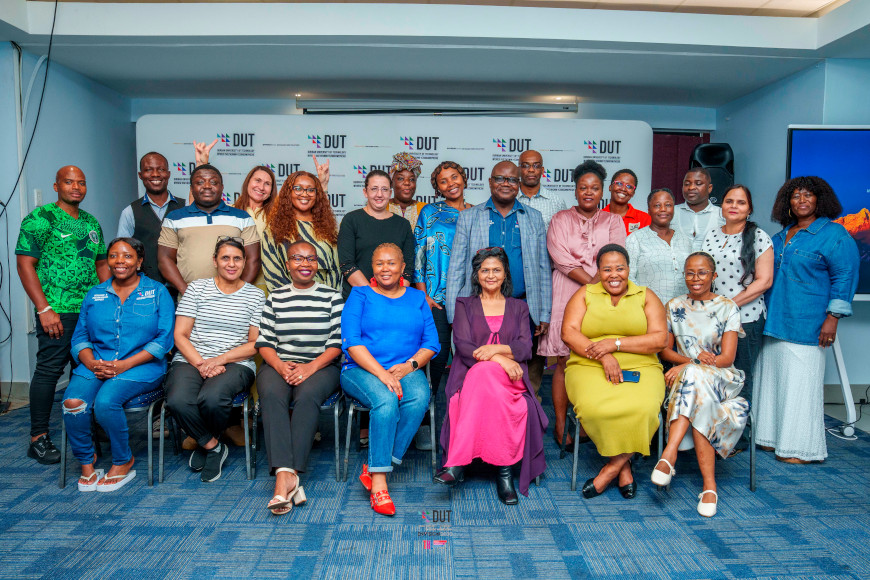
The Centre for Excellence in Learning and Teaching (CELT) at the Durban University of Technology (DUT) hosted a workshop titled “The Nexus Between Decolonisation and Entrepreneurship.” The workshop was held at the Hotel School, Ritson Campus, on Thursday, 12 March 2026.
The workshop explored how entrepreneurship education can move beyond Eurocentric theories and case studies by integrating indigenous knowledge systems, Ubuntu philosophy, and local economic realities. The purpose of the workshop was to critically examine the intersection between epistemic decolonisation and entrepreneurship education and practical pathways for curriculum transformation within higher education.
The opening remarks were presented by the Educational Technologist, Ms Bwalya Nyangu Lungu, who extended a warm welcome to guests and attendees.
The Acting Director of CELT, Dr Shoba Rathilal, delivered a presentation on the relationship between decolonisation, entrepreneurship, and the philosophy of education in higher education. She explained that decolonisation is a global higher education priority, aimed at addressing the alienation many students experience when dominant knowledge systems do not reflect their realities. Dr Rathilal emphasised the need for students to engage critically with different knowledge systems, recognising multiple ways of knowing.
She further highlighted the importance of developing an entrepreneurial mindset among graduates, not only for business creation but for innovation, problem-solving, and responding to societal challenges. In the context of a constrained job market, graduates should be equipped to create opportunities and contribute meaningfully to society. This aligns with the university’s philosophy of education, which emphasises creativity, innovation, and societal transformation.
Dr Rathilal pointed out that decolonisation and entrepreneurship should be integrated rather than treated as separate agendas. While decolonisation broadens knowledge systems, entrepreneurship enables their practical application for social impact. She stressed the role of educators in designing inclusive, contextually relevant curricula and teaching approaches that prepare students to become active agents of change.
Prof Simphiwe Nojiyeza clarified key concepts of decolonisation and decoloniality. He explained that decolonisation refers to the historical process of political independence from colonial rule, while decoloniality is a broader, ongoing effort to challenge systems of power, knowledge, and inequality rooted in colonialism.
Decoloniality requires addressing epistemic, cultural, economic, and political dimensions and recognising Indigenous knowledge systems across all disciplines. Prof Nojiyeza introduced Afrocentricity and Africology as approaches that centre African agency, history, and culture in knowledge production. He argued that Africa has long been a site of innovation and knowledge, challenging Eurocentric narratives that position the West as the primary source of development. He also highlighted how colonialism and coloniality continue to shape language, education, and economic systems in Africa, including the dominance of European languages and structures.
Among the guests who shared presentations were Dr Mandla Mubecua, who spoke on Indigenous Knowledge Systems and Entrepreneurial Practice, Dr Misheck Musaigwa, who presented on Re-contextualisation and Curriculum Redesign in Business Education, and Ms Lindokuhle Ntuli, who discussed Entrepreneurship in the Global South, focusing on cooperatives, social enterprises, and community-based models.
The event was concluded by Ms Bwalya Nyangu Lungu, who thanked the guest speakers for their presence and insightful presentations. She also expressed appreciation for the active participation and engagement of the audience.
Pictured: Attendees at the Decolonisation and Entrepreneurship Workshop.
Photographer: S’bonelo Dlamini.
Phiwayinkosi Sibiya


