
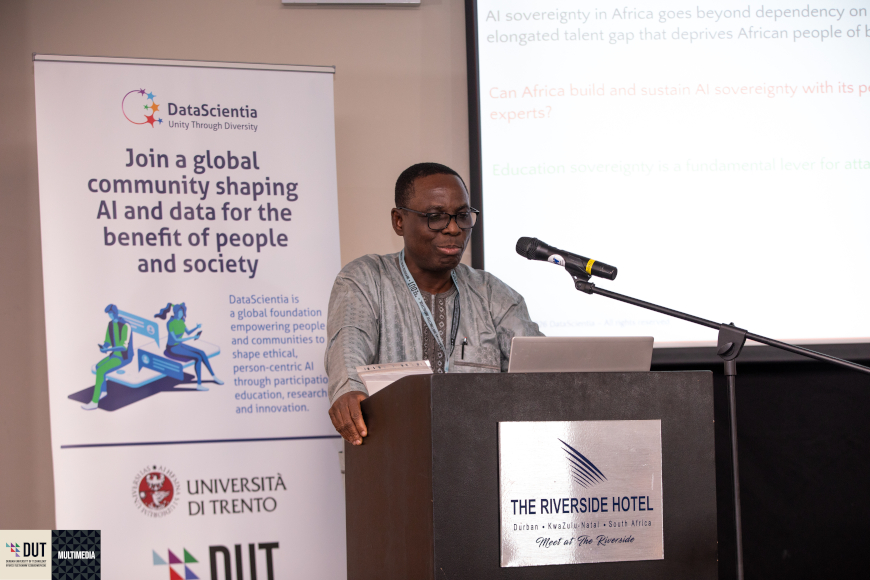
The second day of the DataScientia Symposium at the Durban University of Technology (DUT) built on the momentum of the opening day, bringing together academics, researchers, industry experts and international collaborators to further explore the future of Diversity-aware Sovereign Artificial Intelligence (AI) in Africa.
Hosted by the Faculty of Accounting and Informatics in collaboration with local and international partners, the symposium continued to foster dialogue on developing AI systems that are ethically grounded, culturally relevant and responsive to Africa’s unique developmental needs.
Delivering a presentation titled Diversity-aware Sovereign AI for Africa in Perspective, Professor Sunday Ojo, Adjunct Professor in the Faculty of Accounting and Informatics, emphasised the importance of ensuring that Africa takes ownership of its digital future by developing AI systems rooted in local knowledge, languages and values.
Professor Ojo explained that Diversity-aware Sovereign AI is founded on principles of data independence, ethical inclusivity and local governance. He stressed that AI models should be trained using African datasets that preserve indigenous languages, regional dialects and cultural norms, ensuring that the continent’s diversity is reflected in emerging technologies rather than overlooked.
He further cautioned against data colonialism, where African knowledge is extracted to develop technologies that provide little benefit to the communities from which the data originates. According to Professor Ojo, African countries must strengthen local data governance, invest in computing infrastructure, develop homegrown AI expertise and establish ethical frameworks informed by African values such as Ubuntu.
“As we act locally in Africa, we must think globally. We should not compromise our indigenous worldviews but instead develop AI that reflects our own realities while engaging meaningfully with the rest of the world,” he said.
Professor Ojo concluded by encouraging delegates to contribute towards developing a Diversity-aware Sovereign AI manifesto that will guide Africa’s AI journey through collaborative research, innovation and strategic partnerships.
Executive Dean of the DUT Faculty of Accounting and Informatics, Professor Oludayo Olugbara, delivered a presentation titled African Diversity-aware Sovereign AI: Higher Education Perspective, highlighting the critical role of higher education institutions in developing the talent needed to advance AI across the continent.
Professor Olugbara noted that while Africa continues to face infrastructure and funding challenges, the greatest obstacle remains the shortage of AI talent. He argued that educational sovereignty is essential to achieving AI sovereignty and called on universities to rethink traditional teaching methods by embracing practical, project-based and innovation-driven learning approaches.
He encouraged universities to diversify their curricula, create experiential learning environments and equip students with the practical skills needed to develop technologies that solve real societal challenges.
“Educational sovereignty is the foundation of AI sovereignty. Universities should produce innovators and entrepreneurs who create solutions for society rather than graduates who only seek employment,” he said.
Representing the Director of the DUT Confucius Institute, Lin Wu, Ms Xuin Zhang, a Mandarin Lecturer at the Confucius Institute, delivered a presentation titled Chinese + AI Training in Africa: From Language Bridge to Citizen-generated Data for Person-centric AI. She demonstrated how language education can become a catalyst for AI development by enabling African communities to actively participate in data creation, curation and AI innovation.
Ms Zhang explained that combining Chinese language training with AI literacy and digital skills empowers African professionals to engage directly with AI technologies while supporting multilingual data development. She further emphasised that language competence strengthens data sovereignty by enabling communities to contribute meaningfully to AI development rather than simply serving as sources of data.
She added that the programme promotes person-centric AI by encouraging the development of solutions that address African challenges in sectors such as agriculture, healthcare, education and finance while remaining culturally appropriate, ethical and inclusive. Through certification programmes, industry partnerships and entrepreneurship support, the initiative aims to build sustainable digital skills across the continent.
The symposium also featured presentations by Professor Pius Owolawi from the Tshwane University of Technology on Who Owns AI? An African Thought, and Dr Wayne Moodaley from the University of Cape Town on From Data to Value: Rethinking Sovereign AI in Africa. Their presentations enriched discussions on AI ownership, value creation and Africa’s growing role in shaping responsible and sustainable Artificial Intelligence.
Delegates also participated in interactive breakaway dialogue sessions, where they were divided into thematic groups to examine key dimensions of Diversity-aware Sovereign AI. Each group explored a specific topic under the guidance of facilitators before presenting their findings during the plenary session.
The dialogue sessions provided participants with an opportunity to exchange ideas, identify challenges and develop practical recommendations that will contribute towards a collective Diversity-aware Sovereign AI manifesto for Africa.
As the symposium continues, the collaborative discussions and shared expertise generated over the coming days are expected to strengthen partnerships, inspire innovative research and support the development of ethical, inclusive and locally governed AI solutions that respond to Africa’s diverse social, cultural and economic realities.
Pictured: Attendees of Day Two of the 2025 DataScientia Symposium.
Photographer: Wanga Majali
Sinamile Sithole


