
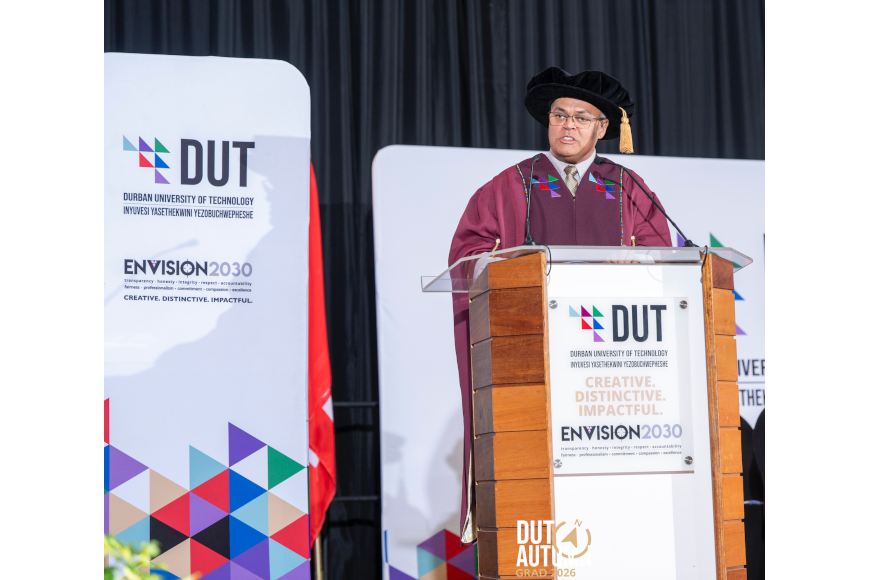
Students have come and gone, some with more flair and excitement than others, but Senior Director of Corporate Affairs at the Durban University of Technology (DUT), Mr Alan Khan, has provided a steady and hearty voice at graduation ceremonies for well more than a decade now.
With a professional journey that spans more than 30 years in broadcasting, media, communications and public engagement, Mr Khan keeps everybody engaged, and humoured when necessary, at the otherwise intense grad sessions held in Autumn and Spring each year.
“I have always believed in the power of storytelling, whether through radio, television, public speaking or higher education. I am passionate about people, authentic communication and creating meaningful human connections. Alongside my work at DUT, radio remains one of my greatest passions. At the heart of everything I do is a simple philosophy: treat people with kindness, respect and humility,” he said this week, while preparing for the latest grad season in Durban.
As Programme Director, his role is to guide the official proceedings of the graduation ceremony while ensuring the programme flows smoothly, professionally and respectfully.
He helps greatly to maintain the dignity and decorum of the occasion, while ensuring timing and protocol are carefully managed.
“The Programme Director is essential to supporting a positive brand experience, by setting a professional and respectful tone. Graduation ceremonies are deeply personal moments for DUT adaptive graduates and families, so I always try to create an atmosphere that feels celebratory, warm and memorable,” highlighted Mr Khan.
His charismatic technique of hosting graduation ceremonies may seem an easy task, but he has definitely mastered it to an art form. Despite having done it for 15 years, he still genuinely loves it.
“Every ceremony represents years of sacrifice, determination and hope for the adaptive graduates and their loved ones. To stand on that stage and witness those life-changing moments is incredibly special. One of the most rewarding aspects is seeing the pride on the faces of parents, guardians and grandparents, especially for first-generation graduates. Even after hosting so many ceremonies, I still feel excited every single time I walk onto the stage. It is a great honour for me to be a part of the DUT graduation events,” he shared with a real sense of pride.
Preparation is extremely important to Mr Khan. He spends time studying the programme, understanding the flow of the ceremony and familiarising himself with the various protocols.
“I write my own script to help ensure consistency, professionalism and correctness. Before going on stage, I usually take a quiet moment to centre myself mentally and emotionally. My broadcasting background has taught me the importance of voice control, pacing and energy. I also remind myself that this day is not about me, it is about the DUT adaptive graduates and their families,” he explained.
For him, the most memorable experiences have been deeply emotional moments involving graduates who overcame extraordinary hardships to complete their qualifications.
He has seen parents cry tears of joy, students celebrate against all odds and families honour loved ones who sadly passed away before graduation.
“Those moments stay with you because they remind you that education changes lives and entire generations. I always remember the former Chief of the South African Navy, Vice-Admiral Refiloe Johannes Mudimu, who was speaking at a DUT graduation ceremony when he received an honorary doctorate in 2012, saying that watching DUT students grace the graduation stage was an ‘avalanche of hope’.”
For Mr Khan, there have definitely been some light-hearted moments over the years, too.
“I have also had moments where adaptive graduates wanted selfies while still on stage or where families cheered so loudly that the entire venue erupted into celebration,” he said.
When asked if he sees his role as a Programme Director as a natural extension of his position as Senior Director of Corporate Affairs, Mr Khan said, without hesitation, “absolutely”.
“My role in Corporate Affairs is fundamentally about communication, marketing and representing the university in a professional and authentic manner. Being Programme Director allows me to connect directly with students, families, staff and guests during one of the DUT’s most important institutional events. It is a natural extension of the broader responsibility of helping shape and communicate the DUT story,” he said.
Mr Khan expressed that he truly enjoys public speaking, but it is definitely a skill that develops over time.
“Confidence comes through experience, preparation and learning how to connect with people authentically. My years in broadcasting taught me how important it is to speak naturally and sincerely rather than trying to sound overly formal. Public speaking is not just about speaking loudly or clearly, in my opinion, it is about making people feel comfortable, engaged and respected,” he stressed.
When asked whether his well-known and vast radio experience probably helped to harness his role as DUT’s Programme Director, he said he’s not too sure about being well-known, but radio has taught him timing, voice control, storytelling, emotional intelligence and the ability to read an audience.
“These skills are invaluable during graduation ceremonies. Broadcasting also taught me how to remain calm under pressure and how to maintain energy and professionalism even during very long programmes. Most importantly, radio taught me the importance of human connection and that translates directly onto the graduation stage,” he said.
When asked how many individual ceremonies he has been a Programme Director for since joining DUT, he confessed that he lost count a long time ago.
“It has been multiple ceremonies across Autumn and Spring graduations over the last 15 years. Each one, however, feels unique because every graduating class has its own story, personality and energy,” he emphasised.
He definitely does not see his role as Programme Director as “just part of his job at DUT.”
“It is a privilege and an honour. Graduation ceremonies represent dreams fulfilled and futures transformed. Even after 15 years, I still feel a sense of excitement and responsibility every time I step onto the graduation stage. The energy, emotion and significance of the occasion never get old,” he said sparklingly.
With such a craft, Mr Khan was asked if his children would perhaps follow in his footsteps.
“That would ultimately be their choice but I would certainly support them in whatever path they choose. I have always encouraged my sons to be authentic, kind and passionate about what they do. If any part of my journey inspires them, I would be proud of that but I also want them to create their own unique stories and identities. My elder son, Nasser, is a qualified teacher specialising in Mathematics and my younger son, Ameer, is currently completing his Master’s in Public Finance, and contemplating doing stand-up comedy,” he shared.
His practical advice to those who would like to become Programme Directors is that preparation, professionalism and humility are essential.
“You must respect the occasion and understand that it is not about being the centre of attention. Good Programme Directors know how to guide a ceremony smoothly while making others feel comfortable and celebrated. Strong communication skills are important but so is emotional intelligence. You also need to genuinely care about people because that warmth comes through in the way you engage with an audience. And you must always remember that it is a graduation ceremony, not a graduation party,” he said heartily.
Mr Khan expressed that his connection with DUT is deeply personal and has spanned most of his life.
“I first entered this institution as a Chiropractic student in 1990, never imagining that one day I would serve the institution in so many different capacities; as a student leader in the SRC, the inaugural Convocation President in 2002, a former Council member, an alumnus honoured with the DUT Silver Tusk Award and today, as a staff member entrusted with helping tell the DUT story,” he explained.
Coming from a richly diverse family background and growing up in multicultural Durban taught him the importance of respect, empathy and human connection. Those values shaped both his broadcasting career and his approach to leadership and public engagement.
“Radio taught me how to connect with people from all walks of life, while DUT gave me the platform to grow academically, professionally and personally. What makes this journey especially meaningful is that my relationship with DUT has evolved through different chapters of my life,” he said.
Mr Khan experienced the university from almost every perspective possible, as a student filled with ambition and hope, as an alumnus filled with gratitude and appreciation, as a Council member helping shape governance and now, as part of the team helping to ENVISION2030 and beyond.
“That is why standing on the graduation stage means so much to me. Every ceremony feels like a full-circle moment. When I look at our adaptive graduates and their families, I see reflections of my own journey, my own hopes and the transformative power of education. DUT is not simply where I work, it is part of who I am,” concluded Mr Khan.
Pictured: Alan Khan
Waheeda Peters


