
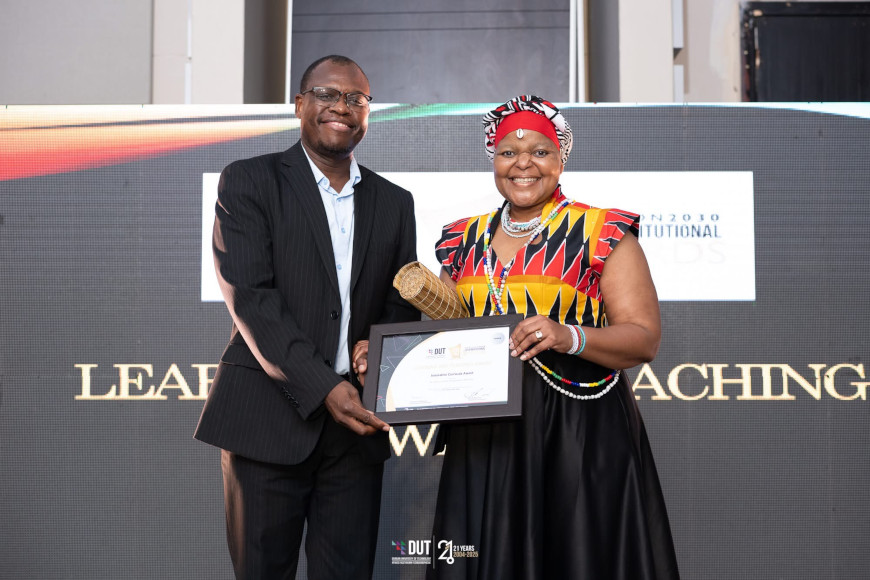
Dr Innocentia Mkhize, a Senior Lecturer in Chemical Engineering at the Durban University of Technology, was recently honoured with the ENVISION2030 Institutional Award for Innovative Curriculum for her exceptional contribution to curriculum transformation. Her award-winning project integrates Project-Based Learning, Design Thinking, and Entrepreneurship into the Green Engineering module for BEngTech Honours, equipping students with practical, market-ready skills and fostering an innovation-driven learning environment.
Dr Mkhize’s passion for creating a more sustainable and resilient learning environment inspired the development of a curriculum that equips students with practical, market-ready skills. She believes that by doing so, students can become agents of change in their communities. “I want our students to leave DUT not only with a qualification but also with the skills, courage, and creativity to start their own ventures, create jobs, and take sustainable solutions back to their homes and rural communities,” she emphasized.
Her work embodies DUT’s ENVISION2030 strategic objectives of innovation, sustainability, entrepreneurship, people-centeredness, and community impact. By transforming the curriculum to include real-world projects and entrepreneurial thinking, she enables students to engage directly with community problems and develop viable solutions. For instance, students tackled a real environmental challenge by designing a solid waste management system at the S-Block on the Steve Biko Campus, using the sustainability principles of Reduce, Reuse, and Recycle.
However, the implementation of this innovative approach was not without challenges. Students initially struggled to transition from traditional, structured learning to an open-ended, inquiry-driven method that required independence, creativity, and critical thinking. Through ongoing guidance, reflection sessions, and targeted support, they gradually became more confident and deeply engaged. Navigating a real-world environmental challenge also required strong collaboration, active listening, and iterative ideation, valuable skills that students developed throughout the module.
Despite these challenges, the module produced remarkable outcomes. Students successfully developed strategies to strengthen the Reduce-Reuse-Recycle culture on campus and designed awareness campaigns that promote responsible waste practices. One student has already taken her project further by applying for 2026 innobiz DUT Business Incubation programme to develop a green business based on her waste-management idea. The module also contributed to improved teaching approaches. In addition, two conference papers emerging from this curriculum innovation have already been published on IEEE Xplore, further showcasing the scholarly and practical value of the project.
As a recipient of the ENVISION2030 Learning and Teaching Institutional Innovative Curricula Award, she urges everyone to become ambassadors of DUT’s Philosophy of Education. “Engaged, socially responsive, and transformative learning should be at the heart of what we do. I encourage my colleagues to continue designing learning experiences that promote collaboration, sustainability, creativity, and ethical leadership. When we embrace these principles and model them for our students, we shape graduates who uplift communities, protect the environment, and innovate for a better future,” she said.
Dr Mkhize’s achievements stand as a powerful testament to her commitment to nurturing the next generation of innovators and leaders. Her work continues to inspire educators and students alike, demonstrating how creativity, community engagement, and forward-thinking curriculum design can drive meaningful change.
Pictured: DUT Deputy Vice-Chancellor: Teaching and Learning, Professor Vusi Gumede awarding Dr Innocentia Mkhize.
Photographer: Khulasande Tshayile.
Nontobeko Ngcobo


