Durban University of Technology (DUT) Doctoral student Nikita Singh and Dr Hlengiwe Nombuso Mtetwa have brought great pride to the institution through their recent wins at the 2026 L’Oréal-UNESCO For Women in Science Sub-Saharan Africa Awards.
Their work has earned recognition among 38 researchers named in the 2026 L’Oréal-Unesco For Women in Science Sub-Saharan Africa Awards, selected from more than 1,000 applications across 49 countries.
Michelle Gololo, Head of General Affairs and Engagement at L’Oréal Sub-Saharan Africa, said their responsibility is to maintain this visibility beyond this ceremony, so that these 38 women and the young women who will succeed them can shape the future of science.
Dr Hlengiwe Nombuso Mtetwa, a postdoctoral researcher at the Department of Community Health Studies, is one of the proud winners at the 2026 L’Oréal-UNESCO For Women in Science Sub-Saharan Africa Awards.
She could not contain her excitement upon hearing of her win.
“I am incredibly grateful, proud and humbled by this recognition. Being selected as one of 38 women scientists across Sub-Saharan Africa, and one of only eight postdoctoral researchers from more than 1,000 applications, is something I do not take lightly,” she expressed euphorically.
Dr Mtetwa indicated that this award is particularly meaningful because it comes at a very important stage of her academic journey. Having recently completed her PhD and transitioned into postdoctoral research, she has been reflecting on the kind of scientist she wants to become and the contribution she wants her research to make beyond academia.
“Research can be a demanding journey, with failed experiments, rejected applications, uncertainty and moments when you question whether your work is making enough of a difference. Receiving this recognition has been a beautiful reminder that the work we do matters and that there are people and organisations who believe in its potential,” she proudly shared.
Dr Mtetwa is equally proud to have represented DUT and South Africa on this platform. Having undertaken her academic training at DUT, from my undergraduate studies through to her Master’s, PhD and now postdoctoral research, this achievement is also a celebration of the people and institution that have contributed to her growth.
“I am deeply grateful to the Foundation L’Oréal and UNESCO for recognising African women scientists and investing in our potential to contribute to solutions for some of the continent’s most pressing challenges,” she shared.
Dr Mtetwa’s research is centred on a relatively simple but powerful question which is what can the wastewater generated every day tell about the health of the communities?
“When people use the bathroom, microorganisms and other biological material can enter the wastewater system. By collecting and analysing wastewater, we can obtain valuable information about infectious diseases and antimicrobial resistance circulating within the populations served by these systems. This approach is known as wastewater-based epidemiology,” she explained.
One of its advantages, says Dr Mtetwa, is that it can provide information beyond what is captured through conventional clinical surveillance, including signals from some individuals who may not have visited a healthcare facility or undergone diagnostic testing.
Her current postdoctoral research takes this concept further by integrating advanced molecular techniques, multi-omics technologies, bioinformatics, artificial intelligence and predictive modelling.
“I am working towards the development of an environmental disease intelligence platform, currently being developed under the name AI-WasteGuard, which aims to transform complex environmental surveillance data into accessible and meaningful information for public health decision making,” she explained.
Ultimately, Dr Mtetwa wants her research to contribute to DUT’s commitment to improving lives and livelihoods by ensuring that scientific knowledge is translated into practical, accessible and locally relevant solutions.
One of the most meaningful experiences for her was being surrounded by remarkable African women scientists from different countries, disciplines and backgrounds.
“Although our research areas differed, many of our experiences as women navigating scientific careers were surprisingly similar. There was something special about being in a space where we could speak openly about our challenges, ambitions, insecurities and achievements without feeling the need to justify ourselves. We learned from one another, laughed together, shared personal stories and formed friendships that I hope will continue well beyond the programme. I arrived as a scientist attending an awards programme, but I left with a stronger sense of purpose, renewed confidence and an incredible community of women whom I now consider friends and potential collaborators,” she said.
For her, that was one of the greatest gifts of the experience.
Dr Mtetwa completed her PhD in Health Sciences, specialising in Environmental Health, at DUT in 2025 and is currently undertaking an NRF Postdoctoral Research Fellowship.
Her doctoral research investigated drug-resistant Mycobacterium tuberculosis complex organisms in wastewater and the associated risks of tuberculosis infections across six African countries, namely South Africa, Ghana, Nigeria, Kenya, Uganda and Cameroon.
The study highlighted the potential value of wastewater surveillance as a complementary approach to conventional tuberculosis surveillance. It also raised important questions about environmental and occupational exposures that warrant further investigation, particularly among wastewater treatment workers and individuals exposed to contaminated water.
Her current postdoctoral research builds on this foundation by moving beyond detection and characterisation towards prediction, prevention and research translation.
“I aim to develop computational tools that can identify meaningful patterns in environmental surveillance data and support public health authorities in recognising emerging disease threats. In the longer term, I hope to contribute to an integrated environmental disease surveillance framework that is scientifically robust, affordable, adaptable and appropriate for African settings,” she shared.
In the longer term, Dr Mtetwa aspires to establish a multidisciplinary research programme focused on environmental disease intelligence, One Health surveillance and public health innovation, with a strong emphasis on postgraduate training and research capacity development.
She aims to also create opportunities for young researchers to acquire skills in molecular microbiology, bioinformatics, artificial intelligence, predictive modelling and scientific communication.
“The award has strengthened my conviction that African scientists can be at the forefront of developing innovative technologies and research frameworks that address our own challenges while contributing to global scientific advancement,” she added.
My first piece of advice to future researchers is to remain curious and never underestimate the importance of the questions one asks.
“Experiments will fail, funding applications may be unsuccessful and manuscripts may be rejected. These experiences are part of the scientific journey and do not necessarily reflect your capabilities or potential. Most importantly, when you succeed, remember to create opportunities for others. We need more women who are willing to mentor, collaborate, share knowledge and make the journey a little easier for those coming after them,” she concluded.
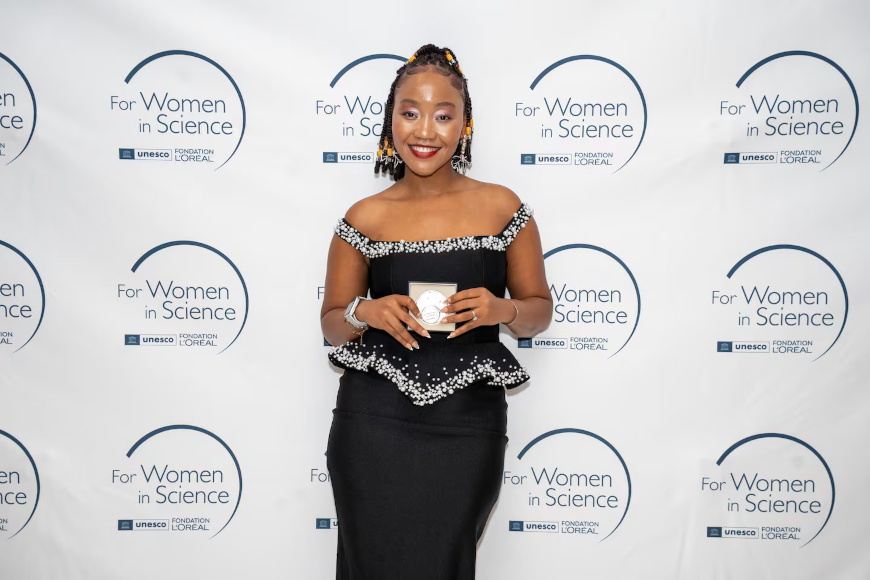
Pictured: Dr Hlengiwe Nombuso Mtetwa, one of the winners of the 2026 L’Oréal-Unesco For Women in Science Sub-Saharan Africa Awards.
Waheeda Peters


