
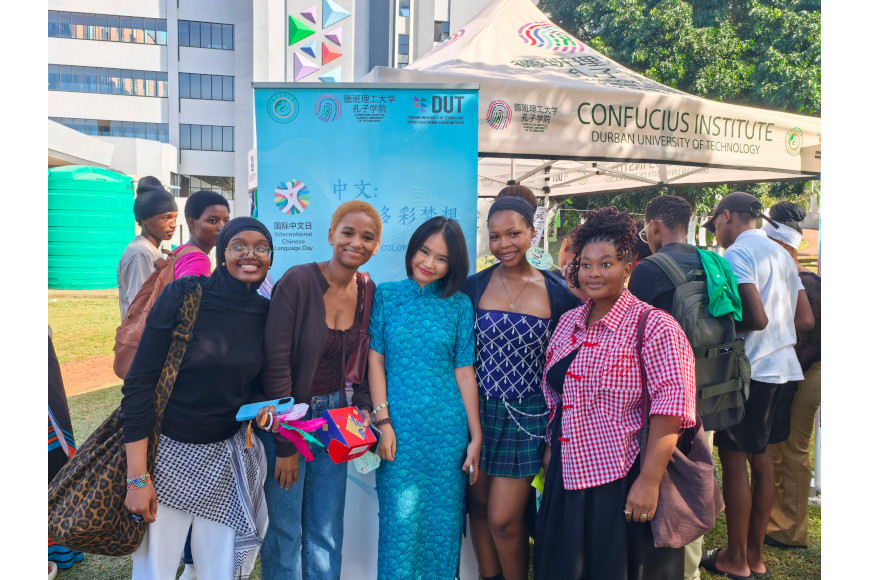
The Durban University of Technology (DUT) Confucius Institute brought Chinese language and culture to life through a series of vibrant, interactive events held in celebration of International Chinese Language Day. Under the theme “Chinese: Lighting Up Colourful Dreams,” the celebrations engaged students, staff, and members of the public through immersive, hands-on experiences that showcased the richness of Chinese heritage beyond the classroom.
Activities took place at the Musgrave Farmers Market on 18 April and continued on 20 April at DUT’s Steve Biko Campus, offering participants a dynamic introduction to traditional practices such as calligraphy, martial arts, cultural games, and lion dance. The outreach at the market created an opportunity for community engagement, while the campus event provided DUT students with a deeper cultural experience.
At the Musgrave Farmers Market, the Confucius Institute hosted a lively cultural booth that quickly drew interest from visitors. The calligraphy station proved especially popular, with participants receiving Chinese names and creating bookmarks on traditional Xuanzhi (rice paper). The traditional Touhu (pitch-pot) game attracted enthusiastic participation, while shuttlecock kicking offered a light-hearted and engaging introduction to Chinese recreational activities. One resident described receiving her Chinese name for the first time as “so new and fun.”
The main campus event transformed the central lawn of Steve Biko Campus into an interactive cultural space. Students explored activities such as lacquer fan painting, Baduanjin (a form of Qigong), lion dance, and shuttlecock kicking. In his opening remarks, Confucius Institute Director Lin Wu highlighted the importance of experiential learning, noting that taking the Chinese classroom outdoors allows participants to appreciate the language as part of a broader cultural and historical context.
At the lacquer fan station, students created unique designs using traditional marbling techniques, producing colourful, one-of-a-kind patterns. The martial arts and lion dance sessions drew large crowds, with more than thirty students participating in Baduanjin exercises on the lawn. Professional lion dancers captivated audiences before inviting students to try on the costumes themselves. One participant remarked that the experience gave her a new appreciation for the skill and physical effort involved in lion dance.
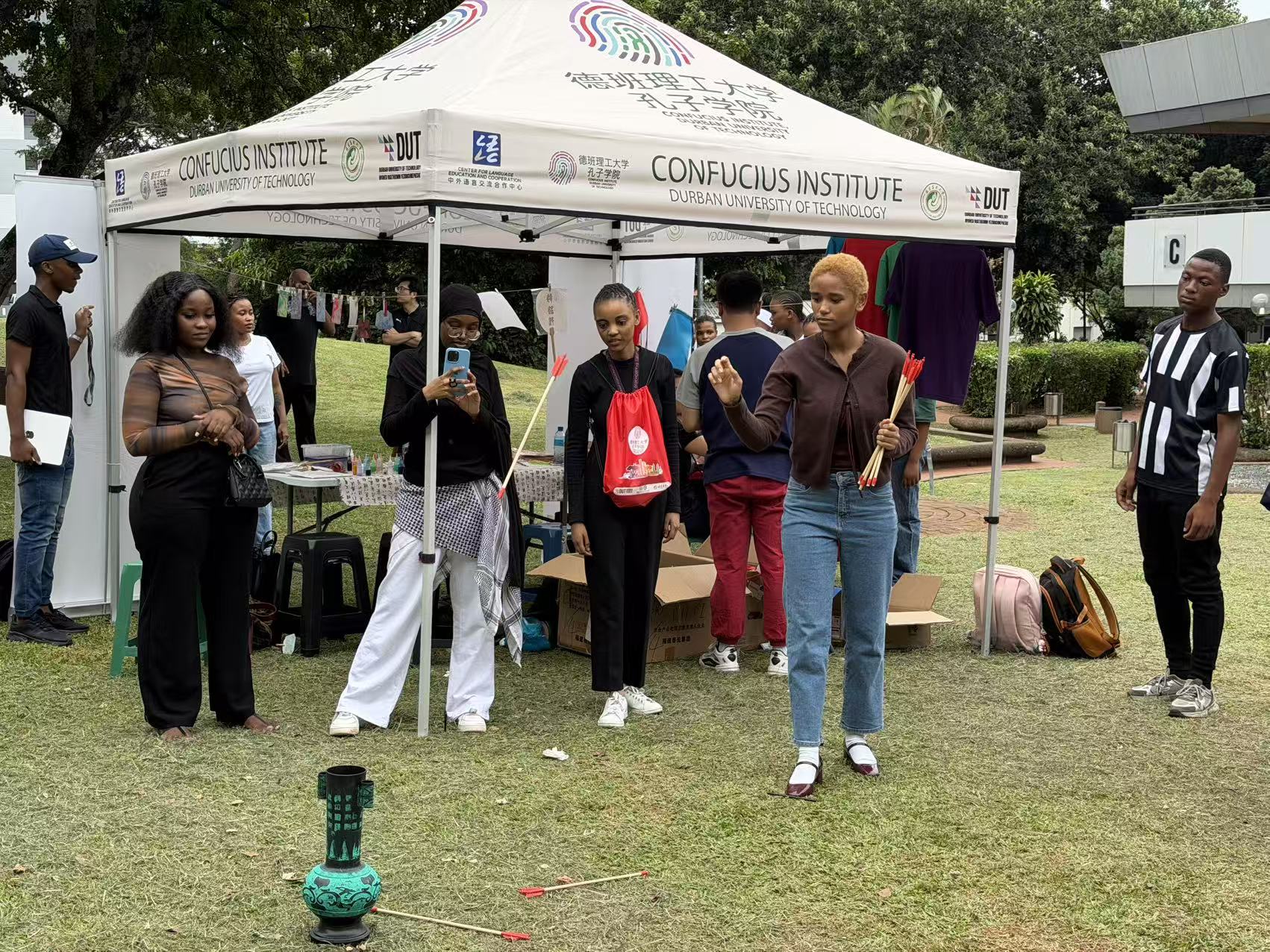 The shuttlecock activity area remained lively throughout the day, with students eagerly testing their coordination and encouraging one another. As the activities unfolded, participants also picked up simple Chinese phrases such as “xièxiè” (thank you) and “fēicháng hǎo” (wonderful), reinforcing the connection between language and lived experience.
Students reflected positively on the impact of the event, with one noting that the experience transformed her perception of language learning. She shared that engaging in activities such as calligraphy made the language feel personal and meaningful, and expressed interest in enrolling in future Confucius Institute courses. Another student highlighted how participating in the Touhu game demonstrated the value of focus and shared achievement in a learning environment.
A DUT staff member commented that the event successfully demonstrated how cultural learning can be both engaging and accessible, adding that such initiatives help foster a sense of community and global awareness on campus.
The celebrations align with the 2026 China-Africa Year of People-to-People Exchanges and support DUT’s ENVISION2030 strategy of promoting global citizenship, inclusivity, and experiential learning. The Confucius Institute continues to play a key role in strengthening cultural ties between China and South Africa, while creating meaningful opportunities for students and the broader community to engage with Chinese language and culture.
Pictured: Highlights from the Confucius Institute’s International Chinese Language Day celebrations held at Musgrave Farmers Market and Steve Biko Campus.
Photographer: Confucius Institute at DUT
Junhao Tian/Yuxin Zhang


