
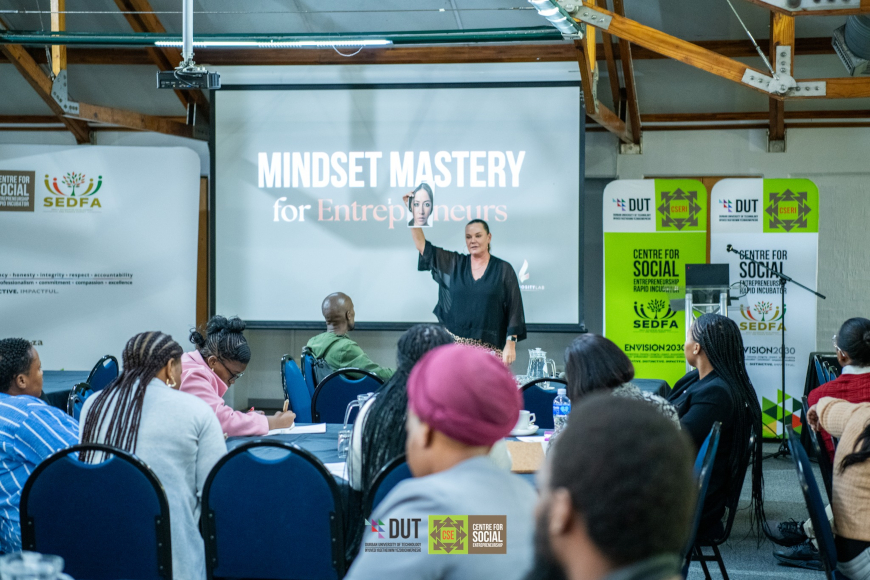
The Centre for Social Entrepreneurship Rapid Incubator (CSERI) at the Durban University of Technology (DUT) recently hosted a two-day personal development workshop for 80 entrepreneurs. The workshop aimed to equip participants with confidence, personal development skills, and business knowledge to help them overcome challenges, improve decision-making, and strengthen their enterprises for future success.
CSERI Director, Mr. Solomon Nyamurima, encouraged entrepreneurs to practice honesty, accountability, and financial discipline in managing their businesses. He emphasised the importance of transparency and responsible financial management to ensure that entrepreneurs receive meaningful support and guidance for business growth.
He also welcomed entrepreneurs and esteemed guests to the workshop and created an opportunity for participants to reflect on their experiences within the programme.
Ms Mbali Shange shared her entrepreneurial journey, reflecting on the challenges and growth she has experienced in her business. She explained that although the journey has been long and difficult, it has also been rewarding, and she has learned a great deal through the CSERI programme.
“Overcoming fear and building the courage to present in front of others, I was encouraged through mentorship and support to keep going despite moments of doubt and wanting to quit. I also encourage fellow entrepreneurs to take full advantage of the opportunity, ask questions, and remain committed to their goals,” she said.
At the mindset and entrepreneurship workshop, transformational life coach Ms Karen Burt spoke to entrepreneurs about the hidden emotional patterns that shape people’s lives. Her central message was that many people are not failing because they are lazy or incapable, but because they are unknowingly protecting themselves from emotional pain through fear, avoidance, and self-sabotage.
Burt began by explaining Sigmund Freud’s theory of the ego in a simple and relatable way. She described the id as the impulsive, childlike part of the brain that seeks instant gratification and focuses only on immediate needs. She compared it to a screaming baby that demands immediate attention. According to Burt, this helps explain selfish behaviour and even narcissism, as some individuals remain emotionally stuck in this early stage of development.
She then explained the superego, which develops during early childhood. “This part represents the voice of parents, authority, and society. It teaches children how to behave, fit in, and seek approval. While it helps people function socially, an overdeveloped superego creates adults who constantly seek validation, fear judgment, and become people-pleasers,” she added.
She explained that the final stage, which develops during the teenage years, is the healthy ego. She described it as a balanced mediator between the selfish desires of the id and the strict demands of the superego.
“A healthy ego is grounded, self-aware, and capable of making thoughtful decisions without acting impulsively or constantly seeking approval,” she explained.
Burt then introduced another concept she personally adds to this framework: the inner critic. She described it as the negative voice inside people’s minds that constantly creates self-doubt and fear. According to her, this voice is often shaped by parents, schools, society, or past painful experiences.
She humorously compared her own inner critic to “Cruella de Vil” sitting on her shoulder, constantly criticising and questioning her. She explained that the inner critic is responsible for much of people’s procrastination, fear, and self-sabotage because it convinces them that they are not good enough.
The workshop then moved into a discussion on self-sabotage, which Karen described as a form of self-protection. She explained that people often sabotage opportunities because they are unconsciously trying to avoid painful emotions such as rejection, abandonment, disappointment, or failure.
To explain this idea, Burt used the example of university students who procrastinate studying until the night before an exam. On the surface, this appears lazy or irresponsible, but she argued that the deeper reason is fear. If a student studies hard and still fails, they may interpret it as evidence that they are unintelligent or incapable.
She also noted that many business owners never allow themselves to rest because they believe constant pressure and overworking are necessary for success. She challenged this thinking by saying that if someone cannot step away from their business even briefly, then they have not built a healthy system or a trusted team. She warned that constantly living under stress eventually harms both physical and mental health.
Ms Brightness Nyawose, Business Development Officer, delivered the closing remarks by expressing sincere appreciation to Karen Burt for dedicating her time to spend two full days with the entrepreneurs. He acknowledged her commitment and thanked her for the valuable support she continuously provides whenever she visits. He further mentioned that her sessions often feel like a form of therapy for the team because of the insight and value she brings.
Nyawose also commended all the participants who remained committed throughout the two-day workshop. He recognised that the programme was demanding for both attendees and Karen Burt but emphasised that their continued attendance reflected their dedication to growing and improving their businesses.
Pictured: Ms Karen Burt engaging with entrepreneurs at the personal development workshop.
Vuyo Mntambo
Phiwayinkosi Sibiya


