
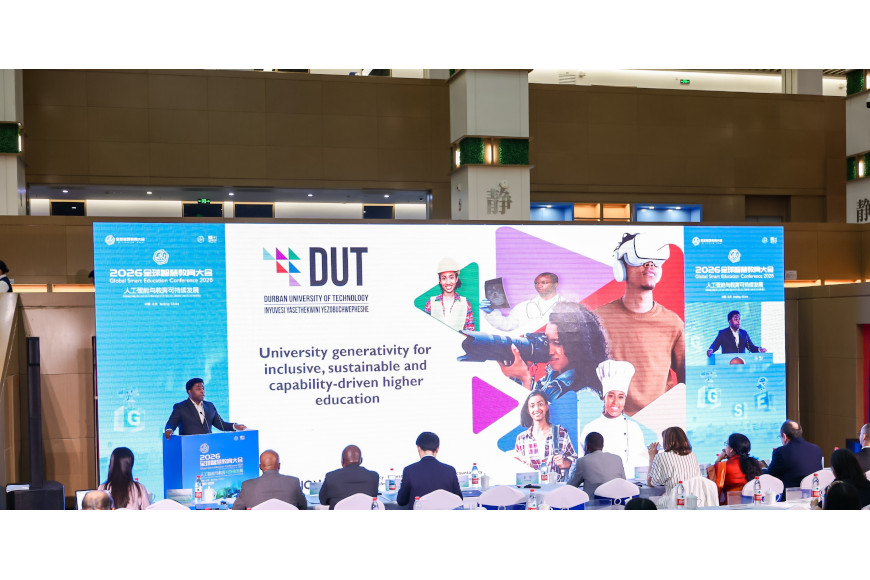
Durban University of Technology (DUT) Deputy Vice-Chancellor: Research, Innovation and Engagement (RIE), Professor Fulufhelo Nemavhola, has called on universities to move beyond simply adopting artificial intelligence (AI), urging higher education institutions to rethink how technology can be used to build more capable, inclusive and sustainable universities.
Professor Nemavhola made the call while delivering a keynote address at the 2026 Global Smart Education Conference, held in Beijing, China, from 18 to 20 August 2026.
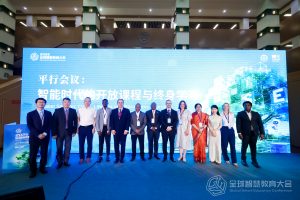
DVC: RIE Professor Fulufhelo Nemavhola amongst the distinguished guests at the 2026 Global Smart Education Conference.
The conference, jointly organised by Beijing Normal University and the UNESCO Institute for Information Technologies in Education, was held under the theme “Artificial Intelligence and Sustainable Development in Education”. It brought together policymakers, scholars and educators from more than 60 countries to examine emerging technologies and approaches to smart education and their role in advancing equitable, inclusive and quality-driven education.
Speaking during the parallel session on “Open Education and Lifelong Learning in the Intelligent Era”, Professor Nemavhola delivered a keynote titled “Beyond AI Adoption: University Generativity for Inclusive, Sustainable and Capability-Driven Higher Education”.
He argued that the future of higher education should not simply focus on automating existing university systems and processes, but on developing institutions that are increasingly capable of responding to the changing needs of students, society and the broader education landscape.
“The goal is not to automate the university we already have, but to build a university that becomes increasingly capable,” said Professor Nemavhola.
He emphasised that AI will play an important role in the future of higher education, but should remain an enabler of human and institutional purpose rather than a substitute for it.
“AI will be part of that future, but it must always remain an amplifier of human and institutional purpose, not its substitute,” he said.
The session was organised by the International Council for Open and Distance Education (ICDE), with the State University of Rio de Janeiro, the Open University of Malaysia and the Smart Learning Institute of Beijing Normal University among its co-organisers. The session brought together international education leaders to discuss the future of open education and lifelong learning in an increasingly technology-driven environment.
The broader conference explored the role of artificial intelligence and smart technologies across all levels of education, with discussions covering AI governance, student well-being, the future of teachers and schools, rural education, special education and learning sciences.
As the annual meeting of the Global Smart Education Network (GSENet), the conference provided a platform for cross-regional and cross-sectoral dialogue on the future of education. It received support from international organisations including the Arab League Educational, Cultural and Scientific Organization (ALECSO), the Commonwealth of Learning (COL), the International Society for Technology in Education (ISTE) and the Southeast Asian Ministers of Education Organization (SEAMEO).
Professor Nemavhola said DUT’s participation provided an opportunity for the University to contribute to global discussions on the future of higher education while strengthening relationships with international academic institutions and education leaders.
“By taking part in the conference, DUT not only demonstrated its pioneering efforts in AI-enabled education, but also forged direct communication links with top global academic institutions, offering invaluable opportunities to advance its digital transformation and boost its global profile,” he said.
Professor Nemavhola’s participation placed DUT within a growing international conversation on how universities can harness emerging technologies while retaining their human-centred purpose and strengthening their capacity to contribute meaningfully to society.
Pictured: Deputy Vice-Chancellor: Research, Innovation and Engagement at DUT, Professor Fulufhelo Nemavhola delivering a keynote address at the 2026 Global Smart Education Conference in Beijing, China.
Photo: Supplied.
Lin Wu


