A project developed by Durban University of Technology (DUT) Electronic and Computer Engineering student Ntuthuko Mdunge and his teammates, Sipho Mokoena and Zethembe Nene, has earned top recognition at the 2026 Southern Africa Telecommunication Networks and Applications Conference (SATNAC).
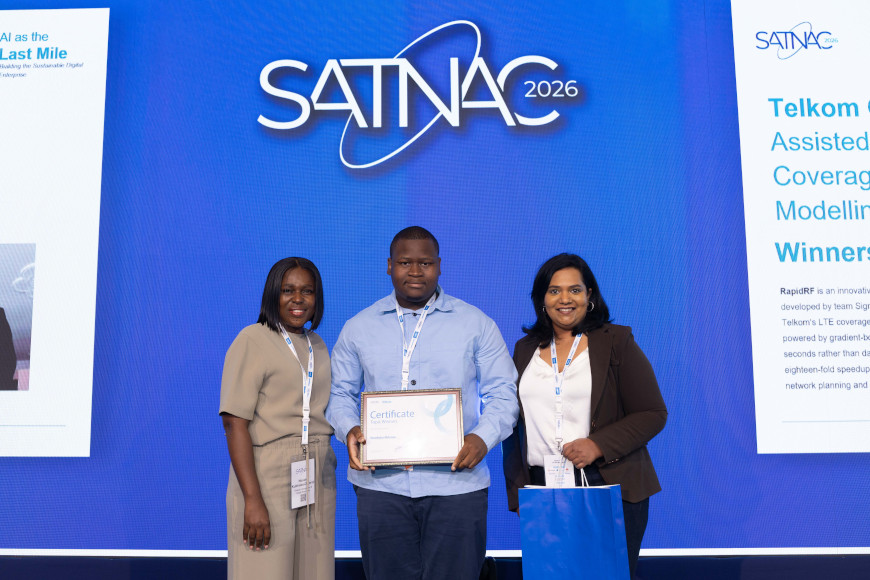
The team, known as SignalMyth, won the Telkom Industry Solutions Challenge, while Mdunge was named Innovator of the Year.
Their winning project, the RapidRF Surrogate Engine, uses artificial intelligence (AI) to predict mobile network coverage in seconds, addressing a process that can take telecommunications operators several days to complete using conventional simulation methods.
For Telkom, traditional physics-based simulations can take between seven and nine days per run. This can make it difficult to respond quickly when a network tower fails or network conditions change.
The team’s AI model learns from these simulations and produces LTE coverage predictions much faster. Using real Durban terrain and land-cover data for training and testing, the model achieved results within approximately 2.6 dB of its reference model while running about 18 times faster.
SATNAC 2026 took place from 11 to 15 October at Champagne Sports Resort in the Central Drakensberg. Held under the theme “AI as the Last Mile: Building the Sustainable Digital Enterprise”, the conference brought together researchers, academics and industry professionals to discuss developments in telecommunications and the role of AI in building sustainable digital solutions.
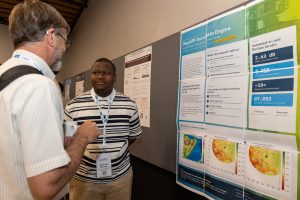
Ntuthuko Mdunge presenting at SATNAC.
For Mdunge, presenting the project to industry experts and researchers was an opportunity to put his engineering knowledge to the test.
He had to explain how the technology worked, respond to questions about his findings and show how the solution could be used in a real industry setting. He also attended masterclasses and engaged with other innovators working on AI applications for South Africa’s telecommunications sector.
“Winning showed me that a student from DUT can compete with, and learn from, people across the industry,” he said.
The experience has given him renewed confidence and valuable feedback to take the project further. His next goal is to test the RapidRF Surrogate Engine against Telkom’s actual network data.
The project brought together several areas of Mdunge’s studies in Electronic and Computer Engineering, including electronics, signal processing, communication networks and programming. His knowledge of signal propagation and communication systems helped him understand the problem, while his programming and data skills enabled him to develop the solution.
For Mdunge, the importance of engineering and technology goes beyond developing new products. He sees STEM as a way of addressing everyday challenges, including the digital divide.
Reliable connectivity, he points out, allows students to access online learning, helps small businesses reach customers and enables healthcare facilities to connect with specialists. He believes young people should be encouraged to pursue STEM fields and explore how their skills can contribute to solving problems in their communities.
His advice to learners, particularly those from communities where opportunities may be limited, is simple: stay curious, keep learning and do not be afraid to try.
Mdunge thanked DUT, the Department of Electronic and Computer Engineering, his lecturers and mentors, Telkom and the SATNAC organising team for their support. He also acknowledged his teammates, Sipho Mokoena and Zethembe Nene, for their contribution to the project.
The achievement puts the work of DUT’s young engineering talent in the spotlight, showing how classroom knowledge can be applied to challenges facing the telecommunications industry. For Mdunge and his teammates, the awards are also an opportunity to take their innovation further and explore its potential beyond the competition.
Pictured: Electronic and Computer Engineering student Ntuthuko Mdunge receiving the Innovator of the Year Award.
Tiyani Mboweni


