
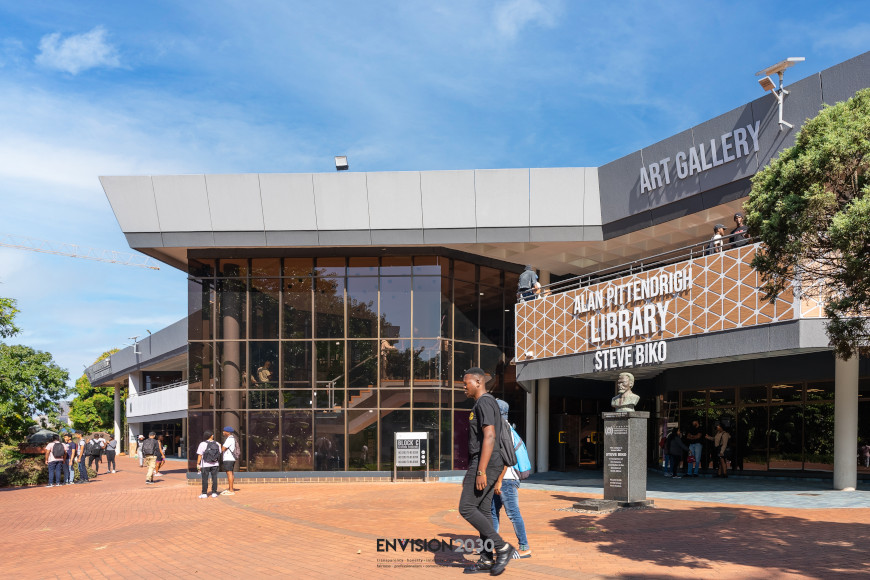
The Durban University of Technology (DUT) has taken a decisive step towards advancing high-impact, interdisciplinary research with the establishment of 18 new Research Institutes, effective from 2026. This landmark initiative underscores the University’s commitment to strengthening its research profile and translating knowledge into innovation, entrepreneurship and meaningful societal impact, in line with DUT’s ENVISION2030 strategy.
The establishment of the new research institutes was approved by the DUT Council under the leadership of Mr Wiseman Madinane and fully supported and approved by the DUT Senate. The research institutes form part of DUT’s Disruptive Projects Programme, which seeks to fast-track high-impact initiatives that position the University at the forefront of technological, social and economic innovation.
Building on its existing research capacity, DUT already operates two established research institutes, most notably the Institute of Wastewater Technology (IWWT) and the Institute of Systems Science (ISS), which have demonstrated the University’s ability to deliver impactful, applied research. IWWT addresses critical environmental and water sustainability challenges, while ISS tackles complex societal challenges through interdisciplinary approaches. Together, they illustrate DUT’s commitment to research excellence, innovation, societal impact, and global competitiveness.

DUT Vice-Chancellor and Principal, Professor Thandwa Mthembu.
This milestone has been achieved under the strategic and visionary leadership of the Vice-Chancellor and Principal, Professor Thandwa Mthembu, with oversight from the DUT Council.
Providing insight into the initiative, Deputy Vice-Chancellor: Research, Innovation and Engagement, Professor Fulufhelo Nemavhola, said: “The establishment of 18 research institutes is a strategic acceleration to strengthen interdisciplinary research, respond to real societal and economic challenges, and enhance DUT’s national and global competitiveness.”
He further highlighted the critical role the new research institutes will play in developing the next generation of researchers. “Through these research institutes, DUT is creating structured platforms for emerging and established researchers, postdoctoral fellows and postgraduate students to thrive, while ensuring that research excellence goes hand in hand with real-world impact,” reiterated Prof Nemavhola.
The 18 research institutes include the Institute of Hydrogen Technology; Institute for Innovation and Entrepreneurship; Advanced Grid Technology Research Institute (conversion); Smart Agriculture and Food Security Institute; Institute for Advanced Manufacturing and Robotics; Institute for Societal and Technological Advancement and Impact; Institute of Ocean Engineering and Marine Technology; Urban Planning and Smart Cities Institute (conversion); DUT Health Devices Innovation Institute; Institute of Micro and Nano Systems (IMiNaS); Institute for the Future of Work and Education; Institute for Environmental and Climate Change Research; Indigenous Food Research Institute (IFRi); Biotechnology and Health Innovation Institute; Space Engineering and Exploration Institute; Institute for Data Science and Artificial Intelligence; BRICS Research Institute; and the Biocatalyst Research Institute (conversion).

Deputy Vice-Chancellor: Research, Innovation and Engagement, Professor Fulufhelo Nemavhola.
Prof Nemavhola explained that the rollout of the institutes will follow a phased implementation approach in line with institutional policy and governance frameworks.
In 2026, DUT will implement five institutes as the first wave: Hydrogen Technology; Innovation and Entrepreneurship; Health Devices Innovation; Data Science and Artificial Intelligence; and Urban Planning and Smart Cities. One existing centre will be converted into a full institute, bringing the total number of institutes implemented in the year to six.
“The first-wave research institutes are anchored in the defining questions of our time; how we power our economies sustainably, harness digital transformation, advance health innovation, grow inclusive enterprises and build cities that can endure,” said Prof Nemavhola. “They signal a deliberate shift in how universities respond to global change, not as observers but as active partners in shaping solutions.” He added, “What sets these institutes apart is not only the technology they will generate but the way they are designed to work, across disciplines, in partnership with industry and communities and with a clear line of sight from discovery to implementation. By accelerating the journey from research to real-world impact, they position DUT as a catalyst for innovation that can be adopted, adapted and scaled where it matters most.”
The research institute programme is designed to deliver direct societal and economic value through innovation, enterprise creation, improved systems, and practical solutions deployable beyond the University. The framework prioritises community benefit, economic development, and job creation as core measures of impact.
For KwaZulu-Natal and South Africa, this initiative translates into research that delivers tangible improvements in areas such as health technologies, food security, energy resilience, and smarter, more sustainable cities.
Pictured: DUT Steve Biko campus in Durban.
DUT Vice-Chancellor and Principal, Professor Thandwa Mthembu.
Simangele Zuma


