
The Durban University of Technology (DUT) has taken a decisive step towards advancing high-impact, interdisciplinary research with the establishment of 18 new Research Institutes, effective from 2026. This landmark initiative underscores the University’s commitment to strengthening its research profile and translating knowledge into innovation, entrepreneurship and meaningful societal impact, in line with DUT’s ENVISION2030 strategy.
DUT’s Department of Information Technology focuses vastly on research being underpinned by a simple philosophy of innovative and clever computing solutions that improve the lives and livelihood of society. Today, there are three remarkable, adaptive graduates who have used their research acumen to achieve their goals in this fascinating field of study at DUT.
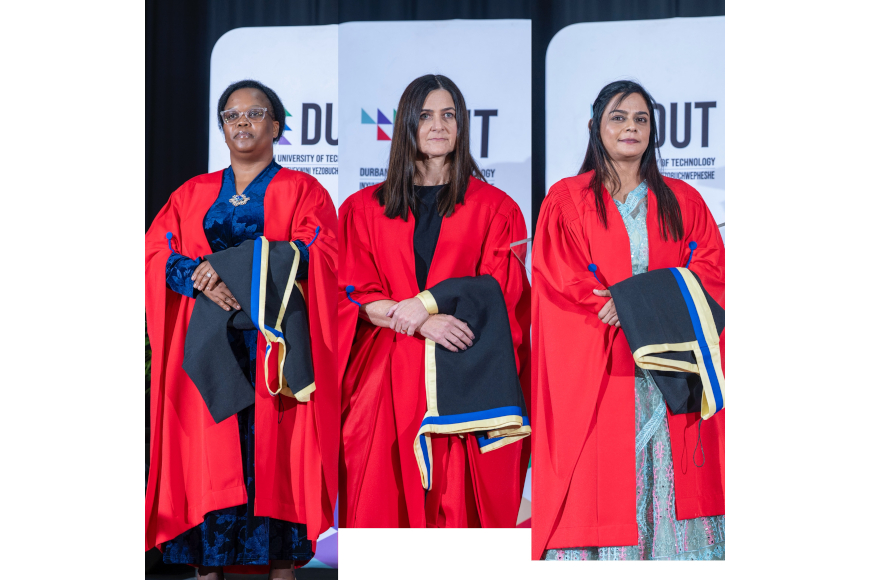
At the DUT 2026 Autum Graduation ceremony held at the Olive Convention Centre today, 19 May 2026, saw Dr Anna Mosima Masethe, Dr Neetu Ramsaroop and Dr Robyn Cindy Thompson graduate with their Degrees of Doctor Of Philosophy’s in Information Technology.
Dr Masethe, spoke on her research which focuses on a context-aware word embedding model for morphologically rich languages using Sesotho sa Leboa as a case study.
She explained that this study examined the Natural Language Processing (NLP) problem of Meaning Conflation Deficiency (MCD) in vector space Word Embedding (WE) models, whereby a model struggles to distinguish between polysemous and synonymous words, leading to inaccurate representation and reduced performance.
“The problem is exacerbated in the context of low-resource, morphologically rich languages such as Sesotho sa Leboa, which is without a reference word embedding model,” she said.
Dr Masethe further elaborated that research outputs from the study include three journal articles and four conference proceedings, peer-reviewed scholarly papers.
Sharing on her thesis was Dr Ramsaroop, whose research is titled: Integrating Magnetic Resonance Coupling with Radio Frequency Energy to Wirelessly Charge Mobile Device Batteries.
“Mobile devices are practically essential to daily life and work, yet their heavy reliance on frequent battery charging poses significant challenges to longevity, convenience, and energy efficiency,” she explained. Dr Ramsaroop further added that traditional wired charging interrupts seamless device use and contributes to unnecessarily high electricity consumption, a growing concern during ongoing energy crises.
This research, said Dr Ramsaroop, explores wireless power transfer as a sustainable alternative to conventional charging of mobile devices for wireless transmission of electrical energy.
“Overall, the research demonstrates a promising mechanism for wireless, efficient, reliable, and sustainable charging of mobile devices and has won two excellent prizes in the 2023 BRICS Future Skills Challenge,” she explained proudly.
Dr Thompson also excitedly shared on her research which explores how one can better prepare for the future by improving the way scenarios are constructed to mitigate risks, uncertainties, and potential disruptions.
“Scenario planning is widely used in business, government, and academia to support strategic decision-making, but current methods are often slow, complex, and influenced by limited perspectives or bias. This research introduces a novel, more efficient methodology for scenario construction that addresses the intrinsic limitations of traditional scenario construction methods,” she said.
She emphasised that it is well-grounded in a strong theoretical foundation, combining insights from systems thinking, complexity science, and social perspectives on knowledge, reflecting the dynamic and interconnected nature of real-world problems.
“The study integrates modern tools such as crowdsourcing and advanced impact analytical techniques, enabling faster data mining and more diverse input,” she explained.
Overall, this research, indicated Dr Thompson provides a scalable, rigorous, and forward-looking methodology to scenario planning, helping organisations make more informed and resilient strategic decisions.
All in all, DUT has equipped its adaptive graduates with the guidance and practical tools to navigate what lies ahead.
Pictured: Dr Anna Mosima Masethe, Dr Robyn Cindy Thompson and Dr Neetu Ramsaroop graduate with their Degrees of Doctor Of Philosophy’s in Information Technology.
Waheeda Peters/Simangele Zuma


