
Durban University of Technology (DUT) has achieved a milestone in its research performance, recording 660.98 DHET-accredited research output units in 2024. This was a 14.9% increase from 2023. The increase of 85.58 units was the latest in a decade-long upward trend, with awarded units rising from 235.62 in 2015, representing an overall growth of an impressive 180.5% across journals, books, book chapters and conference proceedings.
DUT submitted a total of 702.62 research output units to the Department of Higher Education and Training (DHET) for the 2024 cycle. After verification, the final awarded figure was 660.98 units. A small adjustment of 2.41 units will be carried over to the next reporting cycle, demonstrating the precise auditing and verification applied to all submissions. The university achieved an approval rate of 94.1%, the highest in five years.
“This result is not only about producing more but also about producing more credibly,” said Professor Fulufhelo Nemavhola, Deputy Vice-Chancellor: Research, Innovation and Engagement. “When we grow our research output units and simultaneously improve our approval rate, it tells a bigger story; our systems are maturing, our evidence is stronger and our research outputs are being validated with greater confidence.”
Journal publications continue to be the main engine of DUT’s research output. The university claimed 553.36 journal units, with 532.40 units approved, reflecting a 96.2% approval rate. “This is important because journals are where our research is most visible internationally,” Prof Nemavhola noted. “It also means our internal processes, author verification, affiliations, supporting evidence and accurate capture must be excellent because journals are where small errors get magnified.”
Book publications and book chapters showed a significant rebound in 2024. DUT claimed 78.15 units and was awarded 67.95 units, translating into an 86.9% approval rate. Year-on-year growth in this category demonstrated a recovery, after earlier fluctuations. Published conference proceedings also strengthened. DUT claimed 71.10 units and was awarded 60.64 units, with an 85.3% approval rate, reflecting steady consolidation in this category.
While volume is one measure of success, quality is key for external recognition. DHET feedback showed that errors in author counts, digital object identifiers and evidence packaging could lead to unit deductions or rejection. The Department treats incorrect author counts as a serious matter, as they directly affect unit allocation and can be considered fraudulent in extreme cases. DUT’s 94.1% approval rate indicated that submissions were increasingly clean, improving from 92.7% in 2023. “As a university, we must treat every research output unit as a protected asset,” Prof Nemavhola said. “A unit lost to avoidable documentation or capture errors is not just an administrative issue. It is lost recognition for scholarly work already completed.”
Looking ahead, DUT aims to turn the 2024 momentum into a sustainable advantage. Strengthening internal controls, particularly around author verification, Digital Object Identifier (DOI) validation and evidence packaging, is central to ensuring all submissions are audit-ready before they reach the Department of Higher Education and Training. “Our next step is to institutionalise a culture of submission integrity,” Prof Nemavhola added. “Output growth must be matched by process excellence, so our researchers are rewarded fully and fairly for what they produce,” he concluded.
The 2024 research output at DUT reflected the combined efforts of researchers, supervisors, postgraduate students and support teams, who ensured submissions were credible and complete. The headline figure of 660.98 units awarded was not just a measure of productivity, it signaled DUT’s growing maturity as a research-focused university and demonstrated the institution’s ability to meet national standards, in a tightening research reporting environment.
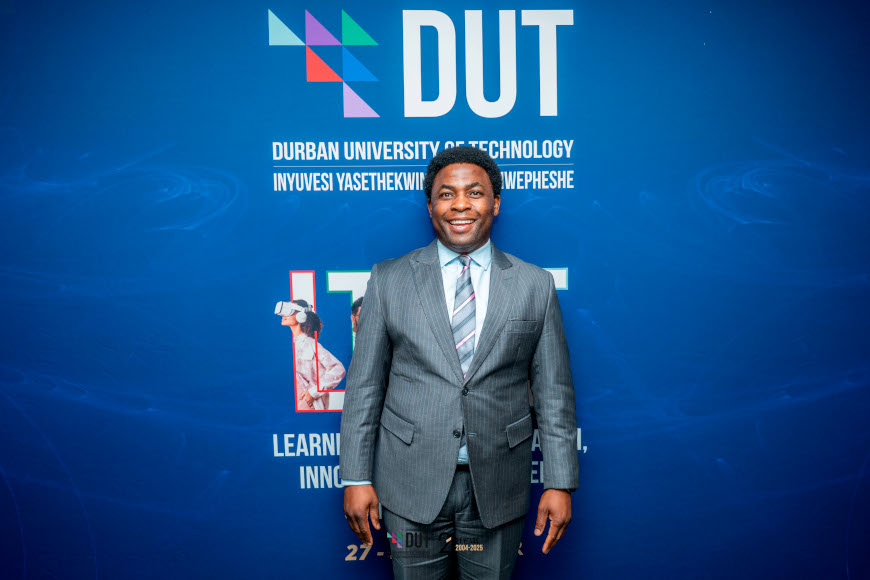
Pictured: Professor Fulufhelo Nemavhola, Deputy Vice-Chancellor: Research, Innovation and Engagement at DUT.
Photographer: S’bonelo Dlamini
Professor Fulufhelo Nemavhola


