
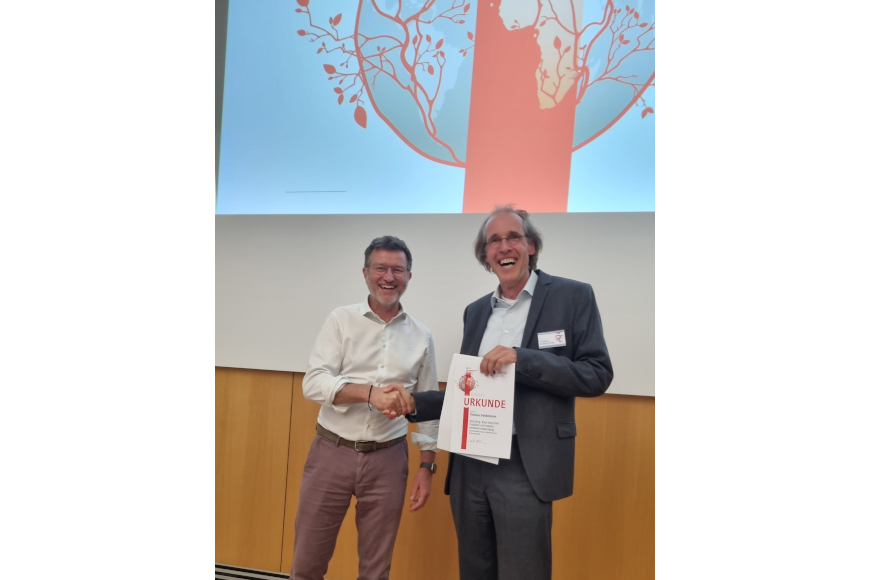
Research has the greatest impact when it extends beyond academic journals to change the way people think, live and care for the world around them. That philosophy lies at the heart of the work of Professor Thomas Dobbelstein, whose internationally recognised research into sustainable consumer behaviour has earned him the prestigious DHBW Sustainability Research Award.
The award recognises a body of research that is advancing academic knowledge while making a tangible difference to environmental education, consumer behaviour and sustainability initiatives in both Germany and South Africa.
Although Professor Dobbelstein is based at the Duale Hochschule Baden-Württemberg (DHBW) in Ravensburg, Germany, his influence reaches far beyond Europe. He is as an Honorary Research Professor at the Durban University of Technology (DUT) and Chairperson of the Advisory Board of the DUT Business School and he also serves on the Board of the Innobiz DUT Centre for Entrepreneurship and Innovation, where he continues to support the DUT’s growing international research, innovation and sustainability agenda.
The DHBW Sustainability Research Award honoured a series of comparative studies conducted between 2023 and 2025 involving approximately 4500 participants in Germany and South Africa. The research examined three important aspects of sustainable consumer behaviour: what motivates people to recycle, what encourages them to buy recycled products and how households can reduce food waste.
Using internationally recognised behavioural models, including the Theory of Planned Behaviour and the Intention-Behaviour Gap framework, the research set out to answer a simple but important question: why do people who care about the environment so often struggle to turn good intentions into everyday habits?
The findings provided valuable insights. The studies revealed that practical knowledge and established daily routines play a far greater role in reducing household food waste than attitudes or personal values alone. When it came to purchasing recycled products, positive environmental attitudes, trusted eco-labels and environmental concerns emerged as the strongest influences, particularly among South African consumers. Concerns about product quality, functionality or contamination, meanwhile, proved to have surprisingly little impact on purchasing decisions.
The research also found that the gap between intending to behave sustainably and actually doing so is considerably wider in South Africa than in Germany, highlighting opportunities for education and targeted interventions that can encourage lasting behavioural change.
One of the most significant South African studies focused on recycling behaviour in townships, where researchers discovered that a sense of personal moral responsibility was the strongest predictor of a person’s willingness to recycle. The finding offered valuable guidance for policymakers, educators and businesses seeking practical ways to encourage more sustainable communities.
Importantly, the research has not remained confined to academia. Its findings are consistent with, and support, an environmental education initiative launched by one of South Africa’s largest retail companies to launch an environmental education initiative for primary school learners. Through interactive classroom activities and recycling competitions, Grade 4 learners receive pencil cases made from recycled PET plastic bottles, helping to build environmental awareness and sustainable habits from an early age.
The project has also attracted significant international academic recognition. Between 2023 and 2025, the research was presented at 16 international conferences, including the prestigious American Marketing Association Conference and the World Recycling Convention. It also produced six peer-reviewed journal articles. One of these, Factors Influencing Purchase Intention for Recycled Products – A Comparative Analysis of Germany and South Africa, published in Sustainable Development, was recognised by Wiley as one of the journal’s Top Viewed Articles of the Year.
The award also highlighted the importance of international collaboration in addressing global sustainability challenges. The research contributed directly to several United Nations Sustainable Development Goals, including Responsible Consumption and Production (SDG 12), Climate Action (SDG 13), Quality Education (SDG 4) and Partnerships for the Goals (SDG 17).
For DUT, Professor Dobbelstein’s achievements reflect the type of globally connected, socially relevant research that the University continues to champion. His work aligns closely with DUT’s own growing international profile in sustainability and societal impact.
This is reflected in the University’s recent performance in the Times Higher Education Impact Rankings, where DUT strengthened its standing across a number of Sustainable Development Goals, further reinforcing its reputation as a university committed to research that addresses real-world challenges while contributing to sustainable development.
Professor Dobbelstein’s ongoing association with DUT is a powerful example of how international partnerships can enrich research, strengthen innovation and create solutions that benefit communities across continents. His work demonstrates that when rigorous science is combined with meaningful collaboration, research has the power not only to inform but to inspire lasting change through meaningful impact.
During the DUT International Week in August this year, DUT will celebrate 20 years of successful collaboration with Prof. Thomas Dobbelstein and DHBW Ravensburg.
As DUT continues to strengthen its global research footprint, achievements such as this reaffirm the University’s commitment to research excellence, innovation and international collaboration that delivers measurable benefits for society, the economy and the environment.
Pictured: Prof. Thomas Dobbelstein receives the prestigious DHBW Sustainability Research Award.
Alan Khan


