
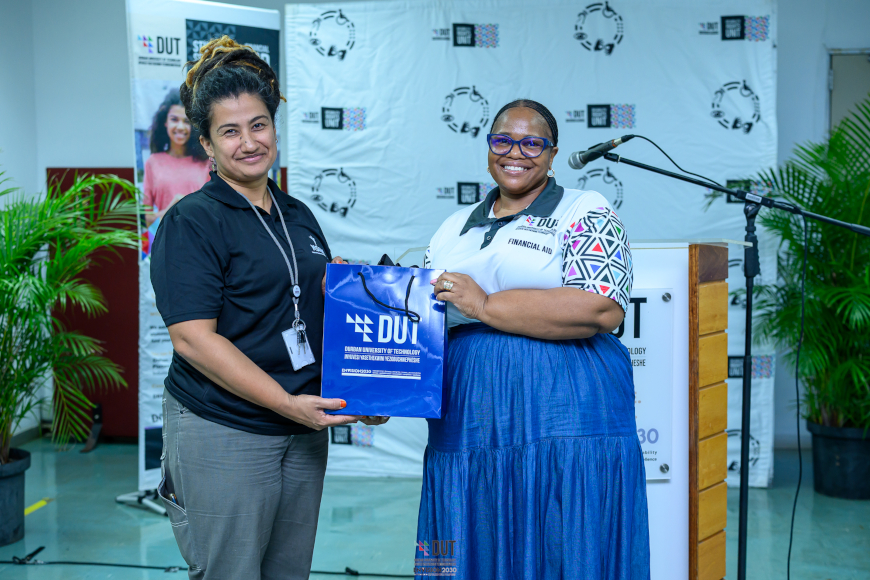
The Financial Aid unit at the Durban University of Technology hosted the 2026 National Student Financial Aid Scheme Disability Roadshow at the Steve Biko Campus in Durban on Friday, 17 April 2026, bringing together students for an informative engagement on funding support.
The roadshow aimed to educate students on NSFAS eligibility criteria and conditions while raising awareness about funding opportunities available to students with disabilities.
Welcoming guests, Financial Aid Unit Manager Mr Absolom Manashe highlighted the importance of knowing the appropriate points of contact within the Financial Aid and Disability Support units when seeking assistance. He added that the session also aimed to help students connect with one another and better navigate available support services.
The event was attended by representatives of the Student Representative Council. SRC Social and Welfare Officer Sibongile Ndhlovu delivered a message of support on behalf of the SRC, noting that the programme promotes inclusivity, awareness, and equal access to financial services for students with disabilities.
She emphasised that every student deserves the opportunity to succeed regardless of challenges, adding that the roadshow provides a platform for engagement, empowerment, and access to critical information.
“The SRC is committed to advocating for the rights and well-being of all students. Together, a more inclusive and successful community can be built,” she said.
Odwa Mahlungu, an Administrative Assistant in the Disability Rights Unit, explained that the unit operates under the Student Counselling and Health Unit within Student Services. She noted that the unit supports students with disabilities by promoting an inclusive and accessible learning environment through academic, health, and psychological support.
“Students are required to register with the unit and submit verified medical documentation to access services such as reasonable accommodation, assistive devices, scribes, tutors, and counselling referrals,” she said.
Mahlungu added that the unit works closely with Financial Aid while maintaining strict confidentiality of student information. She emphasised that disability should not be viewed as a limitation, but that institutions and society must work together to remove barriers and ensure equal opportunities.
Disability Practitioner at NSFAS, Ms Ielhaam Tafari presented an informative session focused on supporting students with disabilities and promoting inclusion in higher education. Drawing from her experience, she highlighted that while students with disabilities may face additional challenges, they should feel empowered to seek support.
She explained that there is no single path to success at university and that support systems exist to help students cope and thrive.
To qualify for NSFAS funding, students must be South African citizens or permanent residents, have a household income not exceeding R600,000 per year, meet academic requirements, and not already hold a funded qualification. Students who did not initially declare a disability may convert from standard funding to disability funding by submitting a Disability Annexure Form completed by a medical practitioner.
“Disability funding under NSFAS is comprehensive, covering both standard academic expenses and disability-specific needs. For 2026, allowances include a learning allowance of R20,800, learning materials of R6,240, and up to R52,000 for assistive devices over the duration of study,” Tafari said.
She added that human support funding may include caregivers, tutors, sign language interpreters, or note-takers, and in some cases accommodation for caregivers. She explained that students must follow a structured claims process, including submission of required medical reports and supporting documents.
Tafari further noted that applications are reviewed through a formal approval process within NSFAS and that payments are made only after institutional registration data has been submitted. She emphasised the importance of accurate documentation, noting that processing may take several weeks due to audit requirements.
The Financial Aid counsellor, Zandile Ngubelanga highlighted that her role involves supporting students with disabilities, particularly with NSFAS-related queries. She noted that initiatives such as the roadshow are valuable in equipping students with information while reducing the need for repeated visits to the Financial Aid office.
Pictured: Disability Practitioner at NSFAS, Ms Ielhaam Tafari with Financial Aid Counsellor, Zandile Ngubelanga handing over the gift.
Khulasande Tshayile
Phiwayinkosi Sibiya


